Showing posts with label Asanga Indunil. Show all posts

06 September 2015

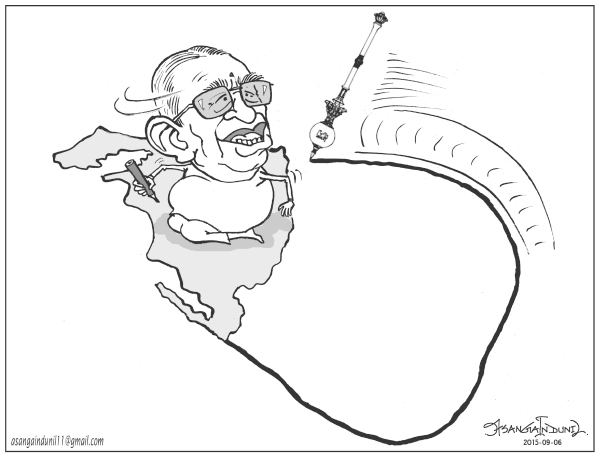
R Sampanthan’s hour of reckoning

Objection to Rajavarothiam Sampanthan being made Opposition Leader has ranged from rank communalism, justifiable fears given his and his party’s unabashed endorsement of a terrorist outfit, through a questioning of representational power to the machinations that are claimed to have disenfranchised over 4 million voters by the simply and pernicious presidential act of looting the coalition that came second in the General Election by a relatively small 350,000 votes.   

The Tamil National Alliance (TNA) and its constituent parties have hardly ever waxed eloquent on matters that concern the entire country.  The focus has been consciously, deliberately and understandably, issues of the Tamil community.  It is also true that the TNA, Sampanthan included, have indulged in Eelam-speak for years, going as far as to name the LTTE as ‘the sole representative of the Tamils’, and later in reduced circumstances after the LTTE was defeated reverted to federal-speak and other devolution tongues.  There’s nothing wrong in all that.  Ideological choices and aspirations are not the preserve of any community or any political party, after all.  

The more compelling objection has been about the legitimacy to represent ‘The Opposition’.  Sampanthan’s party polled a mere 5% of the total vote (515,963).  Those who neither voted for the winner, the United National Party (UNP) nor went along with the promise of that party regarding ‘a national government’ (or more correctly a ‘coalition government’ between the UNP and the Sri Lanka Freedom Party (SLFP)), returned 95 members to Parliament through the United People’s Freedom Party (UPFA) of which the SLFP was the main constituent.  Today, that number has dwindled down to 8.  In effect some 4 million voters have been disenfranchised in the process.  

The objectors (to Sampanthan) argue that the number is higher, pointing out that over 50 wanted Kumar Welgama to be the Opposition Leader.  However all SLFP MPs have to be considered part of the ‘government’ for several reasons.  First, their party has signed an MoU with the UNP. Second, many have received ministerial portfolios.  Thirdly, the leader of the SLFP (whose near-dictatorial powers in the party were amply demonstrated recently) is also a part of the Cabinet.  Object as they might to the way things happened, they are nevertheless trapped as lesser-members of the ruling coalition.  Ergo they cannot propose any in their ranks for the post of Opposition Leader.  

The TNA is, for all these reasons, the party which has the highest number of seats among those groups that are not part of the Coalition Government (misnamed as ‘National Government’ and ‘Unity Government’).  The number of votes polled ceases to matter the moment the results are announced.  From that point onwards the arithmetic is limited to parliamentary composition.  In 1977, one remembers, the Tamil United Liberation Front (TULF) polled a fraction of what the SLFP did and yet returned more MPs to Parliament and thereby secured the Opposition Leader’s post. 

In any event, the fact that SLFP MPs are suffering from a debilitating identity crisis (perhaps handed down by their leader), automatically disqualifies any of them from being considered for the post of Opposition Leader.  For all intents and purposes, in a multi-party democracy, clarity with respect to status vis-a-vis the ‘government’ is a non-negotiable ‘must’ in the office of Opposition Leader. No one in the SLFP can claim this.  

Sampanthan, like all ‘opposition leaders’ will be expected to lead ‘the opposition’, in and out of parliament.  That opposition is made of all communities, all parties other than the UNP and SLFP.  He has pledged to do so.  His ideological preferences aside, Sampanthan is eminently qualified to play this role given his considerable experience as a Parliamentarian and a politician who has at all times, even while supporting the LTTE, acted with decorum and dignity in debate.  As a person who first came to Parliament on the Eelam-pledge of the TULF and who has seen first hand where that took the country and especially the Tamil community, one expects him to do much better than A Amirthalingam.  

He has, by default, earned the right to represent over 4 million voters.  None of them will expect him to articulate all of their political aspirations, but they will hope that he will be as representative of he can be of general citizens’ concerns on all matters.  It is not impossible.  There was a time, after all, when the sole member of the Communist Party, Sarath Muttetuwegama, was a virtual one-man Opposition to the J R Jayewardena Government.  He has his work cut out for him.  The Government pledged ‘Good Governance’.  If he leads the handful that make the opposition after the UNP-SLFP marriage (made in hell?) to cry ‘foul!’ if and when the Government strays, he will be applauded.  If he reduces his role (outside of tokenist assertions of 'Sri Lankanness') to direct or indirect buttressing of Eelamism, he will not.  

Rajavarothiam Sampanthan’s hour of reckoning has arrived.  It will last a few years.  We must wish him well.  

29 October 2013

The saddest politician in South Asia and other stories

[VIEW FROM RITIGALA DURING THE THIRD WEEK OF OCTOBER 2013]
 
HR Language of AI and HRW
 
HTT (Holier-Than-Thou) BBC reports on US military strikes in the following manner: 'CIA drone attacks in Pakistan and Yemen are responsible for unlawful killings, some of which could amount to war crimes, human rights groups say'.
 
The human rights groups, Amnesty International and Human Rights Watch, don't mention Afghanistan, strangely.  But the key word here is 'COULD' i.e. 'COULD AMOUNT TO WAR CRIMES'.  AI and HRW are basing their 'at-best' suspicion on verifiable claims with no questions about reliability of witnesses/sources. 
 
Now in the case of Sri Lanka, AI and HRW don't use such cute language. It is not 'could amount to', but 'have violated'. 
 
There's no surprise about BBC going with terminology-vagueness.  It is after all a pick-and-choose, selectively blind operation which does not subscribe to the most basic ethics in reporting and commentary. 
 
So BBC, AI and HRW have to bend over backwards and force their tongues to utter their vague concerns.  They can't point index finger at the USA, but they will lift the middle finger when it comes to Sri Lanka. 
 
A lovely, lovely game!
 
 
When you French-kiss the USA...
 
French President Francois Hollande has expressed "deep disapproval" over claims the US National Security Agency secretly tapped phone calls in France, the BBC reports.
In a phone conversation with US President Barack Obama, Hollande has said this was unacceptable between friends and allies, demanding an explanation.
When did Hollande sleep and when did Hollande wake up?  Didn't France know anything about the USA? 
For several years now, France has been the cheerleader in Europe for US Foreign Policy.  Obama could count on that country to beat war-drums.  For its part France happily believed that it was recovering lost glory, Lingua Franca and all that. 
At the end of the day France has got some nasty matter on its collective face.  No prizes for guessing what it has been kissing!


The global gallery
 
Senior Indian Congress Parliamentarian from Tamil Nadu M Krishnaswamy has said that certain regional and caste oriented parties in Tamil Nadu are playing to the gallery on the issues related to the plight of Sri Lankan Tamils.  But hey, isn't this what ALL politicians do, in Tamil Nadu and in other parts of India, in India as well as in Sri Lanka?  Where on earth has Krishnaswamy been all these years and wherever he is, hasn't he ever opened his eyes? 
 
The saddest politician in Asia
 
Nasheed from the Maldives, were you thinking?  No.  It's Dr. Manmohan Singh.  At the tail end of his political career, this World Bank yes-man has worked his way down, being Sonia's valet and now Jayalalitha's pawn.  Pau Singh!   


Seasonality of protest
 
Time was when injustice or perceived injustice prompted immediate objection in the form of petitions, demonstrations, marches, boycotts and strikes.  Not any more.  In the 21st Century, objectors, aggrieved and disgruntled have discovered a thing called 'auspicious time'.  They wait until the world is ready, i.e. when the UN Human Rights Council meets, or when there's an event such as SAARC or CHOGM.  FUTA is upset these days.  The u'grads are threatening 'action'.  All because in November they can bare their bottoms or whatever in front of an international audience.  The underlying logic is simple: we can't do it on our own, so please help us.  Did someone say that when deliverance is bartered, you get short-changed? 
 
Is the post-election party over?
 
It is a given.  After each election or rather after each electoral defeat, there's a rumpus at Sirikotha. Old slogans and placards are brought out. 'Ranil Out' becomes the word in the street.  Ranil, for his part, promises reform.  The agitated go indoors.  Status quo is restored.  King Ranil continues to reign. 
 
 
Parliament or Cabinet?
 
'Cabinet reshuffle' in general amounts to people changing addresses or rather exchanging addresses, the Minister of This becoming Minister of That, the Minister of That becoming Minister of Something Else, and so on. In Sri Lanka, thanks to the one-way crossover facility designed by Sarath N Silva and the imperative of getting Parliamentary Arithmetic right, we don't re-shuffles and we get new appointments.  The rate of defection and the need to give some 'something' to each province, district, ethnic group, religious community, caste, constituent party etc., parliament is no longer parliament but cabinet. 
 
If in days gone by people called each other 'manthreethumani' or 'manthreethumiyani', today they have 'amathithuma' and 'amathithumiya'.  
 
Illustrations by Asanga Indunil

10 September 2013

C.V. Wigneswaran chit-chats with a ghost


[IN A PARALLEL UNIVERSE CALLED ‘HUMILITY’…]

Illustration by Asanga Indunil
Canagasabapathy Viswalingam Wigneswaran, retired-judge of the Supreme Court, burdened by the unfamiliar rigors of politicking, took a break.  He told his entourage of supporters to take a break as well and stepped into a nondescript eatery on a dusty street in a less populated area of Vadukoddai.  Still relatively new to this part of the country, not many recognized him.  He was able to sip his plain tea in peace. 

A man, probably in his mid-fifties, who had been sitting at the next table suddenly got up, walked over to the would-be Chief Minister and politely requested to sit with him.  Wigneswaran looked at the bald-headed, stocky gentleman clad in a veshti with his upper garment decked with a salvai with mild irritation, but the smile on the man’s face disarmed him.  He grudgingly consented.

‘Thambi,’ the stranger said but before he could continue, the Septuagenarian retorted, ‘Thambi?’
He was not questioning relationship claim but perceptions of seniority.

‘Yes, Thambi,’ the man insisted. 

This brought on a stare, naturally.  Then the man said, ‘Amirthalingam.  I am Appapillai Amirthalingam.’

‘But you are dead,’ the ex-judge pronounced.

‘Strictly speaking I was killed, but you’ve resurrected me with your manifesto, wouldn’t you say?’
Devout Hindu that he claims he is, Wigneswaran was not ready to challenge ghost-claims, but in the manner of an impartial judge chose to listen.

‘As you know Thambi, I’ve been dead, killed-dead that is, for almost a quarter of a century.  That’s not as dead-long as Chelva Aiyah or Ponnambalam Aiyah, but more dead-long than Prabhakaran Thambi, but it’s dead-long enough.’

‘Wait, you still call him “Thambi”?’ Wigneswaran interjected.

‘In dead-land there’s little to gain by harboring ill-feeling, although Thambi studiously avoids me.’

‘Ok, go on!’ the candidate’s curiosity was aroused.

‘You are old enough to know that we really don’t know what kind of tragedies we precipitate with the most innocent and well-meaning of actions.  In 1977 we saw an election result.  Of course we identified with the cause, the Eelam wish and all that, but that parliamentary seat was as important a dream.  We didn’t know that it would take us to the Indo-Lanka Accord and when that came, we didn’t know that Thambi would renege.  I didn’t foresee Thambi turning into what he did turn into, Surya Devan and all that, and I never imagined he would send me to dead-land. ‘

‘Hmmm….’

‘Hmmm….anyway, the dead years are good for assessment and over the dead-years I’ve managed to skirt around that sad rock called Regret that keeps materializing before me wherever I go.  I wasn’t to know that I would lose the road map or rather have the road map grabbed from me. I wasn’t to know that Thambi would lose the plot.’

‘Come, come….hmmm,’ he couldn’t bring himself to calling this younger looking man-ghost 
“Annai”, but after a few pulled himself together quickly and said, ‘It’s not your fault or Thambi’s fault, and anyway you seem to be treating those Sinhala chauvinists with soft gloves!’ 

‘Oh no!  I have no illusions about Sinhala chauvinists.  But Thambi, we can only go so far with the blame game and that of passing the ball.  There were things we did which built the wrong kinds of walls.  It was not a great wall that carved for us a separate state along lines that we conveniently and arbitrarily drew.  No, it was a great wall between us and a place called “Better”.  Ironically, we regressed so much that today whatever “better” we can talk of is thanks to what we called the Sinhala Government and because that Sinhala Government got rid of Thambi and his goons.’

‘Shhhhh!’ the candidate shushed the former leader of the TULF.

‘This is the problem. We’ve been shushing too much. We shushed when Thambi started killing innocent people. We shushed when he started abducting little Tamil children.  I am sure even you must have shushed when Thambi got me killed.  There was shushing when hundreds of thousands of our people were held hostage. I can go on and on, I am dead and time is all that I have.’

‘Stop.  This is not about all that. This is about an election.  None of us seriously believe we can deliver what we promise. We can blame it on the racist Sinhalese who are not interested in addressing our legitimate grievances and delivering legitimate aspirations.’

‘I know, I know, but Thambi, politics does not begin when elections are called and do not end when results are announced.  Our words go to other mouths, who will add words to those that we utter.’

‘It worked for you!’

‘I don’t want to wish you anything less than the Chief Minister post, don’t get me wrong, but you know, our words don’t follow us to our graves and it is not just we who have to pay for our crimes of omission and commission.’

‘You are batting for the Sinhalese now!’

There was silence.

‘Dead-land is full of people who got their visas long before they ought to have.  It’s a crowded place, this county for the unnecessarily-killed where I am resident now.  Blame it on me.  There’s limited oxygen there.  We really don’t need to have our numbers swelled.’

It was time to pronounce judgment.  Wigneswaran closed his eyes. Reflected. There was silence.  When he opened his eyes, he was alone.  His cup was empty, and there was a half-full cup of plain tea on the other side of the table.