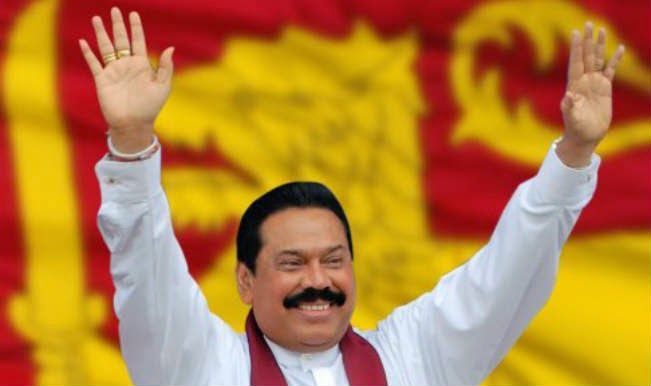
Showing posts with label Mahinda Rajapakse. Show all posts

29 October 2014

The phenomenon that is Mahinda

It is four years since the 18th Amendment to the Constitution came into effect.  It was dismissed at the time and occasionally since then as a subversion of the democratic spirit and further entrenchment of dictatorial provisions in the J R Jayewardene Constitution of 1978.

Now, four years later, the 18th Amendment is in the news ago.  There’s little or no talk of democracy or dictatorship.  The focus is one individual, Mahinda Rajapaksa.  The question that is being addressed is whether or not he can run for a third term. 

What is strange is that all the self-proclaimed constitutional pundits appear to have been in deep slumber for 4 years.  That, or else, they were waiting for the right moment to spring this ‘objection’, aiming clearly to catch the President and his backers off guard. 

It was the former Chief Justice Sarath N Silva who raised the issue first.  Sections of the Opposition as well as prominent NGOs with dubious track records such as the Centre for Policy Alternatives (recently accused of widespread fraud) have got on the bandwagon.  It smacks of regime-hatred more than democracy-love. 

So there’s objection and objection to objection.  Silva’s argument, notwithstanding the problematic nature of his position given his role in current political processes, has excited the Opposition to the point of distraction.  The focus is not on promoting a candidate capable of winning it all (the Opposition seems hard pressed to find such a candidate, in fact), but on stopping the president from contesting.  Silva’s argument however is just one interpretation and an interpretation that has too many holes as has been pointed out by commentators who are not exactly regime-lovers.

Time will tell if Silva’s objection will be upheld by the relevant authorities.  Right now it seems that when the Opposition says ‘Mahinda Cannot’ it is really saying ‘Mahinda cannot be defeated’.  It’s a sophomoric way of conceding that the President is too strong a candidate to contend with.   In other words, the Opposition (either in parts of together) cannot come up with a candidate that can go head-to-head with the President on charisma, accomplishment and the promise of all-important political stability, even if such a candidate could come up with a plus in a compare-contrast of respective negatives (of Rajapaksa and the Government on one side and on the other the candidate and his/her backers).   The best bet, then, is to get the man off the ballot!

Interestingly, this lack of human resources is not the preserve of the Opposition.    Even the UPFA cannot come up with a name that has the kind of overall appeal the President enjoys.  If he were to back down, for example, the Opposition might think, ‘we have an outside chance against an alternative candidate,’ while the ruling coalition would be less cock-sure than it is now. 

It would be simplistic to attribute this state of affairs to the fact of incumbency.  Incumbency helps no doubt, given constitutional provisions and a scandalous culture of abuse by whoever is in power.  An alternative candidate has less edge than incumbent but edge there will certainly be.  In this case, the seeming ‘invincibility’ derives from multiple factors.  These include the defeat of the LTTE, a growing economy, a ‘doer’ image which is felt in concrete terms, a general deference of the voter to a person of proven strength and a general perception among a significant section of the population that whatever the faults (his and his government) Mahinda is ‘one of us’.

The voter might not like the Government, might be appalled by the strong arm tactics of ministers, MPs and members in other elected bodies, disgusted by the flaunting of wealth by the president’s ‘near and dear’ and yet might find no one half as suitable to lead the country.  Not in the ranks of the government and not among the Opposition.  This is why, perhaps, that the Opposition is clinging to the Sarath N Silva ‘point’ while those in the ruling party are so keen to dismiss the same.   

‘Mahinda’, then, is a one-of-a-kind phenomenon, whether anyone likes it or not and whether it is good or bad for democracy.   “Government by Mahinda, with Mahinda and for Mahinda and his ‘near and dear’ over and above the rest of the people never mind budgetary tidbits tossed with election in mind” is, in a democratic sense, clearly second best to “Government by the people, with the people and for the people”.


25 July 2011

Let’s be real about Wikileaks, shall we?

First some caveats.  I am not gung-ho about Wikileaks. As someone pointed out, much of the pernicious intent of US diplomats and the atrocities committed against innocent peoples all over the world and especially in Iraq and Afghanistan in recent times, is known. Even a regular browsing of mainstream media by someone emboldened with an iota of intelligence and the most rudimentary of skills in reading between the lines would have been sufficient to elicit a fair enough picture of what’s happened and what’s been happening in the world and who has been doing what. 
Secondly, it is clear now that the ‘leaks’ are being processed carefully for public consumption by the mainstream media in ways that legitimate the general policy designs of the bigger thugs in the international community, led of course by the USA: the vilification of Iran and justification for attack. 
As for the ‘Sri Lanka files’, only the naĂŻve and ignorant would have believed Particia Butenis (like her predecessor and now confidante of Barack Obama, Robert Blake) was not an interfering, viceroy wannabe who actively operated (and failed) to defeat President Mahinda Rajapaksa in January 2010. Bottom line: it is not news. 
Finally, we are in the early days of Wikileaks and involuntary transparency.  The signals are mixed, whichever way one looks at it. Right now it looks as though the benefits are accruing to US foreign policy prerogatives. The Isrealis are cheering Wikileaks because it has been ‘revealed’ that Arab governments, in secret, are scared of Iran’s potential nuclear threat, never mind the fact that nothing’s been proven yet about Iran’s plans to develop a nuclear weapon.  "We come out looking very good," a senior Israel official has said and he  "They confirm that the whole Middle East is terrified by the prospect of a nuclear Iran." 

         1.       2.       3.  

                           4.         5.  

 Round Table - Prime TV on Wikileaks

Noam Chomsky has a telling response: ‘To tell the world– well, they’re talking to each other- to pretend to each other that the Arab world regards Iran as the major threat and wants the U.S. to bomb Iran, is extremely revealing, when they know that approximately 80% of Arab opinion regards the U.S. and Israel as the major threat, 10% regard Iran as the major threat, and a majority, 57%, think the region would be better off with Iranian nuclear weapons as a kind of deterrent. That is does not even enter. All that enters is what they claim has been said by Arab dictators – brutal Arab dictators.’
So is the news all bad?  Hard to say,.
Tom Flanagan, a senior advisor and strategist to the Canadian Prime Minister Stephen Harper has called for the assassination of Wikileaks founder, Julian Assange. He even wanted Obama to put out a (murder) contract on Assange and said he would not be unhappy if Assange ‘disappeared’. He’s echoing Republican presidential hopeful Sarah Palin here.  Meanwhile Assange is being charged with rape.  This is all classic silencing tactics. 
Let’s assume that Assange is a rapist. Let’s imagine an Assange-less world.  Let’s assume that he’s indeed a willing or unwilling pawn of a larger game that anticipates an ending antithetical to those who truly believe that Wikileaks will help tilt the world in favour of the insulted and humiliated, the beaten and downtrodden, the exploited and plundered. Let’s assume that the howls of protest about ‘leaks’ have been carefully scripted, even if cannot forget that the howlers are actively, deliberately and consciously making plans whose implementation would eliminate thousands of lives even as I write; lives that have caused untold suffering to hundreds of thousands of people, have pillaged and destroyed nations and poisoned the earth, the seas, the waterways and the skies.  Let us assume that Patricia Butenis and other officials whose missives have been ‘leaked’ are indeed dispensible creatures and will be happily sacrificed to achieve larger US foreign policy objectives. 
There are things that are indisputable. Last year, this time, the world did not know of a Julian Assange. Today the man is all over the place and inside the closets of big-name people and big-weapon nations, pulling out skeletons by the thousands.  He’s unceremoniously knocked people off the moral high ground, made hollow the high-minded pronouncements of the self-righteous and basically stripped thugs and thug-nations of saintly garb and halo. In particular Assange has showed us the true face of the US democracy (which Malcolm X correctly described as ‘hypocrisy’ more than 40 years ago).  
Let’s assume that they take him out of the equation. They still have a problem: they can’t take the equation out along with him. The Prophet of Involuntary Transparency, as he’s been dubbed, can fall or be eliminated, but there’s no stopping involuntary transparency now. 
Even if Assange is Obama’s accomplice and Netanyahu’s pawn, even if Wikileaks is used to set up world opinion to attack Iran (not that the thugs that have run and still run the United States of America ever required permission for thuggery), we still have a mechanism that is getting word out. Sooner or later, it will be impossible to lie. People will have to come clean, warts and all or else opt for systemic thuggery in the form of constitutional dictatorships or straight forward military juntas. Works. For a while. 
I believe therefore that what’s happening is that a can has been opened, an idea formulated and a process set in motion that the setters-in-motion might not be able to contain or manage. That’s the flip side of Wikileaks.
It all boils down to what we do with Wilileaks and Wikileaking, if you will. It depends on what we do with involuntary transparency, how we use it or abuse it. Let us not have illusions. The powerful are better positioned to use and abuse. The weak have to strive. It is not impossible. It is high time that people stripped the Obamas of this world of the literature of liberation. ‘Yes we can’ does not belong to Obama; it is something that Obamian victims must embrace and put to work. That’s how Wikileaks can work for us. 
Until such time, it is perhaps prudent to say that the jury is out on Wikileaks. We shouldn’t get too far ahead of ourselves, should we?