Showing posts with label Tamil Eelam. Show all posts

21 August 2018

How about including ‘Reparations’ in school curricula?


History is version. This is true. And yet, certain versions have a greater degree of believability than others. Dominant narratives do bear upon the present and can get in the way of obtaining inter-communal resolve, but the solution is not to dump history altogether as some have proposed and others have tried in surreptitious ways.  

Dumping history is convenient for those who find it tough to substantiate. It is also convenient for those who want to suppress the inconvenient. The British, for example, have a lot to hide. So too the Christian churches of various denominations.  Some butchers and thieves are smart, some are not. Some are just brash and can't be blamed for slippages of those who would cheer them. Like Raja Raja Chola 1. 

Raja Raja Chola 1 (985 and 1014 CE) is a name associated with the ‘Golden Age of the Cholas’. Raja Raja Chola 1 and his successors were warriors. They invaded, they plundered and they bragged about their exploits. 

It is no wonder that the militant adherents to Tamil Nationalism in Sri Lanka (principally the LTTE), lacking a golden history on the island, borrowed from Raja Raja Chola 1. In addition to unforgiving brutality they took a flag and a name. That’s how they became ‘The Tigers’. As for name, they erred when they from the one the Cholas used for the island, ‘Ila Mandalam’. Raja Raja Chola 1 added a descriptive to the name: ‘The land of the war-like Singalas.’ There was no ‘shared-ownership’ as purveyors of Eelamist myth-modeling such as Wigneswaran and M.A. Sumanthiran would like everyone to believe.

What’s relevant is is not the carelessness of the LTTE, but the braggadocio of Raja Raja Chola 1. The Archaeological Survey of India includes reference to inscriptions at various Hindu temples built with the wealth looted from lands conquered by Raja Raja 1. Just for the incredulous, the temples in Tanjavur and Ukkal were not authored by someone who had any interest in cooking history in favour of the ‘Singalas,’ they were not the observations of some interfering, arrogant and ignorant white man, they are not taken from the Mahawamsa or 21st Century scribblings of a chauvinistic Sinhalese intent on denying property rights to Tamil Sri Lankans.

That’s not what’s relevant. The plunderers bragged and the bragging was inscribed in stone.  And thus, we know that they robbed and what they did with the wealth they plundered. 

Eelamists should study inscriptions at the temples in Tanjavur and Ukkal 


Unlike the British (or the Portuguese or the Dutch).

Three years ago, the Oxford Union held a debate on the motion "This house believes Britain owes reparations to her former colonies". Speakers included Indian politician and writer Shashi Tharoor and British historian John MacKenzie. Mr Tharoor's argument went viral, perhaps because it resonated with Indians, who outnumber the British twenty to one. British historian John MacKenzie offered arguments against the motion.

MacKenzie held that Tharoor was wrong about reparations. His argument was based on the contention that ‘no empires have pursued tender or altruistic policies’ and that the outcomes are a product of ‘imbalances in environmental opportunities, military and technological power, or capacities for state centralization’.

By way of defending British plunder in India, MacKenzie points out that there were elites in India anyway and they were already exploiting the masses. He talked about the benefits that the British brought to Indians such as railways, industrialization, education and a unifying language. In any case, MacKenzie argues, that ‘the calculation of reparations, their payment, ensuring that they went in the direction of the poorer in society, and their contribution to economic growth for all, would all be fraught with difficulties.’

How tough it is for the mathematically and logistically challenged, eh? 

There is a popular myth about the British.  They gave us this, that and the other and we owe them much, it is argued frequently (and typically from those whose ancestors positioned themselves to pick the crumbs the British offered).  So, we are told, they gave us a constitution, rules and regulations, roads and railways, and of course English.  

Right. Taxes and slave labor paid for everything. There was no payment to anyone for everything looted. It was not ‘education’ we got, but a particular kind of education. It is not the case that people in this country (and in other places plundered) were uneducated and ignorant. As for institutions and rule books, they were not put in place out of love for ‘the natives’ but to streamline plunder.  English: there’s a reason it’s referred to as kaduwa (sword).

Was it all bad? No. Was it all good? Hell, no. And the balance? Bad, let there be no doubt. Heavily on the bad side, let us note. Shenali Waduge has sketched out just the actions of one British subject in an article titled ‘The Crimes against humanity by British Governor Robert Brownrigg – Butcher of Uva-Wellassa in Sri Lanka’. There was genocide, ethnic cleansing, outright plunder and a clearing in these and other ways for the continued exploitation of the island’s population and the extraction of its wealth. Facilitators were nurtured through ‘education’ and placement in subordinate administrative and enforcement structures. For the record, Brownrigg was not the only butcher.  

Let’s get back to MacKenzie’s logic. It can be applied to things other than ‘empires’ and what they did. There are other situations where people not pursuing tender or altruistic policies where there was an imbalance in environmental opportunities, military and technological power and capacities for centralization.  Here are some: theft, embezzlement, resource extraction, pollution, mass murder. Any of these and much more besides can be brushed aside by citing the principle of power differentiation, which is what MacKenzie’s argument boils down to. 

So, reparations is a subject that we need to talk about and indeed include in school curricula.  There are 61 countries which were in terms of territory parts of the British Empire. Some of them have sued Britain, along with France and the Netherlands (for example 14 Caribbean countries demanding reparations for slavery).  The British won’t submit of course. They’ve always talked about ‘improving future relations through funding infrastructure projects.’ Former Prime Minister David Cameron even promised Jamaica a new prison! 

They’ve actually said ‘sorry’ but then again, talk is cheap; sorrow cannot be banked. If saying ‘sorry’ would do then all legal systems would degenerate to the ‘give-take’ of Catholic Confessionary.  Britain did at one point announce that the descendants of Kenyans tortured by British colonial forces during the Mau Mau uprising would receive payouts totaling 20 million pounds. 

But how about the loot itself?  Yale University, Connecticut, USA recently decided to return to Peru a collection of antiquities taken from the Inca site of Machu Picchu almost one hundred years ago.  Richard Burger who has been in charge of these items for 30 years said that the situation is different from classic repatriation because it was not about stolen goods but a contract dispute; things were not clandestinely dug up’. 

That’s lovely. In our case and in most of the 61 countries where the British did their thing, there was no necessity to be clandestine.  Some of the artifacts, all stolen goods, are traceable. 

Well, we can and should talk reparations right now, especially since the British and other such powers with considerable ‘butchering-history’ lecture Sri Lanka about such things. They don’t say ‘It’s enough to say sorry and to build a few prisons’ now, do they?

Raja Raja Chola 1 and other Chola aggressors were not constrained to be cute about plunder and the investment of plundered wealth.  The wealth from all continents that ended up in the British Isles are not all congealed in artifacts that can be named.  They remain unlisted. They’ve transmogrified into capital and that, as we know, is re-transferable to countless things and processes.  

We cannot say if and when reparations will be made. But we can, when the beneficiaries of butchery and plunder lecture us, tell them ‘get us back the known loot, chum.’

‘A catalogue of antiquities and other cultural objects from Sri Lanka (Ceylon) abroad,’ is the title of a book by P.H.D.H. De Silva, published in 1974.  It lists a considerable set of known artifacts stolen from this island.  There are over 15,000 items listed.  The loot it seems has ended up in 23 countries and 140 holding facilities.  The vast majority are in Britain.  Bristol, Cambridge, Edinburgh, Glasgow, Berkshire, Leicester, Liverpool, London, Sheffield, and Windsor all have ‘Little pieces of Ceylon’ so to speak.  

All stolen goods.  For antique and historical value, each and every amulet, the tiniest statuette, the most fragile manuscript with hardly legible lettering, is priceless. The British Museum houses artifacts and manuscripts of incalculable value.  These can be returned as a first step. We can talk reparations later.

Malinda Seneviratne is a freelance writer. malindasenevi@gmail.com

06 October 2016

President Sirisena has spoken (on Eelamist myth-mongering)

There's no better proof that 'Eelamism'
was a British creation than the fact that
the 'Eelam Map' is a trace of arbitrary lines
drawn by the British.
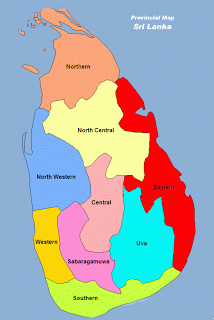
On many occasions when the issue of ‘homelands’ (traditional ones, that is) have come up, I have made the following observation: the current provincial boundaries (which are the basis for the Tamil chauvinists’ claims and demands for forms of regional autonomy ranging from augmentation of the 13thAmendment to a federal arrangement and to even a separate state) are lines arbitrarily drawn by some white man even as he played his part in the plunder of the island’s resources, exploitation of her people, vandalizing of places of religious worship, and the systematic destruction and/or theft of her cultural artifacts.  

The entire discourse of the ethnic-conflict, so-called, has been about alleged grievances.  It has also been about inflating these and perhaps because even with inflation the devolution ‘solution’ is so weak, grievances (alleged) have been coupled with aspirations.  Nothing wrong in this.  It’s politics.  It’s about using available resources (which include the facilities of deceit and threat) for self-improvement, either of the community (in the nobler manifestations) or a few individual articulators (as is more common).  What’s wrong is the chest-beating indignation and self-righteousness.  

They all get tripped on multiple counts, these defenders of fictions, justifiers of land-grabbing intent and rhetoricians adept at painting myth as history and fiction as fact, but perhaps nothing induces blush more than the following two questions.  First, is there any community of the same size (proportionally) with the same sparse substantiation of claims, with a track record of brinkmanship, tacit and even open approval of terrorism, anywhere in the world that has married provable grievance to reasonable aspiration and demanded the delivery of the kind of baby that Tamil nationalists have asked for?  Then there is the vexed question of boundaries alluded to above.  That’s a real bummer, the Americans of the USA who have for reasons that are not too obscure supported such moves, might say.  

Someone would have drawn the ‘Eelam Map’ which is the most prominent element in the flag used by the LTTE and LTTE sympathizers.  From what history were those lines obtained?  Where in the Tamil chauvinist narrative is there reference to any historical account of any credibility that has even a footnote on the boundaries that mark the homeland that is said to be traditional (or historical, as some prefer)?  

C.V. Wigneswaran, poor man, struggling for political relevance and therefore preying on innocent aspirations and playing with nationalist rhetoric, talks of a looooong Tamil history.  Strange, isn’t it, that in this looooong and splendid history those who came before didn’t leave any significant mark of their passing and their alleged glory?  Where are the chronicles? Where are the artifacts?  Where are the Tamil Buddhist texts if as some say the Buddhist archaeological remains in the North and East are remnants of ‘Tamil Buddhism’?  Most importantly, where the devil are the lines, the boundaries, those itty-bitty things that are essential for any kind of cartography?  

The island is divided into 9 provinces.  The divisions were expressly made for administrative convenience.  They were created in 1890 during the reign of Queen Victoria.  Before they were drawn the island was divided into five provinces.  That was in 1833 during the reign of King Willing IV.  The division was made by the British colonial powers.  Again for administrative convenience.  And long before that, we had the Ruhunu, Maya and Pihiti, the ‘thun sinhale’ as in the three provinces of the political entity known as ‘Sinhale’, the name obtained from two words, ‘Siv’ (four) and ‘Helas’ (Yaksha, Naga, Raksha and Deva).   

Where are the ‘old’ maps of that looooooooong ago, Mr Wigneswaran?  Who drew the more recent map, i.e. the one with 9 provinces and what was the logic that drove the cartographer, Mr Wigneswaran?  Well, it’s a question that all devolution-supporters will have to answer if they believe the creative Eelamist historiography touted by Tamil nationalists from at least the time of Ponnambalam Ramanathan.  

They can refuse to answer of course (as they usually do), except for a tiny little irritant.  President Maithripala Sirisena has raised the issue of map-making.  Mangala Samaraweera, Rajitha Senaratne, Dilan Perera and other purchases of Eelamist nonsense cannot ignore the President’s contention.  President Sirisena got the name of the monarch wrong of course, but that’s just an unimportant detail.  What matters is that Maithripala Sirisena said that it was the British who drew what later turned out to be the ‘source’ of the Eelam map that the likes of Wigneswaran (and before him Prabhakaran, A Amirthalingam, GG Ponnambalam and SJV Chelvanayakam) love to wave.  Now that (i.e. 1890) is certainly not loooooooong ago, is it?

Maithripala Sirisena is the first president (to my knowledge) who came out and said it as it is.  He said what politicians of all ideological persuasions in the major political parties have dodged for one reason or the other (except of course the Sinhala nationalists).  Let’s leave Wigneswaran out of it.  He’s doing a bread and butter operation.  Understandable.     What does the UNP and the JVP have to say now?  What do the bleeding heart liberals in academe and in the NGO business have to say?  And how about the Government of Switzerland which believes Sri Lanka got a new constitution?  How about Eric Solheim and the Kingdom of Norway?  Oh, I almost forgot.  Will the British High Commission care to comment?  


The President has spoken, ladies and gentlemen.  And he’s not Mahinda Rajapaksa, the ‘hawk’, the ‘war monger’, the ‘Sinhala majoritarian, chauvinistic autocrat’.   He is none other than Maithripala Sirisena.  The unifier.  The good governance hero.  He’s said something that had to be said.  He has thrown the gauntlet.  Any takers out there?  

Malinda Seneviratne is a freelance writer. Email: malindasenevi@gmail.com.  Twitter: malindasene. 

17 May 2016

Truth and reconciliation must begin with truth, not myth

This article was published in 'The Nation' on May 18, 2010, one year after the LTTE was militarily defeated.  The end of terrorism did not coincide with the end of separatist moves of course.  That project whose military articulation was defeated is alive.  What the end of the war did was to create a space for the necessary conversation about claims and substantiation.  That's an important part of reconciliation.  Today, 6 years later, the key spokespersons for the politics that the LTTE buttressed with terrorism, still prefer myth to truth.  [Read 'The NPC Resolution: both a threat and an opportunity' ]

Pic courtesy irinnews.org
Last week marked a year after the war ended.  There’s been some dispute regarding the exact date and it is quite unbecoming of the claimants to be quibbling about whether it happened on the 18th or 19th of May.  What is important is that it happened, it ended, that our children are safe from suicide bombs and explosions, from forced conscription, dismemberment, displacement and death in a war that achieved precious little.  Yes, the celebrations were put off due to inclement weather, but that’s nothing to be sad about.  There are a million reasons to be thankful and a million ways to show gratitude. 

We are talking about a war that dragged on for 30 years.  We are talking about a situation where academics (sic!) argued even as recently as a little more than a year ago that it is wrong to talk of a post-LTTE Sri Lanka.  Some columnists were so ostrich-like (like Kumar David) that they refused to entertain the thought that the LTTE could be defeated. 

Denial is a sign, a symptom of a malady.  It’s about what one wants so badly or is so used to that its absence or non-arrival will not be talked about, thought of or heard.  Eelamists of the ‘Eelam Now’ mode of thinking and operating suffered from this ailment for some time.  They’re slowly getting cured.  Indeed they are more likely to drop Eelam and go for something more realistic and rewarding such as better governance and enhanced citizenship rights for all, irrespective of ethnic identity that that other and more pernicious set in the lunatic fringe of political discourse: those of the ‘Litte-Now, More-Later’ persuasion among the Eelamists. 

I count among these latter set everyone who argues for an ethnic-based and/or language-based system of power-devolution without referring to relevant history, on-the-ground realities (including the fact that some 53% of Tamils live outside the North and East, 64% of allocations for the Provincial Councils go for their upkeep and the salaries of politicians and staff, and claims of historical habitation that are full of holes) and indeed the fact that ‘devolution’ was essentially the TNA manifesto and not that of the UPFA or Mahinda Rajapaksa.

Today, one year later, the focus should be on realities and not myths.  The Tamil community in the North and East have suffered enough without having to become footballs in political soccer games played by their so-called representatives and political scientists (so-called) who would be hard pressed to differentiate between ‘unitary’ and ‘federal’ and would hee-haw if asked which type the Sri Lankan state is, with examples to buttress claim.

The question that remains unanswered with reasonable substantiation is the following: ‘what are the root causes of the conflict?’  A lot of books have been written on this issue.  Discrimination, non-addressing of grievance/aspiration etc have been cited. Left out has been the exploitation of the ‘ethnic card’ by communalists on all sides, the manufacturing of grievance, the exaggeration of claim, the holding to ransom at gun-point and the articulation of aspiration in dimensions that preclude resolution. 

A second important consideration that is fudged by devolution-wallahs is this: what is the connection between grievance(s) that can be established to be real and devolution?  If the territorial claims cannot be backed by history, if the demographic data shows that self-determination issues have spilled over the boundaries of the North and East (or indeed were never contained therein), then shouldn’t reason dictate that resolution must take a form that is non-territorial, and therefore non-devolutionary?

Conflict-End is a good place to soul-search, so to speak.  It is a good place to ask how we got to where we were and how come close to 100,000 people had to die to get there.  It is the place to begin, paradoxically.  And the beginning, as always, is called ‘Root Cause’.  This is where you will encounter grievance and aspiration.  This is where the intellectually slow and politically lazy politician (and political analyst of course) comes to excavate matter that can be abused for petty political gain.  Today, after 30 years, we have to chip away the frills that have got stitched on to root-cause and recover the real article. 

Today there is talk of truth and reconciliation.  We have our own truth-and-reconciliation methods, but that’s ok.  Truth is the key word here.  We’ve had so much embellishment and extrapolation, myth-making and myth-modelling, that it is ridiculous to try and re-coexist on the unsteady foundation that all this has served to set up over the past thirty years.  We have to re-lay the foundation of co-existence. And this can be done only by being honest.  That honesty, given claims have been as much about discrimination as about traditional homeland claim, requires a historical audit as well as an audit about citizenship anomalies.  It is then that we can figure out what kind of measures need to be put in place to correct flaws and prevent extrapolations that lead to the kind of tragedy that took us 30 years to bring to an end.

We must revisit all the pacts that were made, what held and what was fudged and by whom, all the underlying premises and their tenability in terms of historical, demographic and economic worth. In other words we have to find a way of divesting process of the most pernicious elements of politicking, which unfortunately seem to have dominated our post-Independence history.

Are we ready to face the truth, as individual, community and nation?  Are we ready to place contention on table along with substantiation and have a conversation? Or are we going to wobble along on that unsteady and eventually tragedy-facilitating thing called preferred ‘perception’?

If we cannot get past this, we cannot talk about devolution or any ‘lution’ and certainly not solution and revolution. 

The devolutionists must now put up and shut up.  Bring your history, bring the economic logic, bring the relevant demographic data and bring a comprehensive performance assessment of provincial councils.  Leave behind rhetoric, myth, fantasy and relevant models based on these things.  Bring grievance, not whine.  Let grievance wear its true clothes (i.e. skin) and not the disguises it has been decked with for purposes of political efficacy.  The nation is waiting. 


Malinda Seneviratne is a freelance writer who can be reached at malinsene@gmail.com

08 February 2014

Raja Raja Chola 1 and the quicksand of Tamil chauvinism*

The history of this island can be read as an account of invasion, resistance, conquering and routing the enemy.  It is also a history of migratory waves and, in recent times, emigration as well. There are of course all kinds of histories.  There are those written by the winners which some claim make their authenticity questionable. There are histories embedded in folk traditions.  Histories can be read through careful perusal of archaeological record.  There are claims of place in history, some substantiated and others not.

Some say history is version, but no one will dispute that this assertion makes the version that the Ruwanweliseya is a Catholic Church anything but ridiculous. There are people who are scared of the word history
and they tend to be those who make grand claims without substantiation or have little or no history to talk about. 

These are the ones who murmur the ‘multi-ethnic, multi-religious mantra not so much as a desired or desirable resolution as a manifest aversion to acknowledgment that certain peoples and certain religious traditions have contributed overwhelmingly to the admittedly problematic composites called Sri Lanka and Sri Lankans.
 
We remain products of who we were, who our ancestors were and what they did, whether we like it or not. In other words, history sits at the head table of the present and in ways that are disconcerting to some.
 
One easy escape from historical discomfiture is the construction of more comforting narratives of event, personality and associated metaphors. It takes much effort, a lot of money, a lot of purchasing, myth-models and propaganda. In my view that
s an option that Tamil nationalism was forced to embrace.

The success of that particular effort is indicated in the fact that Eelamists have managed to convince some that
north is Tamil and south Sinhala, that devolution (which includes federalist and secessionist options) makes sense because the North and East (they dont say Northern and Eastern Provinces, because the demarcation-less articulation makes for further inflation of territorial claim) are the traditional homelands of the Tamils.

They do not unpack these terms because doing so would force them to swallow the hard facts of demographic reality (over half the Tamils live outside these two provinces) and geographical factors (most of the Eastern Province is made of Grama Niladhari Divisions with majority Sinhala populations).
Then there is also history
.
They dare not talk of archaeological evidence. They will say the Mahawamsa was written by racist Buddhist monks but do not have anything close to a shred of evidence to counter what
s on the ground in these areas (even if one were to discount the Mahawamsa).  They cannot talk about a permanent Tamil presence in demographically significant terms. At best it is about Tamils who chose to stay behind after the occasional South India invasion was turned back.

There is one exception: the golden age of Chola aggression. The 10th Century AD.

This was the time the Cholas invaded not just this island but vast swathes of the subcontinent as well as territories in what is now known as South-East Asia. The LTTE adopted the Tiger emblem from the flag of the glory days of Chola domination.
 
Tamil nationalism, desperately seeking a historical prop, picked a derivative of the name that the Cholas used for the island,
Ila-Mandalam. They were careless. Raja Raja 1, during whose time the Chola empire reached its zenith of glory, not only invaded but plundered and bragged about the plundering.
The Archaeological Survey of India, for example, includes reference to inscriptions at various Hindu temples built with the wealth looted from lands conquered by Raja Raja 1.  These inscriptions list the names of lands he conquered and refers to the island we today call Sri Lanka as Ila-Mandalam’. Ila is a corruption of Hela or its four-part elaboration Sihala (from ‘Siv-Hela’, made up of Yaksha, Naga, Deva and Raksha, each associated with a vocational sphere) and it is indeed the ultimate irony that the LTTE and its Tamil nationalist precursors used this to coin Eelam.

If this too is version, then Tamil nationalists could have all doubts erased by reading the elaboration that Raja Raja 1, no less, offers:
the land of the warlike Singalas.
Whether the Singalas are/were warlike is not relevant to the issue of historical claim.
What matters is that Raja Raja 1 had no doubt whatsoever that this land belonged to the Singalas.
If it was the case that Singalas shared ownership with some other community, this fact would have been articulated especially if military intervention sought to buttress claim of or defend a kindred community.

In other words. it was a clear statement that ownership of territory had been wrested from the Singalas.

Now the inscriptions at the temples in Tanjavur and Ukkal were not authored by someone who had any interest in cooking history in favour of the Singalas.
These were not the observations of some interfering, arrogant and ignorant white man.
They are not taken from the Mahawamsa. Nor are they the 21st Century scribblings of a chauvinistic Sinhalese intent on deny property rights to Tamil Sri Lankans.

They are straight forward and matter-of-fact articulations of a particular political reality, authored in passing by someone who had absolutely no stake in conceding anything to those he conquered.

The claims about history put forward by Eelamists are eminently debunkable by a lot of archaeological and other evidence, but what shoots these to pieces is ironically the very source that they draw inspiration from: Raja Raja Chola I.

Does this mean that Tamils are not part of this polity or that they are or need to reconcile themselves to being second class citizens? No! It merely means that they do not have any privileged claim on historical grounds to any part of the territory that is called Sri Lanka. As citizens they have every right to expect the same privileges that citizenships bestow on all other communities and all anomalies relating to these needs to be corrected.

Such correction as is necessary cannot be territory based as history, geography and demography do not support such arrangements. Devolution is out, therefore.

As for those Eelam-fixated sections of Tamil nationalists, they can relax now: Raja Raja Chola I has taken a huge load off their shoulders. Had they realised this several decades ago, this country would have been spared a lot of death, destruction and dispossession. Time to move on, though. Raja Raja Chola I demands this.

*First published in 'The Nation' in January 2011.

Malinda Seneviratne is the Editor-in-Chief of 'The Nation' and can be reached at msenevira@gmail.com

03 January 2012

Accountability, reconciliation and community

There are two words that certain people are fascinated with: accountability and reconciliation.  They are so fixated - possible out of a bad dose of ‘Sour Grapes’, exacerbated with undisguised hatred – that they conflate the two or, in the very least, consider the former as part of latter.  Interestingly their venomous discharges are marked by a conspicuous reluctance to indulge in self-reflection.  Neither do they take issue with many crimes of omission and commission on the part of the LTTE, their backers and themselves. 
Kumar David, a man who unabashedly wished for a terrorist victory over the Government Security Forces, for example, feels duty-bound to treat Tiger-claim as fact.  As a result he has to treat any objection to exaggerated claims and unsubstantiated allegation as ‘defence of the indefensible’.  He was referring to my objections to wild claims made by Channel 4 and a motley bunch of intellectually dishonest operators calling themselves ‘International Crisis Group’ in a recent article in the Sunday Island.  I always knew that Kumar doesn’t have a leg to stand on; this piece demonstrated that he is visually handicapped too. He was commenting on a panel discussion in New York (which I participated in via Skype) and proved that he hadn’t been watching or listening.  Poor man. 
Kumar David is one of those eternally displaced Marxists, searching for relevance-straw to cling to, so desperate that he sees saviour in terrorists of all hue and tag, so rabidly anti Sinhala and anti-Buddhist that he will break bread with anyone and everyone who is wont to cast similar slur.  And he will say that it is the ‘correct position for a Marxist to take’.  I pity him. 
What is more important in this business (yes, bucks are involved) of calling for reconciliation and accountability is the deliberate ‘absenting’ of the Tamil offender, i.e. those who killed, maimed, abducted, destroyed, exploded bombs and offered moral and material support to these acts by glorifying, providing money, safe-houses and character-laundry services etc., and remaining silent. 
Dayan Jayatilleka (‘TNA and LLRC’ in ‘The Island’ of December 28, 2011) provides an excellent analysis of this strange footnoting or indeed non-noting.  It’s worth a long quote: ‘The call for an international investigation into the last stages of the war by anyone —such the bulk of the Tamil Diaspora, Tamil civil society and the Tamil National Alliance (TNA)—who did not and still does not condemn the LTTE’s crimes and atrocities, internal executions and secret prisons, child soldiers and fratricidal murders, terrorism and totalitarianism, is as if most of German society did not criticise the Nazis and Auschwitz even after WW 2 ended, and called instead for an international inquiry into the fire-bombing of Dresden by the Allies!’
The TNA, hampered by internal quarrels, appears to be seeking unifying gel in doing what their former task-master, Velupillai Prabhakaran did: play the spoiler.  They are threatening to scuttle discussions if ‘land’ and ‘police’ are not tabled, so to speak.  First of all, a non-territorial problem cannot have a territory-based solution and asking for control over a third of the island and half the coast for less than 6% of the population borders on the insane.  Good for third-rate politicking, nothing else.  More importantly, as Dayan points out, boo-hooing about the inadequacies of the LLRC won’t bring tears to many eyes because the TNA has consistently refused to engage in a self-audit of its own.   

Dayan has a proposal: ‘I strongly urge that the best educated, credentialed and knowledgeable members of Tamil civil society be asked to undertake such an audit. I would think that Prof Ratnajeevan Hoole would be the best to head such an exercise. Others could include P Rajanayagam, S Chandrahasan, Ahilan Kadirgamar, Pakiasothy Saravanamuttu, Nirmala Rajasingham, DBS Jeyaraj and Mutukrishna Sarvanandan among others.’
If the likes of Saravanamuttu are considered ‘educated, credentialed and knowledgeable’, then the Tamil community is poor indeed, given that man’s penchant for number-fudging, issue-dodging and hobnobbing with men and women with questionable integrity, especially with respect to what the LTTE did and did not do.  I do not share Dayan Jayatilleke’s admiration for Cardinal Malcolm Ranjith and the Catholic Church (his religious/ecclesiastical preferences are clearly implied in a reference to both in the same article), but he does have a point. 
We are not going anywhere with the kinds of reconciliation that the West wants us to have if ANY OF THE MANY PARTIES are not ready to engage in self-reflection of the kind Dayan proposes, at least on the lines of the LLRC.  Except for nauseating tokenism about the LTTE having been guilty of violence, the Tamil community has been largely mum about its own culpability. Many cheered, many looked the other way and many were direct or indirect lackeys.  The TNA is yet to come clean on its reprehensible mouth-piece role when the Tigers were riding high.  This is where the TNA’s democracy-need falls flat.  If the TNA cannot reconcile with itself and its crimes of omission and commission, it does not have the moral right to demand anything from anyone, least of all accountability and reconciliation.

The TNA has called for ‘peaceful protests’ demanding devolution along with land and police rights.  I suppose this would boost its political fortunes among certain sections of the Tamil community, but it would make more difficult any reconciliation for the simple reason that it would be silly for anyone to ‘reconcile’ with communalists, especially those whose arguments are not supported by history, geography and demography.  Worse still is that it postpones and distracts from the larger and more important exercise of discussing and reaching agreement on constitutional amendments to correct citizenship anomalies and strengthen democracy. 
A key word left out of the discussion has been pointed out by ‘Gara Yaka’ who writes the YAKHANDA column: community.  You can’t have accountability and reconciliation without community.  This constitution and this economic system rebel against the collective.  Talking rot, like David does, celebrating that which is hardly worthy of celebration (like Dayan does) and wearing pout to further personal political agenda cannot help either. 

[Published in 'The Nation', January 1, 2012]

19 December 2011

If it’s about territory, then it’s about history

M.A. Sumanthiran, speaking at a seminar organized by the Consortium of Humanitarian Agencies recently, is reported to have waxed lyrical about children conscripted for battle.  He had lamented that not only were their childhood taken away from them, they died and that their parents don’t have the privilege of visiting their graves. 
The TNA National List MP could have confessed the fact that neither he nor his party had ever found fault with the abductors, the LTTE, not for child-snatching and not for any of the countless acts of terrorism.  With that kind of disingenuous utterings neither he nor his party can reasonably expect anyone to believe that they are serious about reconciliation. 
Eran Wickramaratne, the UNP National List MP, has lauded various programmes of the Government, but is reported to have attributed everything to foreign pressure.  Perhaps this is a colonial mindset he has acquired after formally joining the UNP and deciding to back the present leadership, but it is strange that this man, known for sobriety, has not attributed the victory over terrorism also to someone like, say, Navi Pillai.  It’s that absurd! 
This is not to say that the Government and the President are all about doing everything possible to alleviate the suffering of all citizens, especially the Tamils.  Quite apart from the fact that no one expects anyone to be Superman, there are issues that are urgently in need of attention which are being neglected.  Not all of these are North and East specific nor Tamil-specific of course, but the fact remains that we are still a long way from reconciliation, even though it was no easy task to get over the biggest hurdle, that of terrorism and the realities of violent conflict. 
Wickramaratne might say the LLRC was also a product of outside pressure and in this he may be correct.  He doesn’t have what it takes to ever fault Western/UN double-speak, but it is certainly true that the LLRC was birthed as a prompted after-thought, never mind the pros and cons pertaining to the relevance of such an exercise. It is a fact and as such one we have to deal with.  It is a fact that produced a report.  The tabling of the report is also a fact. It an ‘out there now’ thing.  Locally made. 
The LLRC is faulted for mandate limitation.  It will be faulted for not offering goodies as per the wish lists of various stakeholders.  To be expected in various degrees of ferocity, one might add. 
The most important news story of the week, however, was not the tabling of the LLRC in Parliament.  It was not about the chauvinistic and myopic posturing of Sumanthiran or the Wickramaratne’s snooty down-the-nose dismissal of things Sri Lankan, by Sri Lankans and for Sri Lankans.  It was about a claim made by the TNA MP, S. Sritharan who claimed ‘there is archaeological evidence to prove that Tamil Buddhists lived in certain areas of the northern province’.  The evidence referred to is that Buddhist archaeological sites had been discovered in the North subsequent to excavation. 
Now there’s nothing to link ‘Tamil’ to ‘Buddhist’ in the evidence except the fact that these artifacts have been unearthed from areas where Tamils now form the majority.  Concluding in this manner is akin to saying that there were white people who held Mayan beliefs because some Mayan artifacts have been unearthed in some spot in the Andes where whites now reside.  It is like saying that the discovery of a Nestorian cross is evidence of Christians having played a key role and one equal to the role of Buddhists in building a civilization. 
Buddhism does not belong to the Sinhalese, this is true.  One of the greatest commentators on the scriptures, Buddhagosa, was a Tamil bikkhu, after all.  Buddhism did have its historical moment in South India, even though it never had the sway enjoyed in what is now called Bihar.  What is most striking about the extrapolation pertaining Buddhist archaeological remains is the conspicuous absence of the ‘Tamil’ signature.  Buddhism, from the time of Siddhartha and through the intense debates between and among the major schools, the Theravadins and Mahayanists, was a doctrine made for archiving. 
It is indeed strange that neither this politician nor those who share the ideology of separatism a la ‘traditional homelands’ can come up with a corpus of material IN TAMIL, either on stone or on some kind of printed form dating back to those heady days when ‘Tamil Buddhism’ owned the spiritual space pertaining to the claimed ‘traditional homelands’.  History shows that Tamils were not illiterate.  They had a script. They had a literature.  It is hard to believe that a community of Tamil Buddhist dominating to the point of leaving behind an exclusive archaeology did not think of penning a few words that could validate such claims millennia later. 
What is interesting about the statement is the fact that the TNA has finally understood that it has to back rhetoric and claim with fact and substantiation.   The long years of Eelam posturing was bereft of any reference to ‘Tamil Buddhists’ except from the staunch Tiger-supporting Peter Schalk, whose efforts were largely ignored by the Christian-dominated articulators of Eelam mythology.  The current ‘latching-on’, then, indicates a) the recognition that history will preside over claim-verification and b) there’s very little fuel in the Tamil Nationalism bus to take the country towards any significant landmark along the road to Eelam. 
It brings the debate down to terra firma, that of citizen’s rights and flaws and anomalies therein.   If exclusivity cannot be established when it comes to ‘traditional homeland’, if the illogical demarcations of provincial boundaries cannot be supported in ethnic or any other terms, if the demographic reality of more than half the Tamils residing outside the North and East has to be taken into account, then we are forced to get back to the constitution and all the flaws in it.  It is not about devolution, then, but about democracy. It is not about cultural domination, but about coexistence. It is not about gerrymandering to suit chauvinistic designs or tweaking of land laws to skew demography in favour of this or that community, but about being sensitive to concerns and indeed fears. 
Sritharan may have unconsciously stuck a poisonous thorn on TNA politics and Tamil chauvinism.  Now   Sumanthiran can no longer say one thing in private and another in public. He needs to grow out of Tamil chauvinism, acknowledge the racism of Chelvanayakam, be loud and clear about his position regarding merging the North and East, accept demographic and geographical realities, clear about history, eschew myth and apologize to the entire population for the crimes of omission and commission committed by the TNA in its Tiger-loving past and its chauvinistic present.  He can do it.  I doubt though that Wickramaratne, given his ecclesiastical prerogatives would budge from the colonial horse he’s borrowed, but then again anything is possible. 
The issue of history has been dodged for too long.  It is the very dodging that feeds chauvinists on both sides of the divide.  It is this dodging that helps keep a flawed and anti-citizen constitution largely unscathed by political upheavals and even regime change.  It is a dodging that all parties, all governments, and all presidents have indulged in.  For too long. 
The LLRC might, sadly, provide a diversion that is useful to politicians, but sooner or later the thorny issue of territory must be taken on.  History will preside, as it should, version, artifact, text and all.   It should not matter whose claims get punched holes in.  We need to get past this if we are to live as friends and citizens, equal under the law.

[Published in 'The Nation' of December 18, 2011]