Showing posts with label J R Jayawardene. Show all posts

24 February 2023

The New Abnormal


Post Independence Sri Lanka. That’s a period of 75 years. Long enough for a decent mix of the good, the bad and the ugly. And the downright scandalous. Now in this long period of time, we’ve had representative democracy. More or less. And we’ve had periods when that what and what it means were grotesquely twisted.  Here’s a question: what were the darkest days for democracy?

The Rajapaksa Era, hands down.

During the tenure of Mahinda Rajapaksa and the presidency of Gotabaya Rajapaksa the following happened, as people would very well recall:


Mahinda Rajapaksa famously said, with regard to economic policy, ‘let the robber barons come!’ He also said ‘I will roll the electoral map for ten years.’ Was it Gotabaya? No, I think, Mahinda. He obtained undated letters of resignation from all MPs of the UPFA and later the SLPP. He waved these over their heads when he compromised the sovereignty of the country, wrecked territorial integrity and allowed India to obtain more than a hegemonic toehold over the island when the leader of that country held a pistol to his head, so to speak.

Well, friends, Mahinda Rajapaksa is guilty of a lot of wrongdoing, this much is clear, but none of the above can be attributed to him. That was J R Jayewardene and his government which included the likes of Ranil Wickremesinghe and Ranasinghe Premadasa. The latter, one might argue, was biding his time but the former was clearly in agreement, never mind the undated letter of resignation he submitted to the then President.

‘JR’ came to power with a five-sixths majority. He didn’t postpone parliamentary elections, as Sirimavo Bandaranaike did in 1975. He simply cancelled elections. Instead, he went for a referendum where the people were asked to allow the parliament elected in 1977 to continue in office for a six years more. All he needed was a simple majority (50%+1) so that the five-sixths sway could be held.

That referendum was rigged. The Presidential Election of 1982 was rigged. Indeed all elections held until 1994 were rigged. Voter impersonation, intimidation of opposing candidates and voters likely to support some other party, burning of party offices, ballot box stuffing, you name it. It was par for the course under JR.

He stripped his strongest opponent of her civic rights. He crushed trade unions. He unleashed party thugs on Tamils in 1983. Students were killed in 1984. Censorship was his constant companion and that of his successor too, let’s not forget. And by the end of the decade, 50-60 people were getting killed on a daily basis. You want a script for a horror film called ‘Dark Days of Democracy’? Well, JR wrote it. Yes, you could do a compare and contrast with Gotabaya’s brief tenure and you may very well conclude, ‘if #gotagohome was legit, it was overkill plus plus.’  

JR had lost legitimacy by 1982. Ranil Wickremesinghe, president and current leader of JR’s party, the UNP, never had it. His only claim to a semblance of legitimacy lies in the fact that he accepted the Prime Minister’s post at a moment when there were simply no takers. That’s about it.  

The largely illegitimate president hasn’t been twiddling his thumbs, democracy-wise or rather with record to being anti-democratic.

Elections. True, there’s been no agitation about PC elections not being held for years and in the case of the Northern and Eastern Provincial Councils, for more than 11 and 12 years respectively. He hasn’t made that point, though, as a justification for what is clearly his opposition to holding local government elections.

Wait, he hasn’t said that has he? Right. He has not. However, he is the EXECUTIVE President, all powerful, all-wise and all that. He knows what’s what. And it’s not as though he’s not executed anything so far. The way he extracted ‘agreement’ with the PUCSL for tariff reform, heavily skewed against the low-end consumer by the way, is scandalous and reminiscent of JR’s tactics. He waited until the forthright chairperson of the PUCSL was out of the country and (it seems) arm-twisted the other commissioners to give in to his preferred formula.

So he, understandably doesn’t want the local government elections to be held. Understandable because a) his party is almost a non-entity now in Sri Lanka’s political firmament, and b) his main ally to whom he owes his position today, the SLPP, appears to have lost much ground in terms of political legitimacy or even relevance. Naturally, the opposition stands to gain in such scenarios caused or exacerbated by economic hardship. The SJP is the main opposition in Parliament. The JVP is already on the ground and running. The possibility of a massive defeat is real.

Ranil Wickremesinghe has been in this business long enough to know the costs of an electoral nose-dive. He knows how the Yahapalana regime in which he was Prime Minister lost legitimacy after the SLPP swept the local government elections in February 2018. Sure, there wasn’t much yaha (good) and hardly any palanaya (governance) post January 8, 2015, but that defeat buried the ruling coalition. Without a party of his own worthy of that term, dependent on a political group he has been at odds with for most of his political career, a resounding opposition victory would be curtains. It’s worth pointing out that given the political fortunes or lack thereof of the SLPP, most of the MPs of that party are now operating as though they’ve given Ranil Wickremesinghe undated letters of resignation.

One may have serious issues with the SJB or the JVP or both but that’s irrelevant here. The point is that this government is elections-averse. It is terrified of the true dimensions of legitimacy being stamped by way of election results. This government or rather its movers and shakers (and there’s no mover or shaker more powerful at this moment than Ranil Wickremesinghe) has resorted to disgusting tactics to stop local government elections.  

If Gotabaya, for whatever reason, was reluctant to anger India and the USA, Wickremesinghe seems to have resolved to bend over backwards in submitting to the strategic and economic interests of these two countries. Most of it behind the scenes, although the recent in-your-face show-of-force by the USA was a bit hard to conceal.

Whether it is economic policy (21st Century racketeers courtesy the IMF instead of the robber barons JR loved), strong-arm tactics (the PTA stands, still) or spurning of democratic norms, it’s JR all over again.
 
If democracy was struck by an abnormality called JR with ripple effects running into the third decade of the 21st Century, it's got a second kick in the face. As abnormal as it was back in JR's time. 'The New Abnormal' would be a fair description. 

malindadocs@gmail.com

09 February 2023

The 13th Amendment: by thugs, with thugs and for thugs


There are some uncomfortable truths about the 13th Amendment, devolution of power and of course provincial councils. Let’s begin with the here-and-now.

Provincial Council elections haven’t been held in years. It is more than 10 years since the Eastern Provincial Council elections were held and more than nine since they were held for the Northern Provincial Council. Did the people in the Northern and Eastern provinces complain? Did their representatives complain? Did any who have screamed for devolution for the last forty years raise even a whimper? Did those who make a living out of talking democracy, reconciliation, good governance, devolution and conflict resolution complain? Have those who are now, in the name of democracy, agitating for local government elections, ever insisted that PC elections be held? Did anyone say ‘constitutional provisions should be implemented?’

No. Simply, no. Humbuggery, yes.

Let’s go back to 1987. Rajiv Gandhi, the then Prime Minister of India, soon to be assassinated by the very terrorist outfit he and his mother before him funded, trained and armed, in effect held a gun to the head of the then President of Sri Lanka, J R Jayewardene, forcing him to sign the Into-Lanka Accord and thereafter get the then parliament (made of parliamentarians who he forced to sign undated letters of resignation) to pass the 13th Amendment. The people were not consulted. There was no debate. Illegality was written all over the document, its enactment and implementation.  

It was an act of thuggery endorsed by a man who had excellent thug-credentials (having bashed heads of striking workers in July 1980, looked aside while thugs from his party’s trade union unleashed violence on Tamils in July 1983 and under whose watch two university students were killed in June 1984). And it was designed to further a cause of a bunch of terrorists. Simply, thuggery.

Most importantly, it wrecked rather than made easy administrative functions a case in point being agriculture, in particular agricultural extension. It has been estimated that on average no less than two-thirds of monies allocated to provincial councils have been used to pay salaries and maintain offices. Some PCs, like the Northern Provincial Council, couldn’t even spend all the money allocated to it in certain years. Simply, a white elephant. Nine of them in fact. Nine rogue white elephants.

Today there’s talk of the 13th Amendment being implemented to the letter, meaning police and land powers would be devolved. First of all, not only was the 13th Amendment imposed by a thug and illegally enacted by thug and his minions for the benefit of another bunch of thugs, it had nothing to do with ground realities. Devolution of power as a remedy to stated grievances is a monumental joke given geographic, economical, historical and demographic realities. We need not elaborate, but if you really believe in the Eelamist lie about 'traditional homelands,' you could read up on Raja Raja Chola I and how that particular marauder who had no stake in championing 'Sinhala chauvinism' described this island: 'the land of the warlike Sinhalas,' no less. 

That said it has acquired legitimacy, if not in the circumstances of enactment by affirmation through practice — all major political parties have contested provincial council elections at one time or another. Not because they agreed with the narratives of ‘grievance’ and ‘aspirations,’ but that they saw it as a means to advance political projects, as individual politicians and as collectives.

Two factors may have serves to dispel concerns regarding the 13th Amendment. First, the powers vested in the office of the president was the insurance policy against separatism. Secondly, land and police powers were never devolved. With regard to police powers, several amendments beginning with the 17th, in effect, made such devolution unnecessary. Land was not even talked about.  

Now, if we are to go with the intent expressed by President Ranil Wickremesinghe, we could very well see Chief Ministers of Provincial Councils having the kind of sway that even the President does not enjoy with regard to policing in their respective domains. Now there’s also the threat of each Chief Minister having the power to override all central government safeguards with regard to the protection of forests and the preservation of archaeological sites at will.

We do know that certain Chief Ministers belonging to certain ethnic groups have been averse to archaeology perhaps out of fear that wild narratives about what happened and creative historiography will be proven beyond a shadow of doubt to be absolute bunkum. We also know that parties such as the JVP have at various points in their history talked of tearing down stupas so that building materials could be put to other use. We had Sunil Handunnetti recently ridicule Buddhists for their preferred forms of worship. What such people in the role of Chief Minister could do should be reason enough to be wary, extremely wary about devolving land powers.

Forests! There are protected areas in all provinces. Even without land powers being devolved forests are being cut down, partly in the name of development and probably more extensively on the sly. Just imagine nine politicians (and we know that it is a profession favoured by crooks, thugs and the uncivilised) with police and land powers running their own fiefdoms. Pretty? Pretty grim!

A word about the JVP is necessary. The JVP gained much ground riding the general antipathy to Indian intervention and opposition to the 13th amendment. Sixty thousand (60,000) people, INCLUDING JVP LEADERS AND ACTIVISTS died in a period of two years (1988-89). The JVP now wants the 13th Amendment to be fully implemented, i.e. with land and police powers devolved. Perhaps we’ve seen the last ‘Il Maha Samaruma’ of the JVP. Anura Kumara Dissanayake and Co., will have to answer to all the party members, supporters and others who perished during the bheeshanaya.  Will Dissanayake say ‘those sahodarayas were a bunch of idiots back then!’

What should be done with a piece of legislation describable as ‘by thugs, with thugs and for thugs’?

Repeal. Simply, repeal. 

Relevant Articles

The pluses and minuses of the 13th Amendment

The 13th Amendment and moral obligations

The forgotten 13th bears upon the 19th and 20th

What of the 13th, 19th, Circular 5/2001 and the MCC Compact?

20th Amendment without repeal of the 13th: a recipe for disaster

The 19th, 20th and sanctimonious humbuggery

Raja Raja Chola and the quicksand of Tamil Chauvinism 

The 'Traditional Homelands' tells a story  

How about including 'Reparations'  in school curricula? 


25 May 2015

The 20th and the spectre of JR’s Referendum


In July 1977 the United National Party (UNP) swept to power in a landslide electoral victory, securing a five-sixths majority in Parliament.  JR Jayewardene promptly used this majority to enact a new constitution which not only created an executive presidency but vested it with unprecedented power. 

There was  a safeguard to ensure that parliamentary representation would reflect the preferences of the electorate better.  Proportional Representation (PR) would do the trick.  Indeed, it seemed logical.  After all, in 1977 the UNP did not secure five-sixths of the vote and yet that was the strength it enjoyed in parliament.  A PR system would correct this, it was argued.  This was long before the evils of ‘preferential voting’ or the manaapa-kramaya became apparent.  

In 1982 JR Jayewardene came up with a move that was antithetical to the democratizing sentiments embedded in introducing the PR system.  He wanted the people to vote on a strange and patently anti-democratic referendum: should the life of the then parliament be extended by a further six years or not?  

In effect, a simple majority (50% + 1 vote) would allow the UNP to retain its considerable sway in parliament for another six years.  In other words 50%+1 would translate into more than 80% power in parliament or rather the retention of that proportion.  All in the name of democracy!  

That and other measures which further limited the democratic space is in part responsible for the anarchic situation that developed towards the end of that decade, resulting in the loss of 60,000 lives in just two years.  

Thirty seven years have passed since we got the PR system.  It’s many ills became apparent many years ago.  However, and ironically, it was the PR system itself that made it next to impossible to do away with it: it was very difficult to obtain the two-thirds majority necessary to amend the constitution.  Also, while the PR system was a curse for the voter since it effectively gave an unfair as well as significant edge to candidates with lots of money.  It is these very individuals now further empowered by the benefits of being parliamentarians who have to vote on measures that would be detrimental to their own interests.  

While JR was in power and until the UNP lost its two-thirds majority in 1989, all amendments passed essentially promoted the parochial interests of the party.  In any case, at the time, JR had in his hand undated letters of resignation signed by all UNP members.  In 2001, MPs did act against their interest to pass the 17th Amendment, but this was done in a hurry and perhaps they did not notice or understand its limiting effects.   

Mahinda Rajapaksa found ways of securing a two-thirds majority and used it to further ‘distance’ the presidency from the people.  He was popular and his MPs were too dependent on him for them to object.  

Today, we have a unique situation.  The President is the leader of the Sri Lanka Freedom Party (SLFP) and the Prime Minister is from the UNP.  The latter helped the former become President and the former appointed the latter as Prime Minister.  The deal was to see constitutional reform through, especially the pruning of presidential powers (done) and changing the electoral system.  The manaapa kramaya would go, they pledged.

President Maithripala Sirisena acknowledged that no one wants the manaapa kramaya: ‘The people have wanted it changed, all 225 MPs are in agreement.’  He is against it.  And so, an election promise was reiterated this week at a meeting with heads of media institutions.  The 20th Amendment (on electoral reform) would be enacted, he pledged.  

Then, strangely, the President interjected a caveat: ‘the MPs want the next election held under the same system.’   The obvious question was asked: ‘If the people think it is flawed, if you think it is flawed, if the entire Parliament thinks it is flawed, if everyone votes to amend the constitution to correct the flaw, what is the logic of holding an election under the previous system, i.e. whose flaws are universally acknowledged?  The President tried to pass the ball: ‘let the Parliament decide on it’.

Some balls, however, don’t pass.  President Sirisena is the Leader of the SLFP.  He is the Executive President.  He won a mandate from the people.  He made pledges.  He can do it or rather get it done.  He cannot hide behind the weak, silly and ultimately scandalous excuse ‘it’s up to the MPs’.  

There is absolutely no logic in changing a system to correct flaws and then using the flawed system even one single time.  If that is the case then the flawed system will produce a flawed result and we will not get the kind of representation that makes it possible to claim we are a ‘representative democracy’.  We will be saddled by the flawed products of a flawed process for a further five years.   

It is not the same thing that JR did in 1982 of course because theoretically it is a new set of parliamentarians that such an election would produce.  However, we will get the same type of MPs.  JR went against the logic of introducing the PR system.  This parliament, if we are to believe the President’s virtual vote of no-confidence on the MPs, would go against the logic that is expressed or to be expressed through the 20th Amendment.  

When the UNP tried to get a UNP-helping version of the 19th Amendment passed, the courts barred the way.  Whether the courts would stand in the way of the gross violation of the democratizing spirit of the proposed 20th Amendment, we do no know.  

JR’s machinations, as mentioned, helped produce a bloodbath down the line.  We don’t need a repeat.  What is planned (as per the President’s ‘revelation’) will certain help the country walk towards that bloody destination.  That plan must be scuttled.  


05 September 2011

Offer clemency to Gandhi’s killers!

  
Posters calling for Murugan, Santhan and Perarivalan
to be hanged

The execution of three persons convicted over the assassination of Rajiv Gandhi  has been stayed for eight weeks by the Madras High Court. Murugan, Santhan and Perarivalan, currently at the Vellore Jail, were to be hanged on September 9, 2011. The bench, offering interim relief, had observed a 11 year delay in the delay of mercy petitions filed by the convicts to the President.

In the meantime, arch Tamil chauvinist and long-time choir-boy of Tamil terrorism, MDMK leader Vaiko had thundered that if the three were executed, then Tamil Nadu would secede from the Indian union: ‘If Santhan, Murugan and Perarivalan, the accused in the Rajiv Gandhi assassination case are executed as per the court order, it will jeopardise Indian unity. When the 100th anniversary of the Independence Day will be celebrated on 2047, Tamil Nadu would not be a part of India.’  

I doubt that Manmohan Singh or Sonia Gandhi would take Vaiko’s threats seriously. Indeed, if Vaiko was a serious Tamil nationalist, then there are probably other and more compelling reasons to threaten secession.  Tamil Nadu probably has the best case for secession and this is why successive Indian governments have consistently shifted the address of Tamil nationalism from its traditional homeland to the absolutely-no-case place off the Southern tip of India, namely Sri Lanka. 

The sentencing of the three persons mentioned above has upset pro-LTTE groups. All three were members of the terrorist outfit and therefore this is to be expected.  Some object because they are against capital punishment. In Sri Lanka there’s been a deafening silence. The LTTE-loving TNA and other groups with eyes so ready to tear on account of debacles suffered by the terrorists have all kept their silence. How about the rest of us? What are we supposed to think?


Rajiv Gandhi

Rajiv Gandhi was no friend of Sri Lanka.  He wanted to ‘Bhutanize’ us.  He bulldozed into Sri Lanka to save the terrorists who his mother funded, armed and trained.  The LTTE did more than bite the hand that fed it, sure, but that’s not something that those who suffered at the hands of the LTTE would find cause to be sad about. 

When Rajiv Gandhi arrived in Sri Lanka on July 29, 1987 to ink the ‘agreement’ he had arm-twisted J.R. Jayewardene to sign (‘Can’t do uncle!’ was his dismissal of the Sri Lankan President’s plea to let Sri Lanka handle her own affairs), a Naval Rating, Vijithamuni Rohana De Silva, part of the ‘Guard of Honour’, lifted his rifle and brought it down on the Indian Prime Minister’s head. I remember that day. I was  trying to get from Gampola to Kurunegala after receiving a call from my mother, saying her father was seriously ill, but had got trapped in Kandy because a citizenry livid and frustrated at how Indian hegemony walked in and robbed our sovereignty, bailed out a terrorist and gave legitimacy to Eelam myth-making (Dayan Jayatillake called it ‘Geo-political realities’ then) had attacked and burnt some buses. I was forced to stay with friends and we watched the news.  We saw that attack.  We all felt sorry for Rajiv and at the same time empathized with his attacker. 

The three sentenced to be hanged, one can argue, did what Vijithamuni Rohana could not do that day.  If we can empathize with one, we can empathize with the other and that does not make either ‘right’.  Perhaps this is why Sri Lanka has been silent about the sentence.  We never cared much for the Nehrus (not for Rajiv, his mother or her father, the last having the gumption to complain that Sir John had not shown him the speech he delivered at the Bandung Conference of the Non-Aligned Movement) and also have very little patience or pity for terrorists. 

Still, if we can forgive V. Muralitharan aka ‘Karuna’, if we can forgive Prabhakaran’s notorious global arms procurement chief, ‘KP’, if we could have send food, medicine and other essential items to the people held hostage by the LTTE knowing very well that Prabhakaran’s thugs would rob left and right, if we could pay salaries to doctors, nurses, teachers, clerks and others in the Vanni and thereby allow Prabhakaran to claim he was running a de facto state, then we can and should forgive these three Gandhi-killers.

These three have erred.  Yes, there are erring degrees and their crime is pretty much up there among the most horrendous. Worse was done by their victim and his successors.  All that is irrelevant. They have not harmed anyone since they were arrested. They cannot harm anyone if they spent the rest of their lives in jail. Society needs to be protected from such people and if the containing facilities exist, then they should be used.


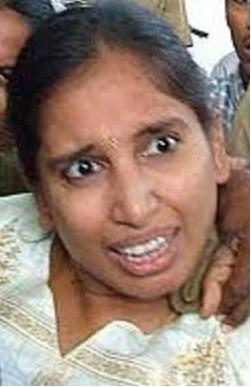
Nalini serving a life sentence at
Tamila Nadu Jail for her
part in the Gandhi assassination
It is 20 years since Rajiv Gandhi was assassinated (did someone say ‘got his just desserts’?).  A lot has happened since.  ‘An eye for an eye makes the whole world blind,’ Mahatma Gandhi once said. I’ve argued against capital punishment elsewhere and will not get into that discussion here.  If, as Vaiko claims, the hanging of these three individuals provokes a full blown secessionist struggle in Tamil Nadu, I will not stop cheering.   That’s not reason enough to want them hanged, though. 

The world would not become any safer or more dangerous the day after if they were executed.  Rajiv Gandhi will not be resurrected.  If India doesn’t know how to deal with them, send them over here, that’s what I say.

A lot of blood has been shed.  A lot of anger has been expressed.  A long time has passed.  There is a time to be wary, and a time to drop guard.  If India is scared about what these three individuals would do, then India can repatriate them back to Sri Lanka. 

I am not sure what their nationality is, but if they were LTTE cadres and were Indians, then they can be extradited to Sri Lanka.  We have rehabilitated and reintegrated into society close to 8000 ex-combatants, some trained to carry out suicide attacks, some trained to toss grenades and spray bullets on civilian cadres.  We can handle these three prisoners.  Not because we condone what they did, but because we know that more deaths will not change things and because we know that this is healing time and execution is not unguent. 

Courtesy: Daily News - Monday 5 September, 2011

04 September 2011

There’s more to cat-skinning that meets the eye

 A couple of weeks ago, I addressed a gathering at a book launch. Rajpal Abeynayake, who was present, wrote in his column last week, that I should be ‘a little bit more circumspect’ in saying that ‘post-war power-sharing projects in countries such as Sri Lanka are driven at least partially by the purpose of foreign interests seeking to commandeer, or at least pilfer, our resources’.  I didn’t use those words.  I make a distinction between power-sharing and devolution.  More on that presently.  As for ‘circumspection’, it is embedded in the qualifiers interjected, even in his representation of what I said.  Yes, there are many ways to skin the cat, and as he puts it, polarization of people to the point of conflict and armed confrontation is but one of these.  The choice of strategy is of course informed by ground realities.  If conflict can be fuelled and if fuelling conflict works, then why not try it?  If it can be done in smoother ways (I recall the US-friendly J.R.Jayewardene shamelessly say ‘Let the robber barons come!’ when he opened the economy and the nation to untrammeled value extraction), all the better.  For those who are in this to make bucks, that is. 

Conflicts cost, Rajpal is right.  Countries have to pocket out bucks for weapons and other hardware.  That’s one way of making bucks.  It doesn’t involve ‘digging, exploration, denuding of forests etc.’ as Rajpal points out.  Avoiding conflict therefore, he argues, makes sense.  And as Rajpal says ‘It’s a good reason to want to think about such things, when rejecting internal power-sharing arrangements out of hand’.  Rejecting out-of-hand anything is not intelligent.  Things should be embraced or rejected after considering the pluses and minuses.  Power sharing, as far as I am concerned (and as I have argued) is a good thing. On the other hand, there are many ways to skin the power cat too, so to speak.  In a political arrangement where power is overwhelmingly concentrated in the office of the President, clipping wings makes sense.  It can only add value to citizenship.  I am all for it.  In Sri Lanka, however, ‘power sharing’ has been erroneously made coterminous with devolution.  Now the argument can be made that devolutionary power-sharing should not be rejected out of hand, taking into consideration the kinds of theft Rajpal has elaborated on.  True, as I said, out-of-hand rejection is bad; rejection or acceptance must be backed by logic, backed by facts. 
There is nothing to say that refusal to devolve would re-invent conflict in ways that facilitated value-extraction.  Secondly, there is nothing to say that devolution will not create conditions for renewal of conflict via upping of demand.  We can’t dismiss the Chelvanayakam thesis (which I’ve referred to often enough) of ‘little now, more later’.  Devolution to the current provincial boundaries will most certainly fix the Eelam map and knowing well that Eelamists are great liars and are damn good at turning myth and fantasy into fact via propaganda, it would be silly to assume that they’ll close shop with devolution, 13 or 13 plus.  More importantly, devolutionary power-sharing should correspond to grievance, i.e. in their true dimensions and not those inspired by chauvinism-inflated fairy tales.   Not only does the demographic data rebel against devolutionary ‘resolutions’, there is nothing to say that other ‘grievances’ can only be resolved through devolution.  Also, the I-can’t-decide-my-future type of complaints are not the preserve of any single community, but cut across ethnicities.  Devolution of power fails the economic test too.  Most of the wealth in the country is created in the Western Province. Even if there was no one engaged in land-digging and sweat-robbing, wealth creators cannot be expected to dole out bucks after being told ‘you look after your province, we’ll look after ours’. 
Not too long ago, we were told that if we devolved, then terrorism would disappear.  That was tried.  Failed.  We were told, ‘you didn’t devolve enough’.  Rubbish.  Those who want to mess things up, take up arms, explode bombs etc., are not persuaded to desist by reason.  The best we can do is to be honest about realities and take it from there.  And this includes calling the Eelamist bluff, which, given reduced circumstances, has been watered down to the articulation of the Chelvanayakam Thesis referred to above.  
If self-determination and democracy is what it’s all about, then the focus should be on changing the structures that perpetuate the devaluation of the citizen.  There’s a lot of ‘polarization’ around and it’s not being talked about because the exaggerations of the Eelam Lobby have made it easy for their neglect.  Devolution is nothing more than a pandering to Eelam myth-making, unless we go for a wholesale re-demarcating of provincial boundaries to correct regional resource anomalies and complement such an exercise with significant constitutional amendments that win back self-determination for the ordinary citizen.  Repeating somberly ‘conflict will come, conflict will come’ amounts to surrendering to falsehood and buttressing the land-theft designs of Eelamists. 
In the end it is the wellbeing of the entire population that should matter.  In this, whether it is Dole or KVC that’s ripping off people does not matter.   It’s the ripping off that is relevant, not the ripper-off.  There is no point in bragging about securing the territorial integrity of the nation if things associated with the term ‘nation’, especially resources, get pilfered left and right within the ‘saved’ boundaries.  And it matters little if the thief is a foreigner or a local. A nation is no one’s private property.   I think there’s a lot of work to be done.  I think we can do without distractions. 

Courtesy: Sunday Lakbima News - 4 September, 2011