Showing posts with label Miyesi Lama Tharaka. Show all posts

23 January 2018

Senaka Batagoda, tell us who we are!


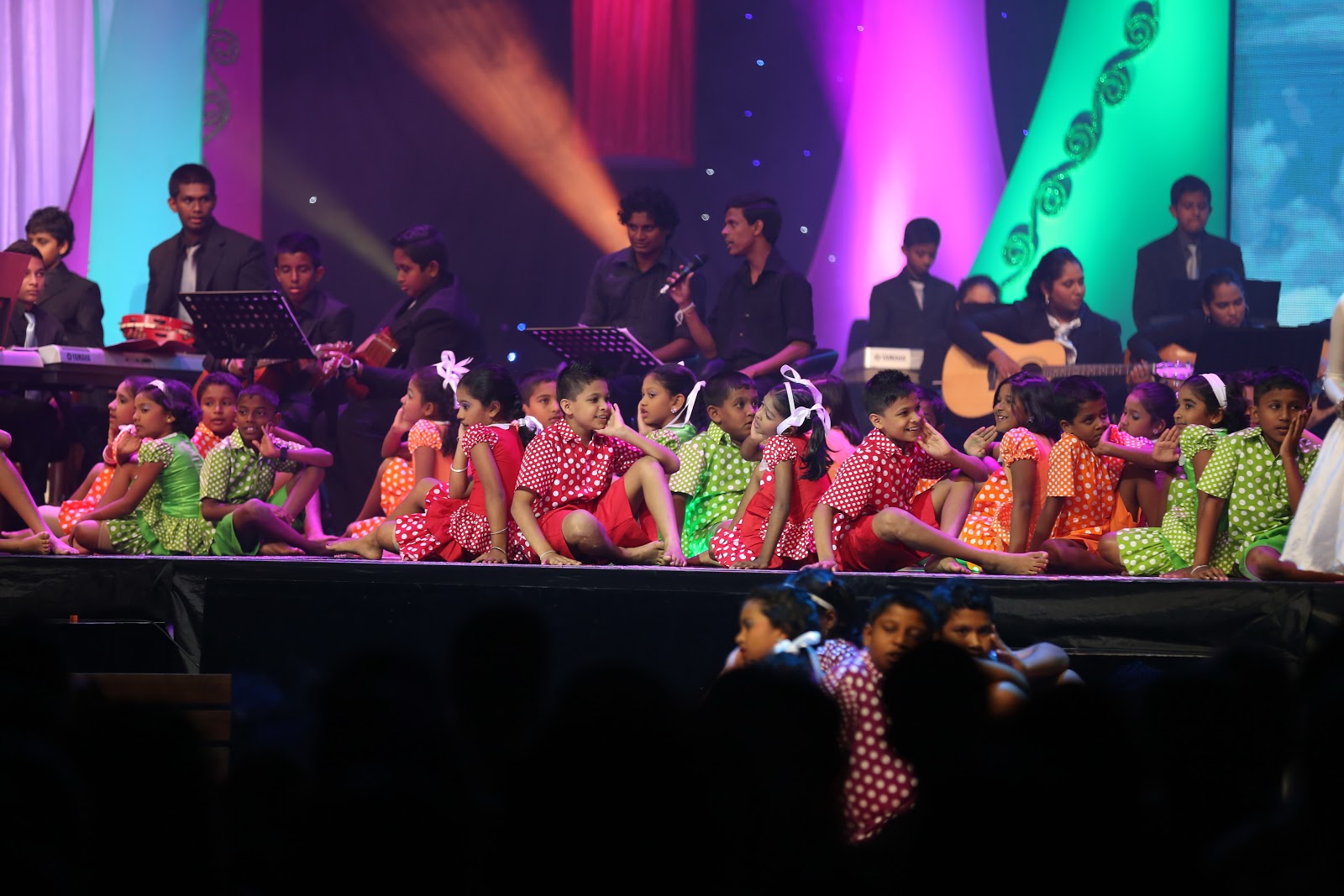
Last Saturday night the students of Nelu Adikari and Kapila Poogalaarachchi put on an amazing show.  It was the second edition of ‘Miyesi Lamaa Tharaka,’ and came five years after the maiden concert.  [for an account of the first show read 'Miyesi Lama Tharaka: a "different reality" show']

It is not easy to manage over 300 children.  There were more than a dozen items.  The children sang and danced.   They sang most of the songs but there were a few where well known artists accompanied them.  For example the song “api sanasille…’  This was sung by Nelu’s brother Athula and Jananath Warakagoda, the renowned percussionist who has supported the excellent efforts of Nelu and Kapila to instill in children a love for all kinds of music.  

‘Miyesi Lama Tharaka’ needs to be written about separately.  This is about the man who wrote the lyrics and composed the melody of ‘api senasille.’  

Bandula Nanayakkarawasam, one of the best and most productive of our contemporary lyricists who compered the show, had a story to tell.

‘This song was written by Senaka Batagoda.  It was he who wrote “Api Kavuruda,” the song made popular by Sangeeth Wijesuriya and the band Wayo.  Once I interviewed him for my programme “Rae Ira Paana.”  We recorded him singing “Api Kavuruda.”  As was the usual practice I made a CD and sent it to the radio station.  

‘I rarely listen to my pre-recorded programmes.  Senaka had listened.  He called me.  He was deeply distressed.  He had a simple question: ඇයි මහත්ŕ¶­ŕ¶şෝ වතුŕ¶» ඇදල ඇදල ŕ¶šŕ¶˝ේ ŕ¶¶ිŕ¶±්ŕ¶Żේ? (“Ai mahaththayo vathura adala adala kale binde?” or “Why did (you) break the earthenware pot after having drawn so much water?”  [This is Senaka's original version]

‘Then he told me that the producer for reasons best known to him or her had replaced his version of the song with that of Wayo.  I was as devastated.’

It’s not Wayo’s or Sangeeth’s fault of course.  They acknowledge Batagoda in their videos.  They have purchased copyrights as well.  They have with visuals and other enhancement turned what some may call a ‘raw’ version into a hit.  Producers know what’s best for the station, one could argue.  However, at the end of the day, there’s an artist who created something special who is left feeling shorthanded.  That’s not good.  

The song, consequent to Bandula’s account, sounds different now.  The title-question is even more philosophical now.  The entire song is about people wondering who they are.  Who are we?  Who am I? These are the questions we don’t ask ourselves but seek an answer to nevertheless.  

In a way, this is the question that Nelu and Kapila are seeking an answer to or rather want the children they teach to find an answer to.  Parents send them to learn music, but they also learn history, heritage and culture.  They learn something about humanity, about giving, sharing and the value of the collective.  They acquire eyes to see the world and see through the world.  They get exposed to roots, if that’s proxy for things like history and heritage, and they open their minds to the universe, if that’s proxy for things beautiful and sweet that are not necessarily wrought from our cultural soils.  

So it’s about who we are and also about who we can become.  It’s about what’s uniquely Sri Lankan and about the commonalities that pay little attention to national boundaries.  It is about things that Senaka Batagoda sings about.  Things that might at first cut appear to be casual observations about ordinary things but on closer examination are deeply philosophical.  

Too often we re-define ourselves according to what we believe the world expects us to be.  In the end we are not who we really our but someone else’s version inhabiting someone else’s version of our reality.  

Lobo captures this in the song “Love me for what I am”:

I can't change any more
of what makes me be myself
And still have enough left
not to be somebody else
  
It’s not always a conscious decision.  We are bombarded in multiple ways all the time with ‘be this!’ or ‘be that!’  We want inclusion, we don’t want to be left behind.  So we go along and tell ourselves (by way of consolation) ‘this is what I want to do/be.’  We don’t often ask ourselves somewhere down the line, ‘who am I?’ or ‘what have I become?’  

Senaka Batagoda felt short-changed.  I like to think that he felt that cheated in the misrepresentation.  He is not just the lyricist, but the lyrics.  When he asks 'ŕ¶…ŕ¶´ි ŕ¶šŕ·€ුŕ¶»ුŕ¶Ż?’ it’s a general question to a large collective he is a member of, but he clearly has a good idea of who he is.  His songs are explorations of the dimensions of being and becoming.  

I don’t know if he has had a conversation with Nelu and Kapila and I don’t know if the duo ever thought of that song seriously.  But in this universe where the improbably announces presence, there’s a community that they are part of and that collective appears to be companions on a long journey.  They walk to destinations that are probably clear to them.  Their footprints are made for following.  

Malinda Seneviratne is a freelance writer. malindasenevi@gmail.com.
06 February 2013

Miyesi Lama Tharaka a ‘different reality’ show


Two years ago, at a small house off a small lane in a relatively small town called Battaramulla three young people launched an exercise to hone musical talent and related sensitivities of little children.  Nelu Adhikari, Kapila Poogalaarachchi and Lionel Bandara were in university together.  All three are accomplished musicians.  All three shared concern over a general decline in taste and thought that instead of whining they would expose little children to the many wonders of good music, whatever the tradition.   They called their little school ‘Nelu-Kapila Miyesi Arana’ (Musical Home of Nelu and Kapila).
They organized a small ceremony to mark the event.  They invited their teachers, among them Nanda Malini and Rohana Weerasinghe, both icons in the field of music and both senior citizens revered by music lovers. 

On that occasion, Nanda Malini offered some comments: ‘I know both Nelu and Kapila. They are both wonderful people.  They are highly respectful of their teacher, seniors who came before them. 
They respectfully and despite all their accomplishment ask with utmost humility for blessings and guidance.  They listen.  At this moment I want to wish them well and I shall do it this way…’ 
Then she sang one of her all time favorites, Buddhanu Bhavena.  Those who were there, the adults, i.e. parents and well wishers, would have been taken back to their own childhood. 

Two years later, at Stein Studio, Ratmalana, all the children who came under the wings of these three exceptional teachers, put together a concert.  Following an introductory seeking of blessings from the Goddess Saraswathi and a fusion instrumental, a documentary about the school was played on the backdrop of the stage.  Footage from the ‘opening ceremony’ referred to above had been included in this presentation.  Nanda Malini, who was unable to attend, was very much present(ed) by the rendering.  It was as though Buddhanu Bhavena was the signature theme of the entire exercise of teaching and learning.  Bandula Nanayakkarawasam, friend to Nelu, Kapila and Lionel, a companion on this long journey undertaken by them, compering at the event, quoted from Goethe: ‘Teaching is about forming taste and not communicating knowledge’. 
What unfolded thereafter was a carnival of good taste in music.  It was a fusion not just of musical traditions but generations.  There were doting grandparents excitedly watching their grandchildren perform, children were excited about being on stage but dropped stage fright and inhibition the moment the first note of the particular item was played, and anxious parents who had diligently accompanied child to class and had been briefed and re-briefed by the teachers about costume and rehearsal relaxed as the teacher-student combine unleashed the full harvest of hard work and love. 

The arrangement of songs was well thought out.  The program proper began with the theme song Ira Handa Tharu Obamai (you are the sun, moon and stars, no one else).  The singers ranged from 4-5 year old kids to children in their late teens.  The entire orchestra was made of children.  They may have slipped here and there, but I wouldn’t be able to tell.  To me, it was all perfect. 
This was followed by the well known Edward Jayakody number, akuru maekee nae (the letters have not got erased) which is a nostalgic reference to childhood and in particular the first grade experience.  What was special was that Edward Jayakody himself came on stage to sing with the children.  Edward, as everyone in the field knows, is one artist within whose heart a beautiful child continues to live.  Speaking after the performance Edward said that this was the first occasion where he sang with an entire orchestra or instrumentalists and singers without a single rehearsal.  He was impressed. Immensely. 

‘The Last Waltz’ and the theme music of the award-winning film ‘Chariots of Fire’ followed, demonstrating that this was not some kind of nostalgia-driven throw-back into the past.  Nelu, being a versatile musician schooled in both North Indian classical music as well as western music, it was perhaps natural that she impressed upon her students the virtues of being similarly versatile in both appreciation and rendition.  There were no hiccups on account of language or because of genre unfamiliarity. 
Bandula prefaced the next song with an anecdote.  As a schoolboy at Richmond he was taken to Mahinda College along with some other boys. They had to dramatize the song ‘Where are you going to my pretty maid’.  He had been very small and very thin, then.  He had been perched ‘as a bird’ on the top most branch of a ‘Mango tree’ (made of a branch broken on their way to Mahinda).  Unfortunately there had been a nest of red ants and the ants, agitated had crawled up his leg.  They bit him and he reacted, resulting in the whole ‘tree’ collapsing. The boys had kept their composure and continued as though nothing had happened.  ‘Where are you going to my pretty maid’ was what inspired him to write ‘Mal pipee deneth arei’.  The tune itself was drawn from that ditty.  The children did not know any of this, but this fact did not take anything away from their performance.

Then they moved to folk songs and other old favorites. Threshing floor songs (kamath kavi) flowed into Ran Dahadiya Bindu Bindu, with Saman Lenin and Harshana Dissanayake joining the group.  This was followed by Ha Ha Balaagenai.  The original vocalist, Pradeepa Dharmadasa was due to sing a few lines with the children, but couldn’t make it due to ill health.  The children more than compensated. 
‘Top of the World’, ‘Dancing Queen’ and ‘Brown Girl in the Ring’, favorites from the seventies, were sung with delight, as was Olu Nelum Neriya Rangala from the film ‘Rekava’.  Bandula pointed out that the film was made by a Catholic, the song was composed by Fr. Mercelline Jayakody and the music was composed by Sunil Shantha again a non-Buddhist.  He observed that this is how it was among people of different faith engaged in music and this is how it should be now and always in all things. 

An instrumental medley of ‘For a few dollars more’ and the Andean melody popularized by Simon and Garfunkle, ‘El Condo Pasa’ was followed by one of Kapila’s compositions, ‘Sarungale’.  From there, the group moved to faster numbers, those that were hits in the seventies, a decade dominated by the likes of Clarence Wijewardena, Annesley Malewana, the Dharmadasa Brothers and others. All the children, regardless of age, enjoyed Kandukare, Kale Ukule Thiyala, Udarata Menike and Gonwassa.  So too, the adult audience. 
There are no limits to music and entertainment.  Peenamuko Kalu Gange, Ho Ga Ralla Binde, and Emba Ganga saw well known artists Indika Upamali, Lakshman Wijesekera and Harshana Dissanayake performing with the children. 

A poignant moment came thereafter when the parents of the teachers were offered tokens of appreciation. The entire audience was in full agreement that the six individuals who came on stage are truly worthy of special appreciation for having gifted our society with three exceptional artists, three exceptional teachers. 
Rohana Weerasinghe, Malani Fonseka, Amarasiri Kalansuriya and Prof Carlo Fonseka, all present that evening, expressed delightful surprise at what they had just witnessed.  They said that the range of songs was truly astounding and complimented the teachers, parents and children for having offered them a wonderful evening’s entertainment. 

They had sung folk songs, pop and other ‘Western’ songs, songs from films and Sinhala pop.  They ended with nurthi gee to dramatic accompaniment.  We saw Ala Benda Mage Ramyavan, Yasa Isuru, Kumatada Sobaniye, Siri Sangabodi and Ada Vessantara.  Clearly, the children not had just voice and ear, they had movement and rhythm too. 
The show ended with Kapila, Nelu and Lionel coming together to sing the theme song, insisting that the sun, moon and start truly belong to the children and no one else.

The entire team proved that love for music and unlimited humanity and humility can yield a rich harvest that can and will nourish this and generations to follow.  They will be that much more tender, one felt.