Showing posts with label Nalin De Silva. Show all posts

06 August 2026

O Religion, thou comest in many garbs!


More than a decade ago the late Prof Nalin De Silva launched a book titled ‘batahira vidyaava, aasanik saha deviyo (Western science, arsenic and god).’ The late Prof Carlo Fonseka spoke at the launch held at the J R Jayewardene Centre. The inevitable happened. The two, who respected each other at some level, quarreled. Academically of course. I had left by that time, but not before I offered my comments.

I can’t remember how I ‘read’ the word ‘Western’ but I did dwell on science, arsenic and religion, observing that those who pooh-pooh Nalin’s takes on the god Natha (believed to be an incarnation of the Bodhisattva Avalokitesvara, again believed to be the future Buddha Maitriya) do treat the West and Western Science in close-to-divine terms.

God is omnipresent, so believe theists. And omnipresence means everywhere, even places unheard of and hidden, places one does not associate with religion and divinity, in your home, your washroom, in brothels and taverns, all over a cemetery, up in the sky and deep underground. In parliament too. God is the speaker, the prime minister, the president, the prisoner, the jailer, the hangman, the hangman’s rope, the speaker’s chair, the president’s seal and the state. God is, or ‘is in’ let’s interject. So too the devil, one might add.

 Well, we have people who religiously advocate the separation of ‘church’ and ‘state’. Those are Western terms of course, but translated, so to speak, into Sri Lankan speak they are essentially used to rant and rave against Article 9 of the Constitution (never mind that Articles 10 and 14 effectively negate it).  Fine. All three could be done away and we can thereby obtain a clean slate, sorry, state.

There are a few niggles that need to be sorted out of course: the Kandyan Marriage and Divorce Act, the Muslim Marriage and Divorce Act and the Thesavalamai Law for example, for when you dump one identity marker you have to do away with them all. And of course religious holidays. No Poya holidays, no extra holiday for Vesak, no Thai Pongal, no Maha Sivarathri, no Deepavali, no Good Friday, no Christmas, no Avurudu, no Eid al-Fitr, no Eid-al-Adha, no Milad an-Nabi, no short-Fridays to go to mosque, no special leave during fasting, and no additional leave for widows belonging to particular religious communities. And Sunday, hitherto a religious holiday, will no longer be so.

Take them all out and check the state. Is it now atheist? Is it religion-free?  


What is religion, though? It is all about belief. Strong and even fanatical belief, to be precise. Where do we find such things? I can think of churches. That’s obvious. Religious communities. Again, obvious. But how about political parties? Parliaments? In the corporate sector? People worship power. They worship money and profit. They would kill for any of these things. The truth is there are ‘articles of faith’ everywhere. Ideologies are more religious than anything else.

There are ‘gods’ and ‘demons’ defined as such by convictions that have nothing to do with anything spiritual. Villainy abounds and therefore so too villains, as defined by the self-proclaimed virtuous of course. We get know-alls. Many. And that’s omniscience of a kind. Godly. There are people who believe they are invincible. Omnipotent. Godly.  

Religions abound. Religiousness is everywhere. Try separating them from that which is believed to be atheistic!

And one fine day
at twilight
under a threshold 
drenched in primordial spray
neither wet nor dry 
a chronic schizophrenic 
half asleep and half awake
tossed a coin:
on one side it said 'good'
and on the other, 'evil'
and the I 
that turned into I and I
a sacred covenant signed.

'We shall be one or the other
and we shall in duality
reinforce 
this love,' said I
and I added, 'and this hate';
'yes,' I replied 
'in the pot-kettle game 
shall I affirm myself'.

And I sealed it with a kiss:
'and thus shall we thrive
through sickness and health
good times and bad,
richer or poorer,
for better or worse,
to love and to honor
forever and ever
amen!'

Dichotomies suck, don’t they? 


06 October 2025

The wealth and poverty of Nalin De Silva


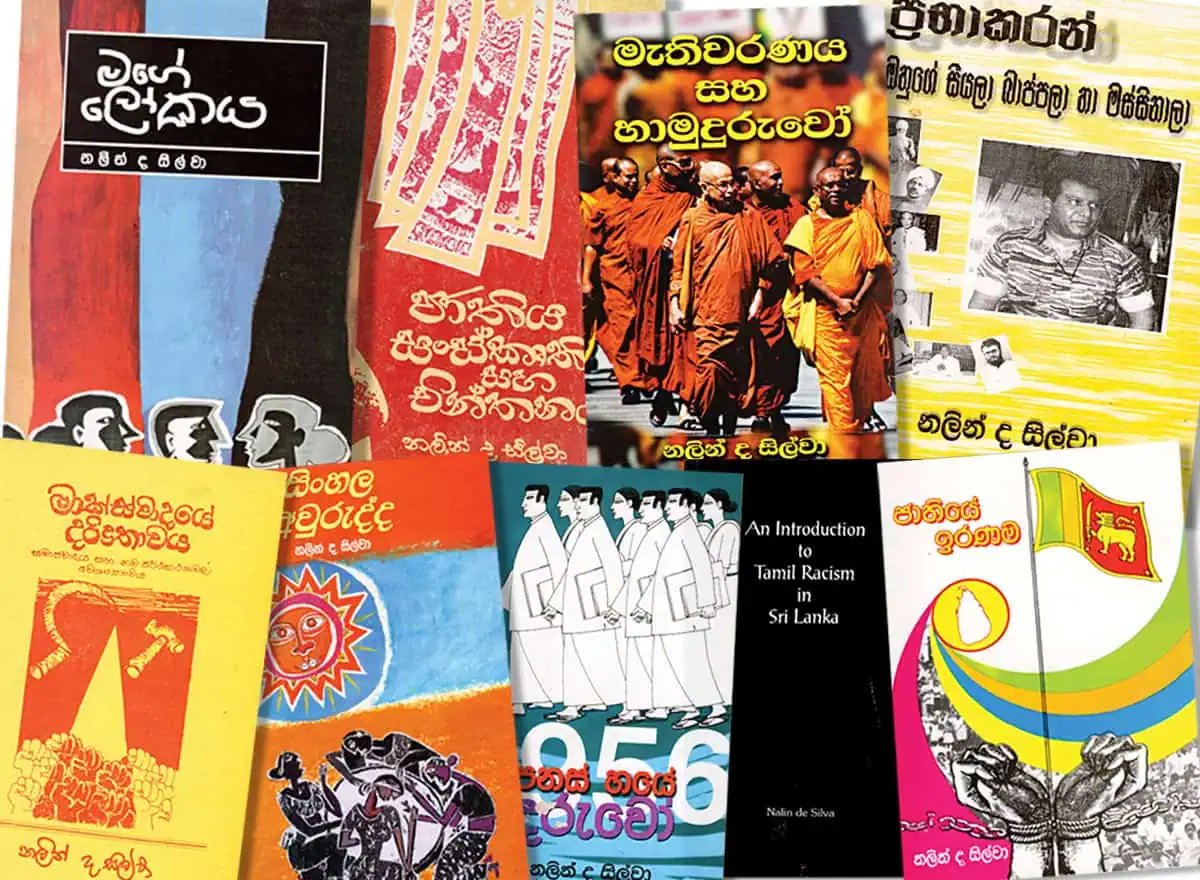
https://www.epotha.com/wp-content/uploads/2024/05/Nalin-de-Silva-Books.webpThe

More than twenty years ago, when I worked for the Sunday edition of ‘The Island,’ I would step into the editorial office of our sister paper, ‘Divaina,’ just to chit-chat with fellow journalists. I enjoyed conversations with almost all the journalists working there, young and old. On one such occasion, I noticed Dr Nalin De Silva standing near a table, looking a bit out of place.  

I had met him a few times before that. He recognised me when I greeted him. This was a time when he wrote weekly columns for the ‘Divaina,' the Midweek Review of ‘The Island’ and also for the science weekly, ‘Vidusara,’ if I remember right. So I asked the natural question: ‘did you come to submit an article?’ Of course the question was asked in Sinhala and his response was likewise in Sinhala. Essentially, the following:

‘No, Malinda. I came to collect the payment. It’s a small amount. They don’t pay me regularly (hariyata gevanne naha). They don’t understand that it is a big amount for me. It was heartbreaking to hear that. Nalin, who was the professor of mathematics at Colombo University, had been sacked. He would be reinstated years later, but that’s another story. The fact was that he was going through a really hard time.

Looking back, one might say, that Nalin never had it easy. He was vilified no end and not always by people endowed with any kind of political, ideological, philosophical or moral integrity. He wrote and he spoke. He stood his ground and argued. He did not mince his words and maybe he should have.

I remember running into him in Colombo Campus about 30 years ago. I was speaking with Dr Arjuna Parakrama of the English Department, my chess coach and a family friend. The two had arranged to debate one another on some topic which was not mentioned. They spoke about the logistics, that much I remember. Then Arjuna said ‘Nalin, we must make sure that we don’t become anyone’s pawn.’ Nalin muttered something and left. I didn’t hear, so I asked Arjuna.

‘He said you are already a pawn.’

Arjuna took it in his stride. He too was one who stood his ground, although he spoke and wrote much less than Nalin. A pity, I should add, even though ideologically and politically I was closer to Nalin than to him.

On the 2nd of May it will be a year since Nalin passed away. His sharp and telling arguments that countered all manner of assaults on the nation and its heritage are no doubt missed by ideological fellow travellers and probably offers much relief of his detractors, especially since it is clear that at least for now ‘the enemy’ that he perceived has gained much ground.

The enormity of the man in the politico-ideological firmament is undisputed. He played a key role in unshackling radical youth from all the errors of Marxist, materialistic and modernist postulates. The resurgence of the political right certainly dealt heavy blows to Marxists, but at the ideological level with regard to emancipatory politics, Nalin’s interventions certainly unsettled Marxists as well as Marxist parties and groups who, interestingly, abandoned the ‘class project’ and embraced all kinds of causes just to retain a ‘left’ badge which meant something only to them and nothing or next to nothing for others. Such individuals, unsurprisingly, ended up being quite comfy with right wing projects. Nalin’s ‘Mage Lokaya’ (‘My world’) inflicted deep wounds, suffice to say.

Nalin of course was not the first to take on Marxists, but in the very least, in Sri Lanka, his was a voice that they simply could not refuse to hear. Whether or not such debates served to engineer some kind of progressive leap in discourses related to social transformation it is hard to say conclusively, one way or the other. However, to the extent that any serious intellectual exercise is a non-negotiable element of emancipatory politics, few would disagree that Nalin did his bit. And more.
Nevertheless, he was more effective on the erroneously formulated idea of ‘the national question.’ Nalin systematically debunked ahistorical claims of Tamil chauvinists and in the process undressed their apologists in Marxist/leftist garb. One recalls that Nalin, along with Gunadasa Amarasekera, S L Gunasekera and a handful of others, took on an ‘enemy’ poor in theory but rich in political and economic strength. This was in the 1990s. That was a time when ‘Sinhala’ and ‘Buddhist’ were terms that could only be uttered at the risk of being called racists, chauvinists, warmongers etc. Interestingly, the name-callers had no issue whatsoever with racists, chauvinists and terrorists belonging to other communities, ethnic and religious.

The nineties were marked by a political culture where anyone opposed to federalism was vilified,  Nalin did not care. He was relentless. He wrote and wrote and wrote. Week after week. For years. Decades. He took his detractors on almost singlehandedly. Many were in NGOs with dubious agenda and they had the bucks. Those who subscribed to ideologies that Nalin opposed had ample support of those in power. They had the kind of access to both public and private media that should have made control of the ideological space a piece of cake. Nalin just wrote to a few Sinhala newspapers. He prevailed. Or rather, the ideas he tried to disseminate took root.

Nalin was ridiculed over his ideas about Natha Deviyo. He responded with a book titled ‘Batahira vidyaava arsenic saha deviyo (Western science, arsenic and god).’ It is not a coincidence that those who laughed at Nalin do not ever take issue with theist subscribing to the Judeo-Christian religions. At the same time they treat Western science as divine writ. The last word. They genuflect before western science even though western science has long since abandoned the idea of objective reality.

Nalin did expend some energy on developing a political organisation or else trying to convince established parties to accept his views. He was political in that sense too. This exposed him to additional fire for his political opponents pinned the since of the party on the man. To be expected of course. Few political pundits can claim to be immune from such attacks though.  

Nalin argued against Cartesian logic and proposed instead what he called the ‘Chathuskotika’ method of inquiry, four-fold as opposed to the Aristotelian two-fold.  In ‘Marxvaadaye Daridrathavaya’ and ‘Apohakaye Roopikaya’ he did raise issues regarding key concepts of Marxism and demystified Marxist dialectics respectively, necessary interventions useful even for Marxist scholars as well as those who privileged slogan over activism that considered relentless study integral to the revolutionary drive.

He would often draw from cartesian logic when it comes to political practice. Perhaps a remnant of dabbling with Trotskyism in his younger years. A pity, certainly, and a contradiction, for the rich and complex logic system he developed was in a sense a result of his efforts to debunk the Trotskyism of his younger years.

He was far from perfect. But he was absolutely honest. He did not comprise, as many others have, his convictions in order to secure some kind of personal benefit. This is why the image of that encounter at the ‘Divaina’ is so deeply etched in my mind. He was poor, absolutely, compared to those who took pleasure in ridiculing him. He was one of the richest minds this country has seen over the last 50 years or so. He made a difference and his ideas may continue to inform ideological debates and consequent political practice for a long time more to come.  

Nalin De Silva was unperturbed by praise or blame. He lived a simple life even as he chose complex subjects to write about. He planted many seeds. They will grow into tall trees, by and by.  

[This article was published in the Daily News under the weekly column title 'The Recurrent Thursday']


17 April 2012

As the sun sets on the dominant paradigm of development…

The fall of the Berlin Wall and the collapse of Soviet-style systems in Easter Europe for people was seen as a triumph of one political and economic system over another, that of capitalism over communism.  Even today very few people recognize that the two systems are essentially two versions of a single paradigm called ‘modernism’, which flows from a largely Euro-Centric understanding of the world and consequent extrapolations. 
For many decades there were things we were supposed to treat as self-evident truths.  We were allowed to be anti-imperialist and anti-capitalist but were not allowed to question ‘modernity’, which was duly accorded with some kind of ‘intrinsic’ value and marketed as something good that everyone should aspire to obtain.  And there was ‘science’ as in an overarching knowledge system and relevant applications which too were based on fundamentally Euro-Centric philosophies and epistemologies.  We could criticize the West and its imperialistic urges but were required to treat with utmost respect and accord god-given status that thing called ‘science’ as defined by the West. 

When people like Dr. Gunadasa Amarasekera (‘Ganadura Mediyama Dakinemi Arunalu’ – ‘I see the first rays of dawn breaking through the dark night’) and Prof. Nalin De Silva (‘Mage Lokaya’ – ‘My world’) began questioning the modernist premises and especially its Marxian variants, they were vilified as racists, chauvinists and accused of being archaic and guilty of an unwholesome fascination with the past. Even those who recognized that they could not be pooh-poohed away, complimented them in backhanded manner, calling them ‘native intellectuals’ as though there is such a thing as an ‘international intellectual’. 

A lot of what these two individuals were articulating were in fact already quite in vogue in intellectual circles in the Western Hemisphere.  The ‘cardinal error’ committed by Gunadasa and Nalin was that they drew extensively from Buddhist philosophy to critique the dominant paradigms and recognized the fact that much of the critique that was coming from within the West itself was founded on principles that Lord Buddha had articulated more than two millennia before. 

I still remember a comment made by Deepthi Kumara Gunaratne of the now defunct ‘X Kandayama’ which quickly succumbed to in-fighting and thanks to incomplete and erroneous reading of the bibles they preferred slid from scholarly engagement to pornography.  This was outside the Public Library in the early years of this century.  He chided me: ‘You will become just another journalist if you don’t give the reading public the new knowledge of the world’.  I asked him what this new knowledge was.  He said, ‘Derrida, Foucault, Lacan’.  I said, ‘mata e siyalu denaatama wediya budu haamuduruwo aluth’ (to me, Lord Buddha is more ‘new’ than all these people).  That newness was something that I discovered thanks to people like Nalin and Gunadasa and which I was persuaded to explore in greater depth by Champika Ranawaka.

In February 1992 Champika Ranawaka and 15 others were arrested at the Kauduwuwa Temple in Wadduwa by some overzealous police officers.  They took into custody and destroyed the manuscript of a book that Champika had authored based on notes he had been maintaining since 1989, i.e. long before terms such as sustainable development and traditional knowledge systems entered the lexicon of ‘sanvardanaya’ (development) in Sri Lanka.  Champika was held for three weeks.  All he did was write.  Re-write, to be more accurate.  He re-wrote that document, which he titled ‘Sanvaradanaye Thunveni Yamaya’ (translatable as ‘The sunset of development’).  That book, ‘published’ in Roneo print in 1991, was the foundational document of the first ever green political movement in Sri Lanka, the Janatha Mithuro. 

Those who are quick to call Champika (and others) racists, chauvinists, extremists etc., refuse to acknowledge two things. First, that their consistent, principled and at that time largely unpopular and vilified struggle against LTTE propaganda and Eelamist posturing (including its ‘federalist’ versions) played an important role in overturning the ideological dominance of the Eelam Project to which significant sections of the polity had succumbed.  They do not acknowledge that had these ‘racists’ not been around, it is quite possible that we would be living in a post-CFA Sri Lanka which would have (in the very least) the LTTE governing one-third the country and half the coastline and where all of us constantly live under the shadow of terrorism. 

Second, even if there is reason to treat with suspicion and fear the Sinhala Buddhist nationalism that Champika championed, this does not take away from the fact that he is clearly way ahead of his generation in terms of intellect and academic output.  Few can match the volume of his writing. Fewer still would dare challenge him to debate on any of the subjects he has engaged with over the past two decades, including the philosophy of science, quantum physics, paradigms of development, politics pertaining to environment and Buddhist philosophy.  He gave political expression to the theories first articulated by Gunadasa and Nalin.  Even those who disagree with him on certain issues, and I am one of them, must recognize that he is a formidable foe, not least of all because of his indefatigable energy, the fact that he is a voracious reader, and his considerable capacity to synthesize the material he encounters and extrapolate and apply in ways few are able to do.  

My principle critique of Champika has been the fact that he has allowed Sangvardanaye Thunveni Yamaya to gather dust, as it were, in preference to the politics pertaining to overcoming the terrorist threat, even though the latter was a prerogative that no nationalist could put on the back-burner.  This is why I believe that despite certain flaws and shortcomings, some of which is understandable given political realities and limitations of resources, he was the most suitable person to be the Minister of Environment and Natural Resources.  It forced his hand.

That he turned the ministry and its various institutions into profit-making entities that did not have to depend on the Treasury, attests to his considerable abilities.  He also deserves applause for running a clean show and can be justifiably proud of the fact that former COPE chief, Wijedasa Rajapaksa’s assertion that his was one ministry that was free of corruption and misappropriation of funds.

What struck me most and what made me write this, however, is a small news item in the Daily News of March 11, 2010 (business section) titled ‘Council for Sustainable Development mooted’.   He has said that a ‘Green Lanka Programme’ will be implemented from 2010 to 2016 through a National Council for Sustainable Development which will be set up by the ministry. 

He has pointed out the dangers of over-dependence on fossil fuels, remarking that the emission quota for this century ended on September 25, 2009, a sobering fact indeed.  We know today that the ecological footprint is obliterating bio-capacities and that nations are running on ecological debt.  Champika Ranawaka, it can be argued, is two decades late.  On the other hand, we have to recognize that we were a nation and a people that were lazy and clearly unwilling to wake up to these realities during the same period. 

There is a significant mismatch between the sentiments that Champika has expressed and the strategies implemented (and those in the pipeline for implementation) and the overall direction, thrust and character of that which is called ‘national development’.  Both ‘environment’ and ‘people’ have been de-factored or suppressed to regime preferences which still salute (in practice) the dominant (and failed/failing) paradigms of development.  

We can vilify Champika Ranawaka, Nalin De Silva, Gunadasa Amarasekera and others if we don’t like their faces or are uncomfortable with their politics pertaining to notions of identity and nationalism, but we can’t vilify ourselves and pretend that things are ok, or that ‘modernism’ or ‘capitalism’ or anything else would ‘work’ under a different regime. That’s being naĂŻve and moronic. 

We believed human beings could dominate nature and craft it as they liked. This was the fundamental flaw of Euro-Centric philosophies and development paradigms and indeed ‘science’.  The ‘centrality’ of the human being has proved to be a massively erroneous conjecture.  Correction requires the injection of massive doses of humility.  I am not saying Champika is humble. He is not.  On the other hand, his theories and the strategies he is trying out are most certainly ‘humbling’ and this is a step in the right (or at least ‘a better’) direction.  

[first published in the Daily News on March 12, 2010]


01 December 2011

Gunadasa Amarasekera: The dentist — philosopher rooted in Sinhala soil


[This article was first published in the Sunday Island in 2001]

Some people are controversial. Some fall victim to the invective that arises out of controversy. Some, very few, smile and go about their work regardless. I suspect that such people are able to weather the storms they unleash or provoke because they have resolved to commit themselves to perceive the eternal verities of life and as such are not perturbed by praise or blame. Some people demonstrate this quality in their work. In others it is present in all their life activity. They are rare.

The first time I encountered Dr. Gunadasa Amarasekera was in the early seventies, when my parents took me to the Dental Institute to get a tooth extracted. Or was it a filling? I can’t remember. I do recall a smiling face. And just the other day, it occurred to me that the warmth written in that smile had not changed. We chatted for hours about his life, his extensive writings, literature, politics, the changes this country, and the ferment in its cultural ethos, challenged as it is by the seemingly inexorable intrusion of western ideological drives in their patently violent forms.
He was born in 1929 and grew up in a remote village called Yatalamatta, some 15 miles inland of Galle. His father was a vedamahattaya and his mother the headmistress of a school. Gunadasa was a sickly child and whereas his older brother and younger sister had been sent to the missionary school in Baddegama, he had been kept at home until he was 12 or so on account of the epileptic fits he had been regularly afflicted with.
Gunadasa maintains that this was a blessing in disguise because it allowed him to familiarise himself with Sinhala literature. His father had been an ardent admirer of Anagarika Dharmapala, and being well versed in both Sanskrit and Pali and given to reciting the classical epics such as the Selalihini Sandesaya. In fact he had written a poem dedicated to Mahatma Gandhi in Sanskrit. Apparently the principle of Vidyodaya, Rev. Baddegama Piyarathana, was his father’s brother. He also remembers listening to his mother reading from the Kusa Jathakaya in school. The intellectual climate in the household had also been enhanced by newspapers such as Sarasavi Sandares which were regularly purchased.
As such there was already a culture of learning and appreciation of literature that the young Gunadasa was enveloped in. This was complemented by the inevitable immersion in the cultural ethos of the village life.
At 12, Gunadasa had been sent to Baddegama so that he could be educated in English. He had stayed with his aunt’s family, who were Christian. "That was my first encounter with the West, and I remember instinctively rebelling, for instance, arguing the worth of ayurvedic medicine."
He went to Nalanda during the war years. "There was a certain ‘awakening’ among the Sinhala educated people. We had W. A. Silva’s novels, the Colombo poets and of course Gamperaliya came out in 1944. It was also at this time that the free education movement began. People like Kannangara and Malalasekera were unreservedly ridiculed. The Catholics, the Christians and the English educated elite rebelled against these trends."
According to him "1956" didn’t just happen. It was preceded by long struggles and many factors, including the existence of people like his father whose sensibilities were deeply rooted in the strong foundation of our culture.
It was while at Nalanda that he first showed signs of becoming a writer. To begin with he was influenced by teachers like W. S. Perera, or "Siri Aiya" as the poet was better known, Karunaratne Abeysekera and Ridgeway Tillekeratne. He also closely associated with the Colombo poets during this time.
"It was around this time that D. B. Dhanapala started the Lankadeepa, thus challenging the Lake House monopoly, and more than that encouraging the local traditions and writers. In 1952 the Times Group had organised a short-story competition, sponsored by the New York Herald Tribune. Gunadasa had submitted a story titled "Soma" which had won first prize. Soma, along with the winner in the English category, "A culture of hate" by A. Felician Fernando, were later published in a collection titled "World Prize Stories".
This had naturally given the young author some exposure and M. D. Gunasena had come forward to publish a collection of short stories titled Rathu Rosa Mal just before he joined the university. He had studied science at Nalanda although the school was not noted for its strength in these subjects and had been selected to the Dental School at Peradeniya. His studies in dentistry did not prevent him from experimenting with the Sinhala language and its creative potentials. While in the university he published a collection of Sinhala free verse titled Bhava Geetha.
"Even at that time, I was looking for a ‘native’ form based on our folk poetry and its particular structural forms such as the pasmath viritha. Bhava Geetha was followed by Amalbiso, Guruluvatha and Avarjana. Karumakkarayo and the short story collection Jeevana Suwanda, also came out around the same time."
The sheer volume of his work during this time, considering also the fact that he was following a strenuous programme in dentistry, clearly speaks to the man’s discipline as well as the intellectual and creative ferment within him. Gunadasa explained that the above mentioned works belonged to what he calls the "first phase," i.e. when he was relatively free from the influence of the Western traditions. They also worked around immediate themes such as university life, adulthood and its associated problems.
Later he was to be heavily influenced by Western authors such as D. H. Lawrence and Arthur Miller and possibly explains his flirtations with eroticism. It was during this "second phase" (which he says was "imitative") that he wrote the novels Yali Upannemi and Depa Noladdo.
It is perhaps not possible to talk about this period of the writer's life without mentioning Peradeniya University and everything it stood for. "There was a general culture of looking to the West." Although Gunadasa remains sympathetic to the socialist ideal, he claimed that he was not too enamoured with the Marxists: "Instinctively I felt something alien in their approach, it was probably the cultural factor." Or perhaps the absence of it in the way that Marxists then and now explicate their canon.
Gunadasa marks Martin Wickramasinghe’s critique of the Peradeniya novel as the beginning of the "second phase" of his journey with the pen. "Martin Wickramasinghe charged that those who belonged to the Peradeniya school were mere imitators and that they were looking through foreign lenses. And so arose the controversy between him and Sarachchandra. Initially I took up a position that was oppositional to Wickramasinghe, but later I reexamined my views. I came to realise that the tendency in Peradeniya was to take man out of his cultural context. They were looking for universal human values."
Perhaps it was a product of the maturing process. Gunadasa himself admits that self-criticism is part and parcel of the writer’s world since he is constantly questioning things. For him a writer is primarily an intellectual. "For a serious writer, writing is not an end, but a means to an end, it is a living process. He has to come to terms with what he perceives, writing is but a by-product of the process."
He left for his post graduate studies in 1967. Gunadasa claimed that by this time his views had undergone radical change and he was intent on trying to place people in the social and cultural context. He wrote Gandabba Apadanaya just before he left. This marked his "third phase".
England had been an eye-opener. "I realised how alien they were and how radically different we were to them. During this time I came out with Ektemen Polovata, Katha Pahak, and Premaye Sathya Kathava.
Gunadasa laments that our reading public, society in general and the intelligentsia have stopped growing. He offered that this is probably due to the fact that once the flaws of blind aping of the West surfaced, it petrified people and prevented them from coming up with something of their own.
"My novels are hardly discussed. I am not saying that they are excellent works, but I do believe that they are worthy of comment and discussion."
It is also in this "third phase" that Gunadasa ventured out of literature to the political and ideological spheres in a more direct way. Abuddassa Yugayak and Ganadura Mediyama Dakinemi Arunalu, this is clearly evident, the latter becoming a veritable handbook of those who found answers to some of their burning questions with regard to civilisation and the social-political crisis they were undergoing in the Jathika Chinthanaya school.
"I found that literature alone was not enough and that something had to be said in a more direct form. In 1980 I wrote Anagarika Dharmapala Marxvadiyek da?" I remember Dr. Nalin de Silva writing a harsh review of the book. But he later told me that that was the book that changed him and took him away from Marxism."
I ventured that literature is able to implant ideas in a deeper way within a person’s sensibilities as opposed to ideological theses, and he said "A writer is someone who experiences discontent. His mind is a prism, it can express itself academically, through fiction, essays or any number of ways. Take Martin Wickramasinghe for example. There is no argument that he is a colossus among the Sinhala writers of the 20th century. But he did not stick to fiction. Through his novels and his essays he was searching for one thing, the Sinhala Lakuna, the Sinhala mark or identity.
"But I do see your point. If our politicians were poets things would have been much better. Look at Mao, and even Lenin, who saw the political and philosophical worth of Chekov’s Ward Six.
"Marxism in Sri Lanka was conspicuously non-creative. It became a substitute for thinking. Our Marxists have made absolutely no contribution of significance to the debates within Marxism. Here it was nothing but fuel for dull minds and mediocrity."
It was time to move on to Jathika Chinthanaya and his long association with the much maligned, controversial and in many ways invaluable Dr. Nalin de Silva.
"As I said earlier, the seeds of ’56 were planted by Anagarika Dharmapala. He helped create the intelligentsia in the village. In fact I believe that the future of this country is still in the hands of the educated rural youth. Rural peoples are culturally rooted and disciplined. What happened was that we got a full blast of colonialism and neo-colonialism. Challenging this cultural imperialism will have to be based on civilisation and nationalism. The West does not have the answers. They are fundamentally rooted in analytical philosophy which is but an expression of philosophical poverty. I think Wittgenstein was right when he said that ‘It’s just language’.
"This is why, the post-modernists can’t go beyond a critique. At least the Marxists tried to go beyond what existed. They failed because they are philosophically tied to the same modernist principles."
Discussing Jathika Chintanaya, I asked him if it was correct to say that the very demand for a definition of the idea is indicative of the modernist affliction and fascination with neat equation and categorisation. He agreed. "It is a concept. There is nothing to ‘discover’ here. We just articulated it, but it is also present in the work of Dharmapala and Munidasa. It is something that is evident everywhere, it’s flavour is understood in the flesh if we move from the Western fixation on ‘having’ to the idea of ‘being’."
He explained that some of the leading lights of the Frankfurt School, those who pioneered Western Marxism in the USA, like Eric Fromm and Max Horkheimer seem to have understood this. "In his essay To have or to be, Fromm claims that the Western world was never Christian outside of the period between the 13th and 16th centuries. They moved from paganism to the industrial revolution where reason degenerated into manipulative intelligence and individualism to selfishness, resulting in a quick return to the original paganism."
Gunadasa observed how in the 50 plus years since Independence, we blundered because we wanted to follow the pagan ethic of "wanting to have". "We moved from Marxist Socialism to extreme capitalism. Why? Because we were rudderless, so to speak. Whatever success that the Marxists enjoyed was because of Buddhism, and its socialist orientation."
"The interesting thing is that renowned theorists like Huntington have now understood that history did not end as Fukiyama claimed, with the world moving towards a uniform set of values, but that what was paramount was the civilisational collectives and drives. Jathika Chinthanaya translates roughly as ‘civilisational consciousness’. I first wrote about it in the Divaina. Nalin of course gave it a solid philosophical foundation. In fact he was our first postmodernist.
There are two categories of people in terms of the reaction to the idea. The first don’t understand it in philosophical terms and you can’t blame them. After all they have been subjected to three centuries of cultural imperialism and as such are handicapped by history. The second category includes those who will fully refuse to acknowledge its logical worth. They find it dangerous because it speaks of a national ideology which is a threat to Western imperialism of which they are but pawns and part beneficiaries."
Dr. Gunadasa Amarasekera is a quiet optimist. Unlike Nalin, he is less interested in the overtly political, and believes that his forte lies in the use of the word. And this he has used to good effect. The series of historical novels that started with Gamanaka Mula, quite apart from their literary worth, are eminently sociological works that trace the evolution of the so-called Sinhala middle-class. We have already been treated to Gamdorin Eliyata, Inimage Ihalata, Vankagiriyaka, Yali Maga Vetha and Duru Rataka Dukata Kiriyaka. They are said to be biographical but clearly go beyond tracing the intellectual journeys of a single man, remarkable though he may be.
It is certainly beyond my task to offer a full literary criticism of the collected works of Gunadasa Amarasekera. All I can say is that his books are read by the intellectually curious and those who enjoy books for their sheer literary value. The value of the man, is, I believe beyond calculation. I remember an essay in his Ganaduru Mediyama Dakinemi Arunalu, where he takes to task those who characterise people like him as "deshiya buddhimatun" or indigenous intellectuals. He asks "What does one call those other, non-deshiya intellectuals? The point is this, if one is not deshiya, by definition one cannot be an intellectual."
At 71, Dr. Gunadasa Amarasekera is long retired from his dental practice. His mind, however, is clearly still at work. I found him to be equipped with up to date knowledge and deep understanding of both the current debates in academic circles as well as a comprehensive understanding of both local and international political currents.
He is currently working on a sequel to his thought-provoking Gal Pilimaya Saha Bol Pilimaya, which he says will probably be out in two to three months. The tentative title is Pilima Lovin Piyavi Lovata. In addition he is working on the last two parts of the series he started with Gamanaka Mula.
I can’t resist saying, "we are fortunate". And also quote my friend Piyasiri, "One man is not a front". But then again, this "front" is and will remain as invisible as the ranks that made up "1956" possible. Hopefully this time around, they will rise outside the crass frames of power politics. In any event, when such change occurs, there is no doubt in my mind, he will rank high among those whose lives made it possible to imagine and create a new kind of living, closer to that which is at the core of who we are, our cultural sensibility.