Showing posts with label Royal College. Show all posts

06 October 2025

Learning and imperishability


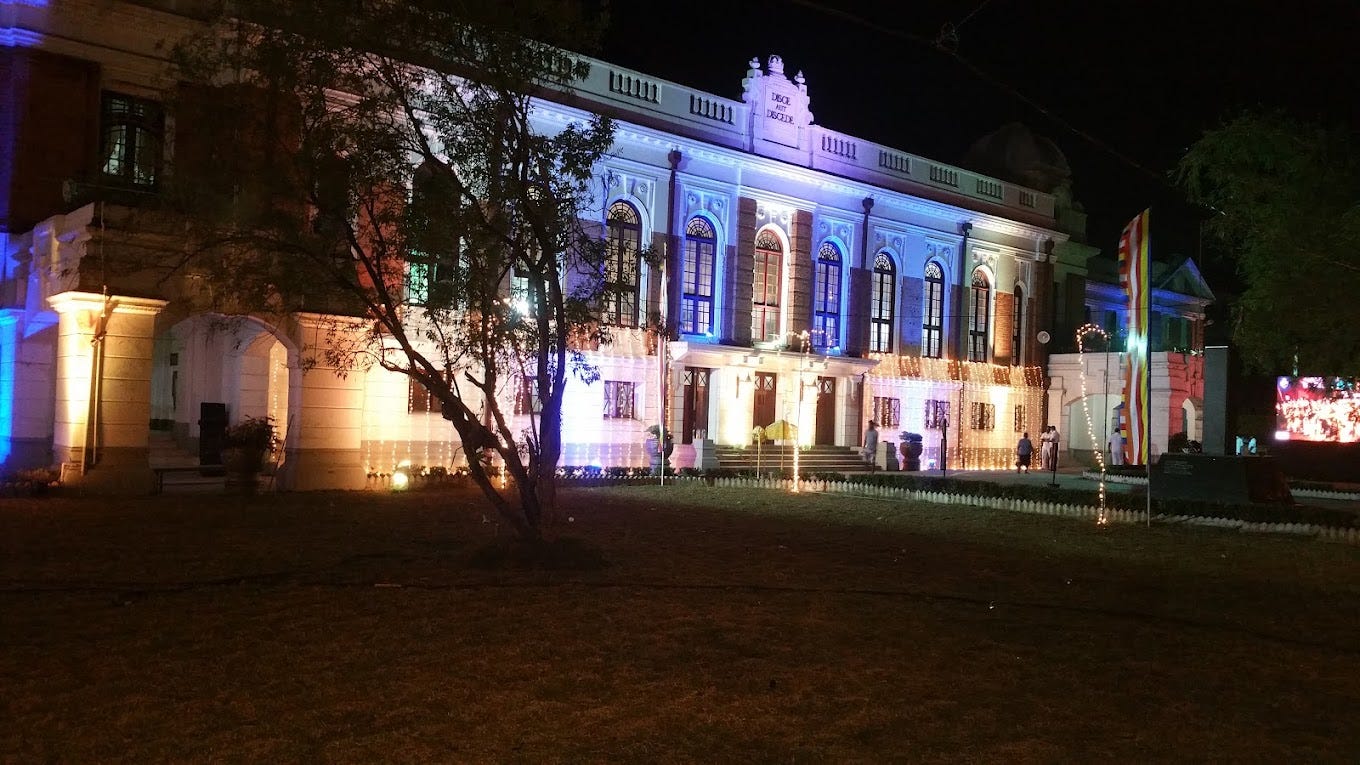
In the main hall of Royal College, under photographs of famous alumni, there are ‘quotable quotes’ neatly etched on long wooden panels. ‘Learning alone is imperishable,’ is one I remember.

I must have been around six or seven when I first read that line. My brain gathered it as a recommendation for self-study, although it didn’t register in those very words. It took some years for me to understand that it was a line that privileged learning over everything else, at least in the matter of perishability.

It took several decades more for me to understand that the claim was time-bound. We learn, we forget, we learn to forget and eventually it all gets scrambled in infirmity and disappears with death. Learning, however, is valuable, and even though value is subjective we could think of things wholesome rather than things that are not.


Learning can be of many kinds but that which arguably the most worthwhile is that which can also be called wisdom. What is wisdom, though? The ability to discern, one might say. The Buddha speaks of eight requisite conditions which ‘lead to the acquiring of the as-yet-unacquired discernment that is basic to the holy life, and to the increase, plenitude, development, & culmination of that which has already been acquired,’ in the Pañña Sutta or the Discourse on Discernment. The qualifier is ‘holy life,’ but they are not entirely inapplicable or irrelevant to life that is, say, secular. Let’s consider.

First, the Buddha says, is apprenticeship, where one learns from or with, respectively, a teacher or a fellow traveler with whom one has established a strong sense of common purpose marked by respect. A learning environment, then.

The second refers to seeking. The student will approach the teacher and seek clarification whereupon the teacher will ‘reveal what is hidden, make plain what is obscure, and dispel perplexity.’

Third, the Buddha says, is seclusion in mind and body. These are not easily obtained in the rush of the diurnal, but neither are they forbidden nor impossible, at least in time fragments even in the midst of duty, responsibility and must-do.

Virtuous, one should be, so the Buddha advocates. It is recommended that the student ‘dwells retrained in accordance with the patimokkha, consummate in behaviour and sphere of activity.’ Now patimokkha is a foundational code of monastic discipline comprising a set of rules for monks and nuns. Cannot a lay person, then, adhere to them? Probably not in the strictest terms. On the other hand, such behaviour and relevant spheres of activity can be aspired to, rehearsed and acquired at least in part.

Retention is the fifth: it is recommended that the student listens to often, retains, discusses, accumulates, examine with mind and penetrate in terms of views, ‘whatever teachings are admirable in the beginning, admirable in the middle, admirable in the end, that — in their meaning and expression — proclaim the holy life that is entirely complete and pure.

Next is persistence. The student is steadfast, solid in effort, and devoted to acquiring and maintaining wholesome mental qualities.

The seventh alludes to choice in the matter of conducting oneself when among the Sangha : the Buddha recommends that the student exercises circumspection, taking care not to speak of anything and everything but focus instead on the subject of the Dhamma.

What is the eighth? Focus. The student is asked to ‘focus on arising and passing away with regard to the five aggregates; form (rupa), feeling (vedana), perception (sanna), mental formations (sankhara), and consciousness (vinnana).’

Where such conditions are met or strived for, one is in a truly learning situation, ready to acquaint oneself with the eternal verities. Wisdom, in a word.

Is it perishable or not? As mentioned, time takes away that which is acquired, knowledge and wisdom included. Things arise, they’d decay and they perish. What is imperishable until enlightenment is achieved, though, is karma; it follows just as the wheels of a cart follow the footsteps of the ox pulling the cart. Or so, Buddhists believe.

We could shelve karma for the moment. We could talk of ‘this side of the inevitable decay of body and mind’ The Pañña Sutta is certainly applicable even in that region. It is worth reflecting on if learning, imperishable or otherwise, is valued.


[This article was published in the Daily News under the weekly column title 'The Recurrent Thursday'] 

19 July 2014

Because my days are numbered…

Years ago, at a preliminary round of a junior best-speaker contest, Suresh De Mel spoke of his ambition. He wanted to be an accountant.  The reason was ‘fascination with numbers’.  He went on to enter university after studying in the Mathematics stream and later re-invented himself as an economist. He was and I believe still is teaching in the Economics Department at Peradeniya.

Numbers are fascinating things.  I have written this before; i.e. how my friend Ravi Arulnandy, when invited to watch a sunset from the Sports School of the Ministry at Independence Square, watched for a few seconds and muttered ‘I see beauty in other things.’ When asked to elaborate, he said ‘numbers’.  I suppose in any society there are number-fascinated individuals. They become mathematicians, accountants, engineers, economists, statisticians and others whose lives are made of numbers and equations. 

I like numbers. Always did.  I liked numbers so much that I believed at the age of 15 that I could not like anything more. So I opted to enter the maths-stream for my A/Ls.  It took me a year to realize that I liked other things more.  My mother, in her greater wisdom, told me to do the exam once and then switch to arts.  I passed, barely, but well enough to qualify for admission to read for a degree in the physical sciences, but fortunately or unfortunately had already decided to sit for the A/Ls the next year in arts.  So I entered the Arts Faculty, Peradeniya.  The interest in Mathematics did not subside, for I selected Pure Mathematics as a ‘Main Subject’ for the General Arts Qualifying Exam. It was a lonely time since I was the only student and unlike parallel students in Science Faculty (who had to sit the same paper) did not have access to the bright-sparks who would complete the tutorials and then tutor their fellow-students. 

I still like numbers.  Last night I wondered what the source of this interest was.  Several hours later, I don’t have a clear answer.  The exercise, however, yielded some unforgettable teachers. 

Being a second child helped, I think.  No one asked me to learn the multiplication tables.  No one asked much about anything, come to think of it.  I am not sure if that was good or bad.  I learnt the multiplication tables and began to see patterns. I picked up a lot of short cuts, not because I wanted to but because I was lazy and preferred play to study.  I just wanted to get books and school out of the way as quickly as possible. Everyday.  I went to school because ‘school’ meant ‘interval’. 

I still remember, though, how I learnt the multiplication tables.  I walked to the particular set of numbers.  If it was the 7-times table that I was working on, I would take one step and think ‘seven’ and would not keep the next unless I got ‘14’ right.  It was like that going up staircases and coming down, even if I was in a rush.  ‘Rush’ forced me to think quickly.  It must have been some variant of the Obsessive Compulsive Disorder.  In later years I would try to calculate the digital root of number places, especially before we got ‘English Numbers’ and other such games. I’ve led a pretty boring life, I know.

Mrs. Rajapaksa and Mrs. Chandraratne (Grade 1 and 2 respectively) must have taught me to write numbers.  I owe them. Mrs. C. Liyanagama was a meticulously neat teacher. Grade 3. She made numbers look like beautiful pictures. I owe her.  Mrs. Palihawadana (Grade 4) was interested in speed. I owe her. Mrs. Tillakaratne (Grade 5) was obsessed with her class producing the best results at the Scholarship Exam. She succeeded. I owe her.  Mr. George Liyanage was strict. Too strict.  Terrified me. I floundered. Lost all interest in Mathematics.  I owe him too for I learnt how not to teach.  Mr. Cooray (Grade 7) had no chance, for by that time I had given up on Mathematics as well as education.  I got 17 in the mid-year test.  Mrs. Sita Weerasooriya who had marked the year-end papers of that class for some reason, and knowing I was the son of a fellow-teacher, checked my score. She was horrified to find I had scored ‘only’ 42. I remember grinning and telling her ‘Madam, that’s very good, I got just 17 in the mid-year test’. 

Mr. Upali Munasinghe changed it all.  He taught as though he was teaching a Grade 1 student.  Two years plus extra lessons at home (he used to stay with us on cricket-practice days; he was master-in-charge, Under 13 cricket) revived an interest and turned it into a fascination.  Mr. Nelson Fernando (Grade 10) had his own methods and was a very effective teacher. He ironed out the crumpled corners of the mind.  As did Mr. Appuhamy, a teacher at St. Anne’s, Kurunegala, who taught my brother and I when we spent our school vacations at our grandparents’ house in Malkaduwawa.  I am indebted beyond words to all three.

Mr. Dayaratne (Pure and Applied Maths) turned a sagging interest in the A/L exam into a more committed exercise that produced a ‘C’ out of a sure ‘F’.  Mrs. Munasinghe (tuition teacher) turned that ‘C’ into a ‘B’ the following year (I took Pure Mathematics along with 3 Arts subjects).  I owe them both for helping me enter university. My last formal mathematics teacher was Mr. Kasturiarachchi, who had just graduated from the Peradeniya Science Faculty and taught me GAQ Mathematics.  I tortured him because classes were at 1.30 every day of the week and he had to come all the way to Polgolla from Peradeniya and invariably teach a drowsy student whose fascination with numbers was considerably deadened by fascination with other things.  I owe him.

And now, totally out of ‘mathematics’, I am taught by my two little girls, 10 and 7 years of age. They teach me how to help them. I owe them too. 

My days are now numbered, I know this. I need to say my thank-yous  before it is too late.  And in these words of gratitude for making numbers please me in so many ways, I am tormented by one lack: the inability to quantify my thanks.  My older daughter asked me what ‘infinity’ is. I went into the etymology of the word. She was fascinated.  Some things are unquantifiable. That’s my last ‘mathematics’ lesson and everyone mentioned above contributed to this ‘learning’.  Mr. Munasinghe is no more.  So too Mr. Appuhamy. I’ve lost the addresses of all the others mentioned.  Makes me sad. 


msenevira@gmail.com

First published in February 2011 in the 'Daily News'

22 January 2014

Recollections of the ‘Battle of Kings’


‘Battle of the Kings’ is the annual inter-school chess championship organized by the Royal College Chess Club.  It will be held for the 18th successive year at Royal College on January 24-26, 2014

It is not a battle of kings, contrary to the claim embedded in the name of the tournament.  It’s a battle of knights and bishops, pawns and rooks.  And who can forget the queens?  It is also a battle of princes and princesses, ladies-in-waiting and pawns that will not reach the 8th rank.  It is a battle where some players don’t actually sit at a table and ponder 64 squares over a couple of hours or longer.  That’s my recollection of this tournament.

I remember the first organizers. I know the organizers of this year’s event and the dozens who have toiled to make the tournament a success over the last 18 years. There were always committed, energetic and enthusiastic senior players. There were younger players who were roped in for specific tasks.  And there was an army of old boys on call to chide, guide and encourage.  It’s an event that turned followers into leaders and leaders into better decision-makers. 

It was not easy for the organizers because they were challenged to do better than those who came before and to make it harder to beat by those who follow.  By and large, the boys of each era have done well.  The increasing popularity of the tournament testifies to the fact that each year something new is added.  In fact, the college hall cannot accommodate all the schools any more. 

Today there are many similar tournaments organized by other schools.  This, however, has stood the test of time.  It is the longest running annual chess event organized by a school.  That says a lot about popularity.  The success is also remarkable considering the fact that today there is no lack of chess tournaments in the country.  Apart from the regular tournaments in the national calendar organized by the Chess Federation, there are many international tournaments held throughout the year in Sri Lanka.  In addition, many young players take part in age-group events overseas.  Despite all this, the ‘Battle of Kings’ still records good representation from all parts of the country. 

Most heartening for me is the fact that apart from Royal most of the winners have been from schools outside Colombo. From the earliest days of chess that I remember, we at Royal were not only aware of the privileges that accrue from the fact of being students of the school, but the responsibilities therein.  Chess players in particular have always felt a need to do what is possible to lift the game in schools outside Colombo and in less privileged schools in the Province.  ‘Battle of Kings’ is only one initiative among many in this regard.  The Club has organized many workshops and many players, after leaving school, have ended up coaching in other schools. 

Looking back at the years gone by, as the organizers no doubt would readily acknowledge, the old boys have been a key source of strength.  Quite apart from providing guidance and encouragement, many have played a hands-on role in this event.  One cannot forget, for example, the contribution of Dr P.P.R. Perera, one of the best arbiters I’ve encountered.  PPR, as he has always been known, ever since he first represented the junior team in 1991, was firm and fair.  Jayendra de Silva has been equally strong by PPR’s side.  Together they helped conducted many a tournament where no one could complain about any untoward incident that marred the spirit of the game.  From the moment the tournament begins to the awarding of medals and trophies, these two were not recognizable as ‘Royalists’.  They were officials.  No, they were rare officials because they did not bring school tie or any other loyalties to the job at hand.

Muditha Hettigama was different.  A former captain, National Champion and the longest serving chess coach at Royal (he might even be the longest serving coach in any sport in the school – someone should check it up!), Muditha had clocked years of service to his school and in particular chess at Royal.  Royal has the best trophy cupboard among all schools in the island when it comes to Chess.  That’s thanks to Muditha, more than anyone else. 

His focus has always been the school and therefore the team.  Royalists, as individuals, have not exactly swept away medals and trophies on offer at national events. On the other hand, those individuals who have done that don’t have much to say about the teams they represented while at school.  If any school has a boast equal to or better than Royal’s it would be Girls High School, Kandy. Interestingly, that too is because of a dedicated coach, Sarath Eriyagama. 

Muditha is unarguably the best coach of school teams around.  He knows how to identify talent and identify strengths and weaknesses among that identified talent.  He not only makes them better players but shows them how to stand alone on their own feet and improve their play.  He inculcates in his charges solid values.  These remain long after they move from chess to other things in life.  I’ve seen this.  The best chess players that Muditha has coached are also really good human beings whose lives are marked by amazing generosity and a definite slant towards what is right, what is just. 

Muditha, through all these years, is the uncelebrated personality whose touch has made this event what it is. His fingerprint is on all elements of the entire process, from inviting schools to how the prize giving is conducted.  And all that falls between these. 

So this ‘Battle of Kings’ is a lot of things to me, as you can see.  The organizers do a lot to make it special for everyone and I have no doubt that each player, teacher, coach and parent will take away some special thought from the event.  The boys do their best.  I think they deserve a salute now and then.  I haven’t contributed much all these years, so saying ‘thanks and keep it up’ is the least I can do.

Malinda Seneviratne is the Editor-in-Chief of 'The Nation' and can be contacted at msenevira@gmail.com

29 September 2011

The Group of ’72 won it all on a mystic Sunday

Gatherings of old friends is always nice, even if what occasioned the meeting happened to be something as somber and sad as a funeral.  My friend Janaka Perera’s father passed away last Saturday and as is often the case when someone close to someone close dies, close-people drop by, commiserate and help in whatever ways possible. 
There were lots of school friends who’ve known each other for more than forty years and some who I hadn’t met in decades.  Time passes, the world moves and when we move out of classroom and school to scatter like so much pollen in the winds of our aspirations and the water-movement of our circumstances.  Saturday night was for reminiscing.  Sunday night was also for reminiscing and of course chit-chat about random topics, re-telling of old jokes, political discussions, and the aa-giya (coming-going, literally and metaphorically) thorathuru or news of post-school lives. 
Sandwiched between night and night was a long morning and afternoon.  It was one of those annual events that I attend every 4-5 years or so: the inter-batch 6-a-side cricket tournament for old boys of my school.  There were two categories, Under 40 and Over 40.  Our batch had won both events on numerous occasions, but this was not our day; we were knocked out in the first round itself.  This didn’t dent the enthusiasm. In fact it only enabled more revelry outside the boundary line. 
I got there rather late in the day but was privileged to watch the semi-finals and the final.  I believe the Group of  2001 won the Under 40 event.  The ’88 Group won the Over 40 version, I believe for the 3rd successive year.  To my mind, however, it was the Group of 72 that won it all.  More than ten years younger than the eventual winners, they saw off younger and clearly fitter teams in the earlier stages by sheer determination and team spirit.  They were bludgeoned in the finals and yet held their heads high. 
In an event made for big hitters and wicket-takers (I saw some batsmen hitting 3-4 sixers an over and a bowler who took a hat-trick), it was a fielder who impressed me most.  Susil Ranasinghe, was ragged by some exquisite batsmanship.  He was fielding at the cover boundary and had to cover about 40% of the field.  A late cut would send him scurrying to the fine leg fence.  The next would be a scintillating cover drive that took him half way to the long off end of the field.  The next would be another late-cut.  These shots were so well timed that Susil couldn’t save any of them.  And yet, he fought ball and speed and of course age to give it all he had.  He was, for me, the man of the tournament.
And so they lost.  They congratulated the winners and came off the field faces flushed and full of smiles.  They mingled with batchmates and schoolmates from their time and other eras.  And Udaya Abeysekera sang.  He sang Rookantha’s ’As deka piyaana nidaa ganna mata bae’ (I cannot close my eyes and fall asleep), Jothipala’s ‘Kothenaka hitiyath…’ (Wherever you may go) and Milton Mallawaarachchi’s ‘Avasara netha mata’ (I don’t have the right…).  Beautifully rendered.  No, I didn’t think he has missed his true vocation.  It was as it should be.  The right thing for the right moment. 
I am not saying that the winners lacked spirit or were underserving of trophy, but there was something gentle, giving and just-being about the ’72 Group that touched; a kind of wrapping paper to a gift that was being accepted after many years. 
Was it all about the particular school?  I don’t think so.  All intersections move us, although in different ways.  It was a kind of re-birthing of memory and times gone by.  And through it all, I remembered Janaka and the fracture he suffered from which he won’t recover easily. 
It was a strange weekend, all things considered.   We are nothing, alone, I realized.  And we can be so much, together, I also felt. 

30 August 2011

I remembered Mr. Upali Munasinghe

I’ve communicated for some time now with Anura Buthpitiya, an ex-Naval Officer now working overseas.  A voracious reader on all subjects, he finds time to read what I write too and even comment occasionally.  I met him for the first time a few days ago at his residence in Athurugiriya.  He had invited a couple of old friends, Priyantha Weerasinghe and Vajira Kasturiarachchi, who had been with him at Ananda College from Grade 3 or 4.  There was a lot to talk about and much reminiscing too.
Among the topics that came up was the switch to Sinhala.  They were the first ‘swabhasha’ batch of students, apparently.  The conversation meandered to teachers.  One Mr. Thanabalasingham was mentioned.  ‘One of the best English teachers,’ Anura said.  Teaching skills as well as commitment to vocation was mentioned.  Reminded them of another teacher:  C.M. Weeraratne, who had been the Vice Principal at Ananda.
‘One of the best Maths teachers!’ Anura opined.
‘What do you mean “one of the best”?  He was The Best!’ Priyantha interjected. 
We spoke about teachers and how they are remembered.  And how they are forgotten.  I observed that people tend to attribute success to a lot of things but remember teachers last.
‘That’s wrong, we owe everything to teachers!’ 
It was late, so I left.  All the way back from Athurugiriya to Mattegoda, I thought of teachers and among my teachers, the one who made mathematics fascinating for me.  Upali Munasinghe. 
He was my Grade 8 class teacher.  He was also the Master-in-Charge of Under 13 cricket.  He lived in a place called Gonaduwa.  There weren’t many buses going that way during those days in the late seventies.  If he got late after cricket practices, ‘Upali Sir’ would get off at Pamankada and stay at our place. 
The man loved to teach.  He would tutor us (my brother and I to begin with and later our sister).  The previous year (Grade 7) I had scored 17 and 42 at the Mid-Year and Year-End exams respectively.  He turned things around.  In school, he taught us from scratch, ensuring that those who had for whatever reason lagged behind were able to catch up and follow the lessons as they got more complex.  It was very simple because he started from the simplest examples and gradually worked towards the more difficult exercises, making sure that everyone was on the same page.  My performance, like those of my fellow students and my siblings improved remarkably, so much so that I was fooled into thinking that ‘Mathematics’ was made for me and vice versa. 
At the age of 15, I was not in a position to figure out what would sustain my interest.  It took me a year into the A/L to realize that as much as I liked numbers, I liked literature and social sciences more.  It was however thanks to Mr. Munasinghe that I remained in the Mathematics stream for the A/Ls and in the following year, when I switched to ‘Arts’, retained Pure Mathematics as a subject.  It is because of him that I opted to take Pure Mathematics as a ‘Main Subject’ in my first year in the Arts Faculty, University of Peradeniya.
That was not the time to think about extra exams, but he got my brother and I to sit for the ‘Old O/L’ exam (Pure Mathematics).  We both got distinctions and that’s because of his effort, mostly.  It was fun and neither of us complained.  Neither were we upset about the encroachment into ‘free time’ which could be spent flying kites or playing cricket and French cricket. 
Upali Munasinghe was single.  He opted to remain so, because he was devoted to his mother, whom he looked after until she passed, I believe in her late eighties or early nineties.  By that time he was past marrying age.  He was devoted to his vocation, like Mr. Weeraratne, I am sure.  He just wanted his students to do well. 
It was the same in the cricket field.  Back then there were no assigned coaches.  The senior boys helped.  Upali Sir knew enough cricket to handle the coaching at that level.  He attended every practice session of all three teams he was in charge of.  That was a tragic year.  One of the most talented cricketers, Harith Nanayakkara, who played in the Under 15 ‘A’ team at the age of 11 and was the automatic choice for the captaincy of the Under 13 ‘A’ Team, was hit by a vehicle when he was crossing the road, returning after the first match of the season.  Harith had been a step ahead of Upali Sir.  He had seen it all.  The boy spent a few days in the Intensive Care Unit and succumbed to his injuries. 
I still remember Upali Sir addressing the ‘B’ team just before the toss of their first match.  He reminded us that it was the first match following Harith’s tragic death.  It was the first time I saw a teacher cry.  It shook me all the more because Upali Sir was not one who wore his emotions on his face.  He was strict.  Although he was a close family friend since he stayed at our place quite often and was a colleague of our mother, who also taught in the same school, Upali Sir didn’t treat us differently.  We were all students. All children.  I was too young then, however, to understand what those tears meant and why he choked over the words.  I am old enough now to understand how soft this man who looked so stern that students fell silent whenever he appeared anywhere, in the school corridors or in the playing field. 
Years later, as is always the case with special teachers, he became friend.  Even though he was such a huge influence and therefore a giant, he treated me as an equal.  I had no hesitation in inviting him to sign as witness when I got married. 
He died a few years ago, in Gonaduwa, as he was about to take medicine for a heart condition.  It had been a matter of a few seconds.  A simple man. Few wants.  Gave so much and asked for nothing in return.  Always, always neatly dressed.  A no-nonsense teacher who, simply by doing his job and being an exemplary human being, made the world a little better. At least for me. 
We all know of an Upali Munasinghe.  A Mr. Thanabalasingham and a Mr. Weeraratne.   Let us take a moment.  Let us honour them with a moment’s silence.  Let us be better than we are, by way of making tribute meaningful.