Showing posts with label Cardinal Malcolm Ranjith. Show all posts

21 April 2023

The immovable feast cooked in Easter fires


Over the last 24 years, Easter Sunday has been celebrated on various days, from the 23rd of March to the 5th of May. It is then a movable holiday or, if one wants to be overly technical about it, a movable holy-day given that the word derives from the Old English hāligdæg (hālig ‘holy' + dæg ‘day’).  Not all holidays have anything to do with divinity or religious purpose, but Easter certainly is. In Sri Lanka, however, while the ‘true’ Easter, if you will, is movable, there’s also a political Easter that is not only static but has in fact taken on greater significance. That’s the Easter Sunday of the attacks on several churches executed by…hold you breath…a since hardly-mentioned organisation led by a since-hardly-mentioned man.

April 21, 2019. The audacity of the attacks, the magnitude of the damage caused and the enormity of the tragedy certainly makes casual passover impossible, even though the politics that followed is as unholy as it can get.

So, first of all, a moment of silence.

A moment of silent in memory of those who lost their lives, were injured or who lost loved ones. A moment of silence for members of the clergy (let’s leave the relevant faith and denomination out) who called out for justice quite out of character to the ‘turn the other cheek’ recommendation.

A moment of silence for the perpetrators, the architects of the attack and those who executed them, their backers, apologists and others who through various means ensured that the name of a particular organisation and the names of particular perpetrators of a particular religious persuasion were systematically removed from the discourse on terrorism, truth, justice and retribution.

A moment of silence for whoever first touted the idea of a ‘mahamolakaru’ and all those who turned it into a refrain when talking about the tragedy, tossing around insinuations, tossed out the dictum ‘innocent until proven guilty,’ and proceeded to judge, condemn and execute…no, not the perpetrators, but some who were at worst enables on account of incompetence and negligence.

A moment of silence for the over 700 persons arrested in relation to these crimes, the over 300 enlarged on bail and the over 40 persons on whom 11 indictments have been served.

A moment of silence for those who believe justice was done the day stiff fines were imposed on some people whose ‘crime’ was, as mentioned, of the omission kind; the 'some people,' coincidentally or otherwise, belonging to a particular community which has been considered 'The Enemy' by spokespersons for both the accusing religious community and the religious community which the perpetrators belong to, now and in the long centuries that have passed.

A moment of silence for those whose fixations, ideological and political persuasions and shameless designs to use the Easter Sunday attacks to exact revenge on people they hated for reasons that had nothing to do with the tragedy pushed them to make a mockery of justice, truth and due process.

A moment of silence for selective amnesia. A moment of silence for selective and pernicious targeting. A moment of silence for ignoring the truth and in the process affecting a lovely pass for the religious fundamentalism that was the bedrock on which the attacks were planned and executed.

Those who carried out the attack were of a particular faith. Let’s not name it because that would be unholy. They prayed to an entity they considered divine before embarking on their murderous mission. Indeed they may have uttered the name of this entity at detonation-point by way of consoling themselves that the appreciative omnipotent would arrange a heavenly afterlife for them.

But no, terrorists have no religion. At least that’s the weak and laughable dismissal offered by those who were trigger-happy to attribute to an entire community numbering over ten million the crimes of a handful who happened to belong to that community because of given name, yes, not even close to, say, religious affiliation reverentially obtained and affirmed as was the case of the Easter Sunday terrorists.

Let’s forget all of the above, ladies and gentlemen. Let’s join hands with the vile, revengeful, pernicious, lying and myopic. Let’s form a human chain from Peduru Thuduwa through Colombo, Devundara Thuduwa, Madakalapuwa and back to Peduru Thuduwa.

Let us, in this hand-holding way, express unity in calling upon leaders to render justice to victims and remain conspicuously silent about the names and convictions of those who caused so much grief on that immovable and immutable Easter Sunday in the year 2019 and made us forget THAT resurrection and embraced the resurrection and re-resurrection of deceit and crass politicking in the name of justice and truth.

And let us celebrate the fact that thanks to these devious machinations, we’ve unshackled ourselves from the tyrannies of the Gregorian and Julian calendars. Let us retire prayer. Let us feast to our hearts' content. Tongue-in-cheek of course.

 malindadocs@gmail.com.

 Related Articles 

 Cardinal sins

Zeroing on the 'mahamolakaru' 

Easter Sunday Attacks: negligence and the negligent

Easter Sunday Attacks: Tragedy and Farce

Do the real mahamokalarayas want kangaroo courts and lynching? 

22 November 2021

Cardinal sins


Sometime in the year 2012, Wijedasa Rajapaksha, at the time a UNP Member of Parliament, called for constitutional measures prohibiting clergy from entering Parliament. The target was the Buddhist clergy. If such a measure was legislated it would have barred people like Eran Wickramaratne from contesting elections. Indeed, all those belonging to Christian denominations which take membership as qualification sufficient to preach, would be similarly barred.

It’s a tough question of course. Is politics a no-no for the clergy? If so, would someone please elaborate on what is political and what is not? What’s not tough is to identify the selectivity and therefore the political and ideological frames that lend themselves to posturing on the question of permissibility.

A colourful and maverick (one may argue) politician, recently departed, once claimed that he had taken refuge in the ‘Noble Double Gem.’ He was essentially taking potshots at the Sangharatnaya. A grand generalisation which, one might add, indicated that the man’s knowledge of the Buddhavacana was pretty limited. Makes for interesting conjecture on the truth or otherwise of refuges claimed.

Get to the point, did someone insist? Alright. This is about Cardinal Malcolm Ranjith. The Cardinal has not talked of contesting elections. That doesn’t make him apolitical. Neither does it mean that he is unaware of politics, political affiliations and processes. It doesn’t mean that he is apathetic about outcomes either. He’s no god. He’s a man. He has opinions like anyone else. He probably has outcome preferences as well.  

Did I say ‘probably’? Sorry. There’s no question about it. All one has to do is to map his behavioural patterns since the Easter Sunday attacks.

Cardinal Malcolm Ranjith wants truth and justice. That’s good. One might say ‘that’s all up to the omniscient and omnipotent.’ Indeed he could say and do as appropriate following stated religious convictions, but then he’s a man, let us repeat, and he’s frail therefore. Moreover one can interpret scriptures in many ways and some readings will sanction a more proactive role from the flocks and shepherds. We’ve had ‘liberation theology’ long before the term came into vogue in the political lexicon. The Catholic Church, the Cardinal (and the Pope) would agree, has rarely been apolitical. It has had interests. It has played the role of agent provocateur. And worse! It has, let us not forget, significant economic interests as well.

So. We have Cardinal Malcolm Ranjith in a political avatar, if you will. Nothing wrong with this. However, if that’s the garb he chooses to wear (and that’s his choice for the most part over the past two years, let us not forget), he must be read and judged politically.

The Cardinal may, in private, seek divine revelation and dispensation of justice; in public he doesn’t show any faith in astral entities — he wants here-and-now truth and justice from eminently non-divine institutions, processes and persons. The pruthagjanas. Nothing wrong with that. Legitimate expectations from any citizen who is concerned about such things, one could argue.

Here’s the ‘here’ of it. A presidential commission of inquiry completed a fact-finding mission. It can recommend and recommend it certainly did. The Attorney General was instructed to act upon recommendations, which obviously requires formal investigations. That’s ‘here.’  Over 700 persons were arrested in relation to the attacks, over 300 were enlarged on bail and dozens of others released. We have 11 indictments in which over 40 persons have been named.  ‘Here,’ again.

And that’s where we are ‘now.’ If the Cardinal or anyone else wants instant convictions, that’s downright silly and irresponsible. You can ask for it (you can ask for the moon too, it’s not illegal) but to expect it would be optimistic. You can take the existence of god as a fact but that’s essentially a faith-item. You cannot expect the judiciary to be omnipresent and omnipotent. That’s why we have courts. That’s why we have procedures.

And yet, that’s exactly what the Cardinal seems to be demanding. He’s drawn conclusions but if he were to be put on the stand and made to substantiate claims, he would probably embarrass himself, god help him.

So what does he do? He appeals to the Pope. Now, the Pope, officially, is not only the head of the Catholic Church, he rules Vatican City, which is recognised as a country. The Cardinal may believe that the Pope is the direct communicator with god, but that’s a faith-claim; the citizens of Sri Lanka are not compelled to accept such things; indeed, like the Cardinal, anyone else can make wild guesses about such things, anyone else can be aggrieved (tongue-in-cheek like) that god has failed in delivering the last word on truth and justice with respect to the Easter Sunday attacks. It’s subjective, folks.

The Cardinal has every right to appeal to the superiors in his order. However, only someone who is absolutely ignorant of established procedures would expect the courts to give ear to the head of some religious order located in some other country.  

Why then has the Cardinal a) written to the Pope, b) reveal the fact and c) read out the Pope’s response? To put pressure on the judicial process and the Sri Lankan Government, did someone say? Well, the assumption would be that the government is foot-dragging but that is speculation that is not proven; in fact the evidence is to the contrary. Put pressure on the judicial process? Really? That’s a good thing?

Clearly the Cardinal is on a mission and it’s all about opening doors for outside intervention that has nothing to do with truth and justice related to the Easter Sunday attack. It’s about creating conditions that could be manipulated for changing political realities.

The Cardinal, resplendently attired in his political cassock, recently claimed that those who used the Easter Sunday attack for political gain would have to pay. If he was referring to the results of the last two major elections, that’s thin political commentary. The Easter Sunday attacks did reveal the previous governments incompetence on managing national security, but it’s silly to reduce the election results to this fact alone. We need not elaborate.

On the other hand, it is no secret that there’s unholy fraternising between the Cardinal and key members of an opposition wallowing in political misfortune. The commitment to truth and justice of that lot was pretty evident in the heady days of witch-hunting and kangaroo courts between 2015 an 2019. It looks like the Cardinal isn’t checking credentials here. Indeed, one should not be surprised if he retired that dire warning about retribution if the political landscape was transformed as per his outcome preferences.

In Catholic theology there are sins, some of which are given tags such as ‘cardinal’ and ‘deadly.’ The gravest of sins would be turning away from god and destroying charity/love in the heart of the sinner. A mortal sin would be a drastic act committed in full knowledge of its gravity. They include vainglory, greed, lust, envy, gluttony, wrath and sloth. There are corresponding virtues too: humility, charity, chastity, gratitude, temperance, patience and diligence. The Cardinal would know.

‘Sins’ in ‘Cardinal sins,’ is a verb. An act. There could be commission and omission here. I do not wish to lecture the Cardinal on things ecclesiastical but would humbly submit that the virtue of humility could be affirmed at all times. In the here and now. In fact, ‘always’ wouldn’t be a bad thing either.

malindasenevi@gmail.com. www.malindawords.blogspot.com
[Malinda Seneviratne is the Director/CEO of the Hector Kobbekaduwa Agrarian Research and Training Institute. These are his personal views.]


06 June 2019

The politics of alienation and isolation

And they resigned in solidarity with people accused of Jihaadist association! 

Ajith Fernando, an old friend and an incredibly good and humble human being, got it right when he said, ‘Terrorist don’t win when they manage to kill 200, 300 innocent people. They win when they manage to alienate and isolate the entire Muslim population.’

Now, broadly speaking, there are two ways in which a community can become alienated and isolated. First, if the rest of the population, out of fear, prejudice or for some other reason, conflates that community with the terrorists, in this case the National Thawheed Jamaath (NTJ) or the ISIS or in general terms, the ‘Jihaadists’ (of whom there can be and are many variants), all acting in the name of Allah, the greater Islamic community and as per their reading of the Quran. Secondly, the community can for reasons of security (closing of the ranks so to speak, operating on the notion ‘me against my brother, but my brother and I against others’) or conviction alienate and isolate itself.  Where alienation and isolation do occur we tend to see one of the above two or both in varying degrees of intensity.  

Strangely, in Sri Lanka, at least in views expressed in English, the dominant view is that a) there IS alienation and isolation of Muslims, and b) it is a condition imposed on the Muslims, one in which they have not played any role.  

These views have gained a lot of credence thanks to some very tangential and even pernicious statements. Today we have the US House Committee on Foreign Affairs expressing concerns about ‘the demonizing of Muslims in Sri Lanka’. That’s rich, coming from one of the world’s most racist countries where Muslim-demonization is almost an article of faith. 

We also have Mangala Samaraweera’s multiple tweets: a) ‘Hatred is never appeased by hatred. By non-hatred alone is hatred appease. This is a law eternal.’ Today it was left to our Muslim Ministers to exhibit this sacred teaching of Lord Buddha while imposters in robes incited hatred in his name. A shameful day for our beloved #lka; and b) #Cardinal Malcolm Ranjith fanning the flames of hatred and communalism by visiting fasting robed MP Rathana. #Vatican TAKE NOTE! Perhaps he is feigning ignorance (unlikely) but this is quintessential Mangala: he can’t help attacking the Buddhist Order and the Buddhist community while at the same time sweeping under the carpet the context. One notes that he has never once tweeted about ‘imposters in the clothing worn by Islamic clerics,’ when referring to the NTJ. 

So we have, all of a sudden, a ‘situation’ where the Cardinal is ‘fanning the flames of communalism and racism.’ We have the ‘Muslims being demonized’. Perhaps we should talk of all demonizations and delve into the real demonizers.  

The New York Times quotes Rauff Hakeem, leader of the Sri Lanka Muslim Congress: ‘our people fear a blood bath.’ Existential fears are not the preserve of the Muslim community though: if people are terrified in ways they have not been for 10 years, it is because of the Easter Sunday attacks, carried out, let us repeat, in the name of Allah, with the expressed affirmation of a reading of the Quran and of course the Islamic faith. THAT was a bloodbath (and not FEAR of a bloodbath) Wariness can make people imagine all kinds of doom’s day scenarios. Given the affirmed religious identity of the terrorists, it is not unnatural for people to be wary of that community. 

That said, to use words such as ‘demonization’ and to vilify efforts that seek justice as a means to a quick resolution and thereby the creation of a situation where mutual respect, trust etc., can take root, does not help. In fact it can have the opposite effect. The Buddhist community did not carry out or sanction a terrorist attack. Neither did the Muslim community as a whole. There was an attack that killed hundreds of people; it was not done in the name of the Buddha. If people don’t want a sense of proportion, if they want to play the margins, make mountains out of molehills etc., they are not helping. They are fanning the flames of discontent, they are feeding extremisms.  

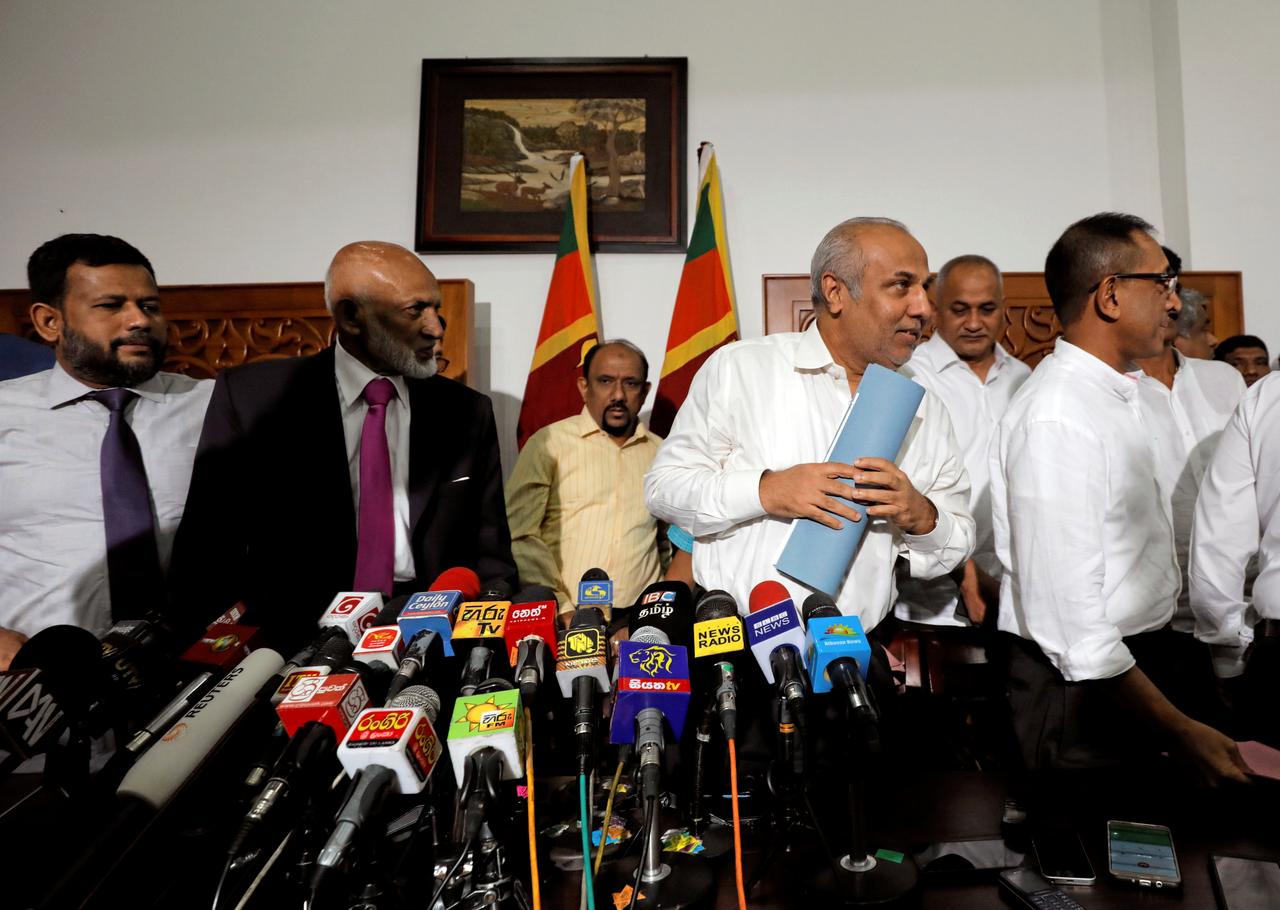
The New York Times news report (‘All 9 of Sri Lanka’s Muslim Ministers Resign as Bombing Backlash Intensifies’) carried the following bylines: Dharisha Bastians and Mujib Mashal. The second, going by name, seems to be a Muslim. The first is the Editor of a state-owned newspaper. Well, no one asked ‘All 9’ to resign. They were not made to resign. They did so of their own accord. That’s not backlash. That’s choice. The NYT has not uttered a word about the tendentious comments made by the three whose eviction was sought nor Bathiudeen’s association with the NTJ. No, but the NYT feels fit to use the title ‘Mr’ when referring to Bikkhus. Bastians, even when she takes issue with him, says Cardinal Malcolm Ranjith and not Mr Malcolm Ranjith. It is disrespectful and odious. It is quite antithetical to the rhetoric of coexistence and reconciliation indulged in by the Government that hand-picked her for a state-sector job.  

What’s the truth here? Here are the facts. First. The call was for the removal of three persons. The resignation of six persons whose removal was not sought in solidarity with three persons who are under a cloud (on account of statements made and close association with terrorist suspects) raises a simple question: identification with that very same ‘cloud’? A wit quipped, ‘if a Parliamentarian is accused of raping a woman and called on to resign or it sought to be removed, should all men resign in solidarity?’ 

They’ve offered an explanation of sorts: it was because they felt that Rathana Thero’s hunger strike had raised fears among their community regarding imminent violence, an explanation which of course helps the ever-ready vilifiers of the majority community.  

This notion has got a bit of carry due to a statement made by Rev Gnanasara Thero of the Bodu Bala Sena (BBS) about serious action to be taken in the event the President did not accede to Rathana Thero’s demands. Gnanasara Thero and the BBS, however, were hardly part of the agitation. Moreover, Salley and Hizbullah are known to have pleased with Maithripala Sirisena to obtain the release of the thero through a presidential pardon. Interestingly, Gnanasara Thero has since castigated Rathana Thero for causing a distraction in the struggle against the struggle to overcome the threat of Islamic extremism!  In any event, translating a peripheral fact into fear-mongering is playing politics, nothing less. Probably, one surmises, in order to congeal a Muslim vote bloc in a future election. 

Second. Rathana Thero’s efforts, as mentioned above, drew the support of all communities, Muslims included. Sure, there were a lot of snide comments about Rathana Thero joining Muslims in their fast with hardly any comments on his demands or the context in which they were made, but there were many who were in complete agreement with the Thero’s position.  There was absolutely no conflation of Muslims and the Jihaadists. Cardinal Malcolm Ranjith in supporting the Thero put the full weight of the Catholic Church behind the effort. Tamil politicians joined the fast. In short there was solidarity of the kind rarely seen in recent times for protests of this kind.

Third. There is a strange reluctance to address the real and terrible threat to all Sri Lankans: jihaadist terrorism. Nothing has threatened to tear this country apart and rendered the entire citizenry vulnerable in the last ten years as the Jihaadist attacks. That threat is real. The entire drama about some kind of Sinhala Buddhist ‘backlash’ is in this context a distraction. It plays into the hands of the Jihaadists. 

What can one expect to happen when the terrorists are spoken of in tokenist terms or ignored altogether and at the same time those who have not conflated terrorists and the community they belong to are vilified, just because they happen to belong to a majority community? Is that not pernicious conflation? Does it not alienate Sinhalese and Buddhists? And if and when that happens, would you expect Sinhalese and Buddhists to pretend to be asleep or unconscious? 

Well, that’s what one can call the ‘Mangala Sutra’, ‘Mangala’ as a symbol and representative of all those whose passion has been to vilify the Sinhala Buddhists. Well, now it seems that this phenomenon can be trumped by what one may call the ‘Rathana Sutra’ but only if Ven Athureliye Rathana Thero says a lot of things, which need to be prefaced as follows: 

‘The greatest threat to unity, reconciliation, co-existence and peace among all communities, at this particular moment is Islamic extremism. The people must unite to fight this threat. However, we must not forget that if we do not do our utmost now and always to make sure that everyone feels safe, if we do not protect one another, if we directly or indirectly feed other extremisms, this task will only become that much more difficult.’  

Yes, Ajith Fernando has raised a pertinent point. Isolation and alienation never helps. Let us not push anyone or let anyone push us to such dreadful places.

malindasenevi@gmail.com