Showing posts with label Ven. Athureliye Rathana. Show all posts

06 June 2019

The politics of alienation and isolation

And they resigned in solidarity with people accused of Jihaadist association! 

Ajith Fernando, an old friend and an incredibly good and humble human being, got it right when he said, ‘Terrorist don’t win when they manage to kill 200, 300 innocent people. They win when they manage to alienate and isolate the entire Muslim population.’

Now, broadly speaking, there are two ways in which a community can become alienated and isolated. First, if the rest of the population, out of fear, prejudice or for some other reason, conflates that community with the terrorists, in this case the National Thawheed Jamaath (NTJ) or the ISIS or in general terms, the ‘Jihaadists’ (of whom there can be and are many variants), all acting in the name of Allah, the greater Islamic community and as per their reading of the Quran. Secondly, the community can for reasons of security (closing of the ranks so to speak, operating on the notion ‘me against my brother, but my brother and I against others’) or conviction alienate and isolate itself.  Where alienation and isolation do occur we tend to see one of the above two or both in varying degrees of intensity.  

Strangely, in Sri Lanka, at least in views expressed in English, the dominant view is that a) there IS alienation and isolation of Muslims, and b) it is a condition imposed on the Muslims, one in which they have not played any role.  

These views have gained a lot of credence thanks to some very tangential and even pernicious statements. Today we have the US House Committee on Foreign Affairs expressing concerns about ‘the demonizing of Muslims in Sri Lanka’. That’s rich, coming from one of the world’s most racist countries where Muslim-demonization is almost an article of faith. 

We also have Mangala Samaraweera’s multiple tweets: a) ‘Hatred is never appeased by hatred. By non-hatred alone is hatred appease. This is a law eternal.’ Today it was left to our Muslim Ministers to exhibit this sacred teaching of Lord Buddha while imposters in robes incited hatred in his name. A shameful day for our beloved #lka; and b) #Cardinal Malcolm Ranjith fanning the flames of hatred and communalism by visiting fasting robed MP Rathana. #Vatican TAKE NOTE! Perhaps he is feigning ignorance (unlikely) but this is quintessential Mangala: he can’t help attacking the Buddhist Order and the Buddhist community while at the same time sweeping under the carpet the context. One notes that he has never once tweeted about ‘imposters in the clothing worn by Islamic clerics,’ when referring to the NTJ. 

So we have, all of a sudden, a ‘situation’ where the Cardinal is ‘fanning the flames of communalism and racism.’ We have the ‘Muslims being demonized’. Perhaps we should talk of all demonizations and delve into the real demonizers.  

The New York Times quotes Rauff Hakeem, leader of the Sri Lanka Muslim Congress: ‘our people fear a blood bath.’ Existential fears are not the preserve of the Muslim community though: if people are terrified in ways they have not been for 10 years, it is because of the Easter Sunday attacks, carried out, let us repeat, in the name of Allah, with the expressed affirmation of a reading of the Quran and of course the Islamic faith. THAT was a bloodbath (and not FEAR of a bloodbath) Wariness can make people imagine all kinds of doom’s day scenarios. Given the affirmed religious identity of the terrorists, it is not unnatural for people to be wary of that community. 

That said, to use words such as ‘demonization’ and to vilify efforts that seek justice as a means to a quick resolution and thereby the creation of a situation where mutual respect, trust etc., can take root, does not help. In fact it can have the opposite effect. The Buddhist community did not carry out or sanction a terrorist attack. Neither did the Muslim community as a whole. There was an attack that killed hundreds of people; it was not done in the name of the Buddha. If people don’t want a sense of proportion, if they want to play the margins, make mountains out of molehills etc., they are not helping. They are fanning the flames of discontent, they are feeding extremisms.  

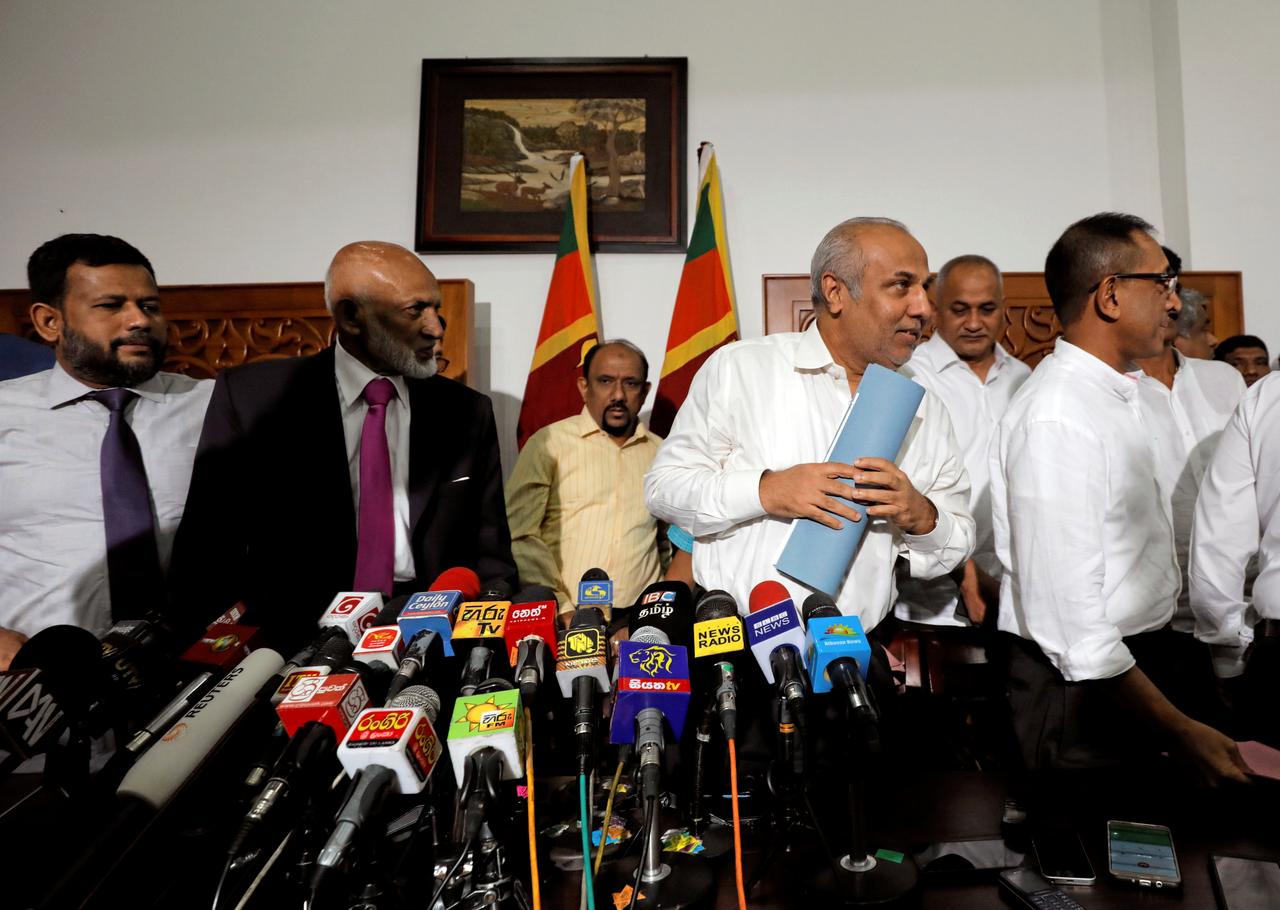
The New York Times news report (‘All 9 of Sri Lanka’s Muslim Ministers Resign as Bombing Backlash Intensifies’) carried the following bylines: Dharisha Bastians and Mujib Mashal. The second, going by name, seems to be a Muslim. The first is the Editor of a state-owned newspaper. Well, no one asked ‘All 9’ to resign. They were not made to resign. They did so of their own accord. That’s not backlash. That’s choice. The NYT has not uttered a word about the tendentious comments made by the three whose eviction was sought nor Bathiudeen’s association with the NTJ. No, but the NYT feels fit to use the title ‘Mr’ when referring to Bikkhus. Bastians, even when she takes issue with him, says Cardinal Malcolm Ranjith and not Mr Malcolm Ranjith. It is disrespectful and odious. It is quite antithetical to the rhetoric of coexistence and reconciliation indulged in by the Government that hand-picked her for a state-sector job.  

What’s the truth here? Here are the facts. First. The call was for the removal of three persons. The resignation of six persons whose removal was not sought in solidarity with three persons who are under a cloud (on account of statements made and close association with terrorist suspects) raises a simple question: identification with that very same ‘cloud’? A wit quipped, ‘if a Parliamentarian is accused of raping a woman and called on to resign or it sought to be removed, should all men resign in solidarity?’ 

They’ve offered an explanation of sorts: it was because they felt that Rathana Thero’s hunger strike had raised fears among their community regarding imminent violence, an explanation which of course helps the ever-ready vilifiers of the majority community.  

This notion has got a bit of carry due to a statement made by Rev Gnanasara Thero of the Bodu Bala Sena (BBS) about serious action to be taken in the event the President did not accede to Rathana Thero’s demands. Gnanasara Thero and the BBS, however, were hardly part of the agitation. Moreover, Salley and Hizbullah are known to have pleased with Maithripala Sirisena to obtain the release of the thero through a presidential pardon. Interestingly, Gnanasara Thero has since castigated Rathana Thero for causing a distraction in the struggle against the struggle to overcome the threat of Islamic extremism!  In any event, translating a peripheral fact into fear-mongering is playing politics, nothing less. Probably, one surmises, in order to congeal a Muslim vote bloc in a future election. 

Second. Rathana Thero’s efforts, as mentioned above, drew the support of all communities, Muslims included. Sure, there were a lot of snide comments about Rathana Thero joining Muslims in their fast with hardly any comments on his demands or the context in which they were made, but there were many who were in complete agreement with the Thero’s position.  There was absolutely no conflation of Muslims and the Jihaadists. Cardinal Malcolm Ranjith in supporting the Thero put the full weight of the Catholic Church behind the effort. Tamil politicians joined the fast. In short there was solidarity of the kind rarely seen in recent times for protests of this kind.

Third. There is a strange reluctance to address the real and terrible threat to all Sri Lankans: jihaadist terrorism. Nothing has threatened to tear this country apart and rendered the entire citizenry vulnerable in the last ten years as the Jihaadist attacks. That threat is real. The entire drama about some kind of Sinhala Buddhist ‘backlash’ is in this context a distraction. It plays into the hands of the Jihaadists. 

What can one expect to happen when the terrorists are spoken of in tokenist terms or ignored altogether and at the same time those who have not conflated terrorists and the community they belong to are vilified, just because they happen to belong to a majority community? Is that not pernicious conflation? Does it not alienate Sinhalese and Buddhists? And if and when that happens, would you expect Sinhalese and Buddhists to pretend to be asleep or unconscious? 

Well, that’s what one can call the ‘Mangala Sutra’, ‘Mangala’ as a symbol and representative of all those whose passion has been to vilify the Sinhala Buddhists. Well, now it seems that this phenomenon can be trumped by what one may call the ‘Rathana Sutra’ but only if Ven Athureliye Rathana Thero says a lot of things, which need to be prefaced as follows: 

‘The greatest threat to unity, reconciliation, co-existence and peace among all communities, at this particular moment is Islamic extremism. The people must unite to fight this threat. However, we must not forget that if we do not do our utmost now and always to make sure that everyone feels safe, if we do not protect one another, if we directly or indirectly feed other extremisms, this task will only become that much more difficult.’  

Yes, Ajith Fernando has raised a pertinent point. Isolation and alienation never helps. Let us not push anyone or let anyone push us to such dreadful places.

malindasenevi@gmail.com


26 January 2017

Don't underestimate Ven Athureliye Rathana Thero


Ven Athureliye Rathana Thero, quite silent and almost a non-factor in the public domain for almost a year, made the headlines of all national newspapers last week.  ‘Rathana Thero goes independent,’ or versions of this, made the headlines.  The truth is that Rathana Haamuduruwo had already been made independent.  He had been unceremoniously evicted from the Jathika Hela Urumaya.  Although a national list MP of the United National Party(UNP), it is no secret that he does not identify with that party.  Although close to President Maithripala Sirisena, he has no truck with the Sri Lanka Freedom Party.  The JVP doesn’t consider him a friend.

It was almost as though the obvious was being stated.  Rathana Haamuduruwo has since stated that he will support the government.  The JHU has called for his ouster from Parliament.  What happens next, no one knows.  Some insights into the haamuduruwo’s character, going by his history, might help infuse some reason into conjecture.

One Wednesday afternoon in early April 2001, while making my way from Town Hall to Jayasekeraramaya (Kuppiyawatte Pansala), I came across a small crowd of people staring in shock and horror at the Punchi Borella bo tree.  Mangala Samaraweera, then a minister of the People’s Alliance government headed by Chandrika Kumaratunga had ordered the half-wall surrounding the tree to be demolished.  There was debris all over the place.  The intent, according to reports, was to remove the bo tree, supposedly to alleviate traffic congestion.  No warning.  No explanation.  Just a bulldozing with scarcely a concern for hurting the sentiments of Buddhists. Strange for a man and a colleague of others who then and now preach ‘reconciliation’ and demand ‘sensitivity’ from Sinhalese and Buddhists.

I proceeded to the temple where Ven Athureliye Rathana Thero (then of the Sihala Urumaya) was to explain the Satipattana Sutta to a few of us as he had every Wednesday morning for several weeks.  I reported what I saw and that signaled the end of the ‘class’ for that day.  Rathana Thero took off.  Anuruddha Pradeep Karnasuriya, now a senior lecturer in Political Science at Jayawardenapura University and a spokesperson for the Jathika Hela Urumaya told me (in Sinhala), ‘the haamuduruwo will be standing on a barrel and making a speech in a few minutes’.  

There was no barrel, but he did climb on to a block of concrete displaced by Mangala’s machines and addressed the crowd which grew and grew to make within a few hours turned a full blown demonstration.  Among those who came to check things out were UNP members, Dinesh Gunawardena and Mahinda Rajapaksa, all of whom were duly booed by the protestors for dishonesty, cowardice and even complicity in the anti-Buddhist operations of that regime.  

I relate this incident because I believe it gives an insight into the political thinking and practice of ‘Rathana Hamuduruwo’.  

I first saw him in December 1986 when he addressed students of Dumbara Campus, University of Peradeniya at the Weerasooriya Commemoration (Weerasooriya being a student who was shot dead at Peradeniya during a protest 20 years previously when Sirimavo Bandaranaike was Prime Minister).  He was articulate.  Compelling.  Quite the orator.  Quite a character.

Two years later he headed a panel set up by the Action Committee of the university to inquire into various allegations leveled against a group of students who opposed the JVP dominated student movement.  At the time he was one of the key leaders of the Inter University Student Federation (IUSF) and appeared to be a JVP loyalist.  He was fair and did his utmost to settle the issues without the matter snowballing into a mini war.  

Then came the bheeshanaya.  

I saw him again in July 1990 when I visited Peradeniya while on vacation.  I saw him walking into the enclosure reserved for the clergy in the WUS canteen.  I was surprised and even happy that he was still alive.  So I spoke with him.  And that was the beginning of my long friendship with RathanaHamuduruwo, a friendship marked by agreement and disagreement, much affection and many a light moment.  He took criticism.  He could take a joke.  

Less than two years later we shared a cell at the Wadduwa police station.  The OIC of that police station, Karunatilleka, was a man with a reputation for brutality.  I heard sounds of people getting assaulted.  There was screams.  I asked the hamuduruwo if we would be beaten up.  He said ‘hmmm’.  I asked if we would be killed.  He said ‘probably not,’ adding, ‘are you scared?’  I was, but lied.  He knew.  He said, ‘don’t be scared; after a few blows your body will go numb and you won’t feel anything.’  He was correct.  After I had been dragged out and ‘treated’, it was his turn.  Rathana Haamuduruwo began chanting the Karaneeyametta Sutta.  The OIC blurted out, ‘karaneeyametta thoge ammage h…..,’ caught hold of the hamuduruwo’s head and banged it several times against the wall of the cell.

Back then he was the chief incumbent of a temple in Palliyamulla, Matara.  Rights to the temple he relinquished and moved to Colombo in the late nineties.  He went from temple to temple like a vagrant.  Kind and accommodating chief incumbents suffered the ‘strange’ comings and goings and one by one, inevitably, asked him to move on.  Those who talk about his ‘maaligaava’ (palance) on Gothami Road, “Sadaham Sevana,” clearly haven’t seen his room or observed the life he leads.

So he has a history.  It all began with the fact that the great left leader, Dr. S.A. Wickramasinghe was from his village, Athureliya.  His beginnings, therefore, were heavily influenced by the Marxism of the then ‘old’ left.  Ranjithan Gunaratnam, the older brother of the current leader of the Frontline Socialist Party, Kumar Gunaratnam, then the convenor of the IUSF, had spent many hours discussing politics with Rathana Haamuduruwo at Peradeniya.  

‘He must have talked to me for more than 100 hours over many nights; we discussed late into the night and he would sleep on the floor,’ is how he described that association.  ‘Ranjithan was a wonderful human being,’ he added, implying that his humanity had a larger part to play in the political choices that he, Rathana Haamuduruwo, made as a student.  

When the student movement went ‘military’ he quit and as was the way at the time because a prime target.   He survived both the JVP and the vigilante groups of the then UNP government.  He survived — hence my surprise at seeing him in the WUS.  He was a prime mover in the formation and activities of several political groups: Ratawesi Peramuna, Janatha Mithuro, National Movement Against Terrorism, Sihala Urumaya and Jathika Hela Urumaya (JHU).

On the 14th of February, 2005, I went to see him at the Vihara Maha Devi Park where he was to address young people attending an event that offered an alternative to the crass and commercialized thing called ‘Valentine’s Day’.  Ama Wessa was the name of that programme, interestingly organized by Rev Galabodaaththe Gnanasara Thero of the Jathika Sanga Sammelanaya.  

I asked him what was happening, referring to rumours that the Buddhist clergy was planning to contest the upcoming Parliamentary Elections.  He smiled and said ‘What’s happening?  Athureliye Rathana is going to the Parliament — that’s what is happening.’  We were and are friends, so the arrogance was in part due to friendship.  And due to friendship I said ‘before this election is over, you will consider me one of your key political foes’.  

The JHU never had the numbers that the JVP had.  It never had a party machinery that could hold a candle to that of the JVP.  And yet, the JHU made maximum use of meagre resources, Rathana Hamuduruwo being one of the key individuals who could at any given moment alter equations and change the political direction of the entire country.  If the JHU and Rathana Hamuduruwo had the parliamentary strength that the JVP enjoyed from 2005 to 2010, it is reasonable to state that they would have done much more than the JVP did, for better or worse as the case may be.

But we saw how the march on Mavil Aru changed perceptions and policy.  We saw how that ‘first move’ turned out to be a ‘necessity’ in altering the policy of appeasement, mollycoddling and going through the tired and unproductive motions of ‘peace’ such as ceasefire agreements and negotiations.  

We saw how Rathana Haamuduruwo, accidentally invited to a donor conference in Kandy, took the microphone uninvited, said a few words, distributed a leaflet and thereby stymied efforts to channel aid directly to the LTTE in the post-tsunami context.  

We saw how he single-handedly pushed the JHU out of the coalition led by Mahinda Rajapaksa in late 2014 and how this move expand the space for the consideration of an alternative like the Maithripala Sirisena candidacy.  

We also saw how the signature project ‘Mathata Thitha’ lacked the support to bear any real fruit but we see that his vasa visa nathi ratak project to rid agriculture of chemical inputs is slowly but surely gaining ground. 

Ven Athureliya Rathana Thero has been deservedly accused of lacking in organizational discipline.  He is outcome-focused and sometimes he sets multiple destinations for himself and therefore leaves followers stranded high and dry.  Whether or not we like his preferred outcomes, whether we endorse what appears to be an ad hoc manner of engagement, it has to be acknowledged that without human resources to write home about, without an organizational machinery that is robust or even in barely working order, and despite a multitude of political detractors he’s ‘gathered’ over the years over and above those ready and able to vilify him at every turn, this bikkhu has nevertheless surprised one and all at key political moments. 

So what do we make of this Unilateral Declaration of Independence (UDI)?  A longtime friend and political associate who has known Ven Rathana Thero as long as I have, when it was put to him that the Thero had been made independent anyway, had this to say: ‘Stating the obvious, yes; but what it means is that a ball has been bowled to create doubt in the mind of the batsman’.  

What the response indicates is that there’s a new turn of events that the general public is anticipating.  Others, after all, have ‘left’ or declared ‘independence’ from the yahapaalana political establishment, but no one generated anything close to the kind of media curiosity that Ven Rathana Thero’s statement precipitated.  There’s a demand for a rallying point, one might say, an anticipation of a first stone that needs to be cast.  Whether or not we will see Ven Rathana Thero doing another ‘unexpected’ we cannot predict.  Neither can we predict the kind of configuration that might result if there is such an eventuality.  The possibility lurks, though.  That’s quintessential ‘Rathana Haamuduruwo’.  

19 April 2012

A ‘Janatha Mithuro’ moment

[First published in the Daily News, November 10, 2010, this bit of 'small history' and the 'small' things that 'small' people did shows, hopefully, that odds can be evened out]

There was a time I was associated with an organization called the National Movement Against Terrorism (NMAT).  It was an agitational front that grew out of or was a new avatar of a group that called itself ‘Janatha Mithuro’, formed in the early nineties and led principally by Patali Champika Ranawaka and Ven. Atureliye Rathana Thero.  The members were mostly young graduates and undergraduates who took issue with the Premadasa Government as well as the fascist Janatha Vimukthi Peramuna. 

There were others too, like M.D. Daniel, a long standing Maoist and a campaigner for the rights of farmers and his twin-like comrade-at-arms, Sunny who was involved in an attack on the US Embassy in 1971, along with G.I.D. Dharmasekera (later ‘Anagarika’) or so the legend goes.  The ‘Janatha Mithuro’ (JM) were interested in green socialism and advocated a different paradigm of development which factored in different methods of assigning value to things. 

The JM naturally attracted the ire of the fascist JVP and the nineties saw a fight for control of the universities between the two groups.  The JVP got the IUSF but lost control of Colombo University, Moratuwa and the Science Faculty of Kelaniya Campus, not necessarily to the JM but to anti-JVP groups in which the JM had a big say.  The JM played a key role in the all-important Southern Provincial Council Election in 1993 which marked the beginning of the end of 17 years of UNP rule and helped propel Chandrika Kumaratunga to power.  The on-the-ground aspect of that campaign was dominated by the JM.

I still remember a meeting that took place in Rattanapitiya at my schoolmate Bandula Chandrasekera’s house just after the People’s Alliance won the 1994 Election.  Champika said simply, ‘A lot of people who walked with us will find this win enough of a consolation to give them a sense of achievement; we must expect a drop in support.’  It was downhill from that point onwards. 

The NMAT championed a cause that had few takers.  They echoed the sentiments that Dr. Nalin De Silva had articulated for almost a decade: the LTTE can and must be defeated militarily.  The NMAT had a role to play in whipping up support for this ideological position.  Naturally, they were labeled ‘war-mongers’, ‘racists’ and other such names by those who wanted to legitimate the LTTE and break up the country.  Those who after the defeat of the LTTE are secretly heaving sighs of relief will not, significantly, whisper a word of thanks to the likes of Dr. Nalin De Silva or Champika Ranawaka, one notes. 

The NMAT got ‘derailed’, I believe, when its leaders got into electoral politics, first with the Sihala Urumaya and later the Jathika Hela Urumaya.  The NMAT was transformed into a house for the shock-troops of those political entities. After the unprecedented success of the JHU in 2004, the NMAT was left orphaned and also homeless. 

It was at this point that the NMAT was taken over by a few individuals who insisted that the organization will (in the words of its principal ideologue, Anuruddha Pradeep) be like a Petrol Shed (one-item shop: countering of terrorism) and not a supermarket (taking on issues of identity, religion, injustice etc).  The NMAT was effective because it knew its limitations.  All that needed to be done was to put up a well-designed poster in Colombo and the JVP (believing that the NMAT was an arm of its key enemies, the JHU and Champika Ranawaka) would play with the same slogan and put up a poster all over the country, obliterating the NMAT signature. The NMAT wanted message taken and got the JVP to do it.  The NMAT also put out many publications which were later used to counter LTTE propaganda abroad.  Then there were also the occasional demonstrations.  Small crowd, yes, but compensated by cohesion, focus and dressing.  Thus was created the conditions for a paradigm shift in terms of how to deal with the LTTE.

By the end of 2008, the NMAT went out of circulation, so to say. Someone asked me what had happened and I remember responding: ‘there was a leadership change’.  ‘Who?’ was the follow-up query. ‘Gota’ was the answer. The work was done. 

Last night (November 20, 2010), there was a gathering (at short notice) of the first set of ‘Janatha Mithuras’ to bid farewell to Karunaratne Paranavithana, newly appointed Consul General to Toronto.  At the time the first discussions pertaining to forming a political party were held (sometime in 1990), Parane was a first year student at Colombo University.  It was a small gathering but a lively one. Talk of old times, nostalgia, old jokes, heated debate about current realities made food unnecessary (although we did knock back some rice).  Someone asked about NMAT and someone answered, ‘It was dissolved at the Nugegoda Bo Tree’. I can’t remember if the date of dissolving was mentioned. 

Someone else chipped in ‘Janatha Mithuro was dissolved at the Fort Railway Station; that’s what the JVP said at the time’. We laughed.  I quipped, ‘The JVP was dissolved in Parliament’. More laughter. 

Karunaratne Paranavithana, Charitha Herath, Anura Weerasekera, Lakshitha Jayawardena, Bandula Chandrasekera, Priyantha Pathirana and Anuruddha Pradeep were each in their own way effective political activists, excellent orators, intellectuals in their own right and they all contributed to making this country what it is today.  None of us are perfect; all of us are flawed and there are probably thousands who believe we set the clock back even as millions identify with and cheer the outcomes we all helped produce by doing our little bit and a lot more than that too at time. 

I feel privileged to have had the opportunity to associate these people and look forward to such another gathering years from now when we are younger than we are now, less wise and more free to think and love. Just to compare notes, make a joke and laugh until our lungs give out.