Showing posts with label ISIS. Show all posts

30 May 2019

Reconciliation does not grow in the Valley of Lies

Negombo. May 5, 2019. Two weeks after the Jihadist attacks. Who attacked Muslims, who boycotted Muslim shops?   


Half a truth here, half a truth there
armed with half-truths onward
all in the Valley of Lies
rode the six hundred.
‘Forward the Lie Brigade!
Charge for the monks!’ he said.
Into the Valley of Lies
rode the six hundred.

Sorry, Alfie. Couldn’t resist. These are tense times and a half-chuckle here and there you would pardon, I am sure. I was reminded of the verse by a number: 300. Half, yes, but this is only half the story. Read on.

In June 2014, 300 Sri Lankans petitioned the then Government to ‘take urgent action to stop attacks on Muslims’. This was in the aftermath of incidents in Aluthgama, Beruwala, Welipenna and Dharga Town, and pointed out to inflammatory speech by the Bodu Bala Sena (BBS).

Aluthgama, Beruwala, Welipenna etc was followed a few years later by Theldeniya and Digana as names associated with violence. Anti-Muslim violence. Violence perpetrated by those who affirmed the Buddhist faith, as per their convictions and understanding. 

In both instances, the Buddhists are made out to have clapped with a single hand, the statements would have us believe. We could quibble about who cast the first stone or who cast more stones, but there are few who are blameless. Well, no one need cast stones and even if ‘the other’ did so, it does not justify retaliation (if indeed that was what it was) of the kind we saw. That said, the popular narrative among the English twitterati is that stone-throwing or rather the casting of the first stone is a Sinhala Buddhist preserve, a ‘fact’ that even  absolves suicide bombers. 

Today, however, it seems that stones have been gathered a long time before ‘Aluthgama’ with or without the knowledge of people living in these areas. ‘Without’ let’s assume. No, let’s say ‘Without!’ with conviction, for grand generalization is a curse.   

What happened to the ‘300’  worthies (and their ilk, numbering well over 600) after the Easter Sunday attack by Muslims who claim to be affirming to the letter their faith? Not all such petitioners are in the practice of issuing statements at every turn, although the Easter Sunday attack was not exactly something trivial. Still, typically, there are signature-solicitors in such exercises. What happened to them? Why was Aluthgama, Theldeniya etc., ‘hot’ and ‘Easter Sunday’ cold? How did the anti-Muslim violence in Negombo following the attack and the boycotting of Muslim business  establishments go unnoticed? Was it noticed but ignored because the perpetrators did not belong to the community such people love to hate, namely the Sinhala Buddhists? Only D.B.S. Jeyaraj talked of what happened in Poruthota, Periyamulla and Dalupotha on May 5, 2019. Is it that our anti-Buddhist anti-Sinhala mobs didn’t find a mouth-watering story to tell? 

Anyway, all of a sudden, in the name of inter-communal amity, we are told to desist from naming the religion of the terrorists, the religion in whose name they killed. So we have a nameless commentator in the state media talking about ‘the hidden hands behind the anti-Muslim riots’. This print warrior will hopefully, even belatedly, tell us about all the hidden hands behind the terrorists affirming their Islamic faith, i.e. the terrorist-spawning educational institutions, mosques and most importantly the teachings, which sadly amount to a perversion of Islam (according to Islamic scholars) but nevertheless taken to be that doctrine in its purest form.  

Jehan Perera, writing in late April believes that Sri Lanka was dragged into a global conflict with Islamic extremism. His biggest worry was that the present government would lost the Catholic vote!  As has always been the case, and evidenced by subsequent missives, Perera is upset by the inconvenience of security measures. Happily he is not in charge of the subject. Again, in a piece about engagement being the price of reconciliation, he expresses his greatest worry — the ouster of this regime. More pertinent is the this human rights warrior’s marked reluctance to engage with the reality of religion-based extremism, how religious freedom was and is being abused to churn out terrorists, and how the problem is deeper than a bunch of people itching to blow themselves up. 

Thisaranee Gunasekara, who loves to chew out Sinhala Buddhists, writing in April unequivocally lays the blame on that community for anti-Muslim violence. It was the BBS that gave birth to Wahhabism, the ISIS and the NTJ, doctrines and outfits that pre-date ‘Aluthgama,’ she would have us believe. Sinhala Buddhists created the hell that is Syria, she might even conclude one day. Paikiasothy Saravanamuttu is a bit cuter than Gunasekara: ‘The violence, the animosity, Sinhala Buddhist versus Muslim, certainly could have led to these people becoming much more radicalized.’ 


They haven’t gone as far as Taylor Dibbert of www.foreignpolicy.com to say ‘Buddhist anger could tear Sri Lanka apart’, but that’s exactly where they are heading.  Susan Ormiston of CBC news who interviewed Saravanamuttu and others interjects, casually, ‘Buddhism is the majority religion and has seen the rise of ultra-nationalist groups.’  Interestingly and tellingly, the CBC news item covering an inter-faith event following the terrorist attack huffs and puffs before mentioning the ISIS and even then only in relation to some uniforms being found. Until then it’s about ‘bombings’ and ‘the Easter Sunday attack’. However, CBC is determined to ‘explain how this network of homegrown terrorism grew’. 

There you have it — homegrown. Home. Sri Lankan, exclusively. So it has to be something here. And then we have ‘the experts’ who are either non-Buddhists, anti-Buddhists or feel compelled to be on the bahu jaathika - bahu aagamika (multi religious, multi ethnic) bandwagon, never mind percentages. They relate the ‘Buddhists are to blame’ story.  Terrorists have no religion, we are told, but those who attack Muslims are Buddhist extremists (if they are not Buddhists, as mentioned above, such stories are killed). 

A more sophisticated (but as pernicious) analysis has been offered by Anuk Arudpragasam (‘A state of disorientation: dispatch from Sri Lanka after the Easter Bombings’), who mentions the ‘global factors’ but insists that it is all about ‘the country’s unwillingness to see how it has inflicted wounds on minorities.’ He speaks of deeply engrained racism and unexamined history of violence. All of a sudden, we have the old, tired and pernicious text, ‘the Sinhala Buddhist are to blame!’ And the unsaid but racist, ostrich-like  corollary, ‘minorities are blameless’.  He is right, however, when he says, ‘it is easier sometimes to follow a script, after all, even when it comes at the cost of peace.’ He’s a proponent, and he’s not alone.


All this makes it impossible to address ALL THE FACTORS because few in this drama are blameless.  ‘We are all guilty therefore we are all innocent’ is also a cover, we must insist. However, a preference for half-truths or downright lies (for laudable or vile reasons) takes us to the Vale of Deceit and that is where mistrust, anxiety and hatred are spawned. Looking for root-causes is one thing, but to say, for example, that the LTTE, BBS or NTJ (and no, they are not equals for multiple reasons) gave birth to the other two (or different ‘others’) or, alternatively, they all fell from the sky, is to pass the buck (that was always with all of us) to one another.  

So we get to a point where we cannot entertain any doubts whatsoever about any non-Sinhala non-Buddhist doing wrong. That would be racist. That would be intolerant. That’s what we are being told about Dr Shafi Shihabdeen, the man accused of performing forced sterilization following Caesarian surgery.

One must wonder what happened to the women’s rights outfits that are constantly looking for a protest-op. We all know that ‘innocent until proven guilty’ has not stopped them before. 

Are Sinhala Buddhist women ‘untouchables’ if they suspect someone from another community abusing professional trust (to put it mildly)? Why can’t they ask all women ‘Caesared’ by Shihabdeen and who gave birth subsequently as well to come forward, so we can get an identity-related breakdown of the numbers and thereby get to the truth of the matter? 

The tireless efforts to hang the Sinhala Buddhist as the one and only villain in this drama cannot help reconciliation. Indeed, it allows those who in the name of identity plan and execute violence of one kind or another on religious or other minorities the perfect cover. They would be, simply, just a bunch of villains in a villainous majority community. 

On the flip side, it allows (as it has allowed) the quiet rise of racist and bigoted ideologies and attendant violence. They have the cover of the classic justification: ‘in self defense!’   

The bottom line: identity should not be a cover or an excuse for infringement of the law or abuse of constitutional safeguards such as religious freedoms. The ‘600’ (or more) are not helping. Well, they are helping all extremists, one could add. Half-truths do that. 

malindasenevi@gmail.com


23 May 2019

And here comes the Equivalency Circus


M.S. Fouzul Ameen should have been alive today. The furniture shop owner from Kottaramulla, Nattandiya was killed by a mob on May 13, 2019. Many shops owned by Muslims should still be standing. They are not. No one should have or should show any apprehension of any Muslim, regardless of attire or appearance. Non-Muslims are wary and Muslims are apprehensive of one another. Should not be that way, but that’s what things have come to. 

After Fouzul Ameen was killed, a Facebook post with a picture of his ID card tagged to it, raised a question.  "මේ මනුස්සයා ගේ දරුවන් අන්තවාදීන් නොවී සිටීමට අපට කළ හැකි දේ මොකක්ද? -ඔව් අර ලේ ඉල්ලපු අයගෙන් තමයි අහන්නේ?-“ (what can we do to stop the children of this man from becoming extremists — yes, the questions is for those who were demanding blood).  

Legit. As legit as this response to the post: ‘තව්වො මරපු මිනිස්සුන්ගෙ ID හොයාගන්න බැරිවෙන්න ඇති නේද? බී කොන්සිස්ටන්ට් ඕ බී සයිලෙන්ට් කිව්වලු.’ (Perhaps you couldn’t find IDs of those who the NTJ killed? Be consistent or be silent, they say). 

Perhaps as response to the observation, a clarification followed: බෝම්බ ප්‍රහාර වලින් මිය ගිය ජනයා ගැන මෙසේ ලීවෙමි "මම ආරක්ෂාවෙන් පසු නොවෙමි, මියගියේ මගේ මිනිසුන් ය. මා සයිලන්ට් නොවෙන අතර කන්සිස්ටන්ට් බව සහතිකය’ (This is what I wrote about those who died in the bomb attacks, ‘I am not safe, those who died are my people.’ I am not silent and I am convinced of my consistency.’ And here’s the response: ‘හරිම ලයාන්විතයි බෝම්බකරුව්න් විශයෙහි. ඔබ කොන්සිස්ටන්ට් නැත.’ (Very tender are you with respect to the suicide bombers; consistent you are not.’

The violence in the North Western Province is unlike what we saw on Easter Sunday in that the latter was a product of long-term strategizing including the setting up of terrorist training camps, stockpiling arms and ammunition, and systematic indoctrination. But we can and should talk about the equivalencies.

The law enforcement authorities were clearly complicit in the case of the Easter Sunday attacks and in the mob violence led by people outside the particular areas that erupted three weeks later that took the life of Fouzul Ameen. Politicians offered support, direct or indirect, or were silently complicit. Theoretically, both could have been prevented provided warning signs noted, warnings heeded and relevant measures put in place.

Issues of identity marked both. In the one, terrorism for the purpose of faith-affirmation. In the other, the targeting of a community. In the one, some argue, the rise of a movement as response to existentialist angst. In the other, although the same people will not acknowledge, a similar angst, at least in the outward expression, never mind the clear hand of bankrupt politicians.    

The equivalency has been given credence by many commentators, mostly from Colombo’s Twitterati (aka Kolombians and Colombots) made up of Born Again Democrats and Funded Voices. The Easter Sunday bombs shocked them, naturally. So did the violence in the North Western Province. In the first case, they were quick to say ‘Terrorism has no religion’ (never mind that the terrorists were affirming a faith and not forgetting, following that logic, the fact that we have many religion-less mosques and Islamic educational institutes! In the latter case, the perpetrators were labeled: ‘Sinhala Buddhists’ (with or without the ‘extremist’ tag).

Some, correctly, pointed out the long history of patriotism affirmed by Muslims. The names of officers who laid down their lives in the war against terror were mentioned. And yet, interestingly, the very same people who make this point also claim that ‘Sinhala Buddhist majoritarianism’ caused the war which, again they say, was fought by Sinhala Buddhists against Tamils! Strange. 

Dr Harsha De Silva went an extra mile, claiming that the Kuliyapitiya violence cost the economy more than the Easter Sunday attacks. Yes, ‘Doctor’ Harsha De Silva. Economist. Someone called Taylor Dibbert was more specific. He penned a piece for www.foreignpolicy.com titled ‘Buddhist anger could tear Sri Lanka apart’. At least he’s said out loud what the aforementioned twitterati only whispers in private. Yep. Buddhists are the villains of the piece. They are who could tear Sri Lanka apart. What that to-be-torn country is, of course, is up for debate.

For a long time, we have had this anti-Buddhist sentiment finding expression in various ways. It takes the form of advocating a secular state without mentioning history, without talking about all the privileges enjoyed by non-Buddhist religious fraternities (compared, for example, to what religious minorities enjoy in Muslim or Christian nations). Mangala Samaraweera and his ilk say ‘We are Sri Lankans’. Correct. But then again, why don’t this One Sri Lanka folk work tirelessly to advocate and constitutionally concretize the ‘One Nation, One Law’ thesis? Why not scream for the abrogation of customary laws? 

But we are in a season of equivalency here and that calls for a vilification of Buddhists and of course Sinhala Buddhists. In the long history, we have had villainy. Magha of Kalinga: was he a Buddhist? The Portuguese who destroyed temples: were they Buddhists? The British who perpetrated genocide (a word oft mis-used by its users), ethnic cleansing and whose rule was marked by religious persecution and, again, the vandalizing of temples and kovils: Buddhists? Then there is the recent history. Velupillai Prabhakaran, goaded by Tamil racists: a Buddhist? The NTJ/ISIS: products of Buddhist extremism? 

Back to equivalency. The Janatha Vimukthi Peramuna (JVP). They were quiet for three whole weeks and were quite shy about explaining off the fact that they entered the name of a top rung NTJ operative in their national list. Then, Kuliyapitiya happened. Then came the poster, condemning all extremisms. Correct. But late. And selective, strangely. 

And now we have both the United National Party (UNP) and the JVP in navel-gazing mode regarding the vote of no confidence on Rishard Bathiudeen. We know the charges. We know that the near and dear, blood-wise, faith-wise and political loyalty wise, were right up there among the bigwigs of the NTJ terrorists. Sure, we can and should ask why a similar vote is not taken on Dayasiri Jayasekera for some actions that were similar to the lesser charges against Bathiudeen. That aside, it is nothing less than scandalous for Navin Dissanayake to say that the move on Bathiudeen is racist. That’s almost saying ‘if you are not a Sinhalese or a Buddhist and you engage in any kind of hanky panky, you get a wide berth because, well, you belong to a minority and therefore any action against you has to be racist.’

There’s equivalency of other kinds. Recent history. Tamil racists persuaded  hotheaded Tamil youth to take up arms. They introduced a kind of vulnerability that the Tamil community had not hitherto experienced. Look what the NTJ did. The same. And yet, behind the shield called ‘religious freedom’ we saw the rise of a doctrine among whose key tenets are elements that are in contravention of basic democratic norms and seek to bend the penal code. Yep. Wahhabism. That’s a religion. It fathered the NTJ. But we are not allowed to say it, are we? Oops, I just did! So sue me!  

Equivalency is the word here. I think I might have got it wrong. It might be better to talk about wild extrapolation. As another social media commentator observed, ‘Those very same losers who were silent when 250 plus people were killed by some nutters, are now so vociferous about some politically staged crap about the majority of the country being racists; if that were so, this place should be worse than Syria.’

Last weekend we saw Muslims and Christians in their thousands celebrating Vesak. That’s not going to deliver reconciliation, but it will not hurt it either. Indeed, even though the gesture was warm and warmly received, I don’t think anyone should feel compelled to celebrate some other faith on account of penitence (on behalf of ‘nutters’ professing the same faith) or fear. I say this knowing well that many among them did it for reasons more wholesome than fear and which went beyond ‘penitence’.  What is more important, and I believe it is happening in the Muslim community in a big way, is determined objection to all forms of teaching that buttress extremism of the kind we saw on Easter Sunday. 

At a recent media conference, some Muslim leaders were outspoken about the need for the Muslim community to indulge in introspection. Ali Saby observed that a historic opportunity has arisen to reform Muslim Law and customs in Sri Lanka. I offer that this opportunity can be squandered by the equivalency hordes referred to above.  

There are two ways to trip. One is to sweep the truth under the carpet. The other is to spin a web of lies or half-truths. Such things are not the preserve of any single community, religious or otherwise, of course, but the Equivalency Clowns are certainly doing it full time. Doesn’t help. If indeed we get to reconciliation and civilization it will not be because of them but in spite of them. We owe it to every single victim of the Easter Sunday attack and to the good furniture shop owner, the late M.S. Fouzul Ameen.

malindasenevi@gmail.com

16 May 2019

The prerogatives of humanity and citizenship

It will take more than a pretty picture, sure. But let us not arrogate upon ourselves the tasks of the Police and security forces. Let us be vigilant but resist all urges to become vigilantes. Let not fear, anxiety and suspicion immobilize us into doing nothing to alleviate the fear, anxiety and suspicion of our fellow citizens. 


This weekend marks the 10th anniversary of the historic defeat of the LTTE. It coincides with Vesak. It comes just four weeks after a deadly attack by the National Thawfeek Jamaath (NTJ), an attack for which the ISIS has also claimed responsibility. 

There are many things to talk about at this moment. We can talk about the utter incompetence of the Government in terms of the subversion of national security. We can talk of the government’s complicity, first on account criminal negligence, but also in casting a blind eye for reasons of political expedience and an insane fixation on the principle of religious freedom that allowed for worry-free growth of extremism. We can talk about the complicity of previous regimes in similar terms. These are articles for another day. 

We can talk about the popular idea being floated by the Colombo Twitterati, aka Kolombians aka  Colombots that terrorism has no religion. We can discuss whether or not the Easter Sunday attacks were carried out by people affirming a particular faith, namely Islam. We can ask, ‘if that is the case, should we not conclude that there are “religion-free” mosques?’ We can ask, ‘If terrorism has no religion, does it mean that the ISIS and NTJ do not exist?’ We can ask, ‘can they be wished away?’ We can ask, ‘if we cannot use the words “Islam” and “Muslim” when we talk about the Easter Sunday attacks, how is it that those who hold these position talk about “Buddhist” extremists?’ Articles for another day.  

We can talk about customary law. We can question the logic of a legal system where sex with a minor is considered statutory rape but where such things are sanctioned by other laws. We can ask how it is that certain citizens could be punished for having more than one wife but others are not. We can ask how reconciliation is served by dress codes that essentially say ‘I can see you, but you cannot see me; do not communicate with me, I do not trust you but you better trust me, for this is my way and if you don’t like it, take the highway!’ We can talk about such walls. In other articles. Another day.

We can talk about many other things, but I will not. I will talk about and to the citizens of this country. 

There are things beyond our control, and things we can and should do. We can read the signs, read the movement of signs and draw conclusions. We can thereafter design plans of action and execute them to secure our preferred outcomes. Do that. I have no problem with it.  

Today, I want to talk about fear. About anxiety. Suspicion. 

There are crimes of omission and commission that all communities, religious and ethnic, are guilty of. This is not to say that we should disregard history and the magnitude of error and crime of course, but that’s also for another day.

Today the entire country is in confusion. We cannot trust either the Government or the Opposition. Leaders of all communities are suspect. There’s a gap between word and deed. The problem and the uncomfortable truth is that we have been forced to be hesitant even about things that are within our control. For there’s suspicion among us. There’s fear of each other. There is anxiety. 

I remember a similar time of anxiety, fear and suspicion. July 1983. We lived at the time down a lane where there were families of all communities, ethnic and religious. Indian Tamils, Sri Lankan Tamils, Sinhala Buddhists, Sinhala Christians, Tamil Hindus, Tamil Christians, families of mixed faiths and ethnic identities, Muslims. The mobs looted the Tamil houses and set fire to one. The fire was put out by three teenagers and an old man, all Sinhalese. Our neighbors and other family friends and friends of friends took refuge in our house.  

That evening, I overheard my mother telling my father, ‘They say that houses where Tamils have taken refuge will be attacked.’  My father responded, ‘They are our neighbors and friends, such questions do not arise.’ 

I’ve heard people talk about July 1983, not wanting another such tragedy, partly for the monstrous affront to humanity and partly out of fear that it would push Muslims into the arms of extremists and thereby produce another protracted armed confrontation, partly for the ‘economic fallout’ and partly for the ire of the ‘international community’.  Be that as it may, what is crucial about all of it is that such an incident would mean that we have compromised everything that is good and wholesome embedded in the notions of ‘neighbor’ and ‘citizen’.  That is the first and foremost concern, for now. And that alone should spur us to do what needs to be done.  

Rev Mawarale Baddiya Thero, speaking at an event titled ‘Jathika Maga’ (‘National Path’) recently referred to all this, after speaking of the political factors that produced the Easter Sunday attacks. Let me paraphrase and transliterate.

‘This is the month of Vesak. It should be fragranced by incense sticks and flowers. Let not this month be polluted by the stench of blood. There are karmic consequences to what we do.’ 

Of course it is not something that should be limited to Vesak, but the reverend was obviously obtaining from the religious significance of the month to make the point. 

Who are we if we cannot take care of each other, especially in a time of anxiety, fear and suspicion? Isn’t this the moment when we can best affirm our humanity, neighborliness, friendship and citizenship?  The call is not for a dropping of the guard of course. Be circumspect by all means, but let not fear, suspicion and anxiety move us to displacing frustrations and picking easy targets as proxies for ‘The Enemy’. Let us not presume. Let us not judge. Above us, let us not arrogate upon ourselves the tasks of the Police and security forces. Let us be vigilant but resist all urges to become vigilantes. Let not fear, anxiety and suspicion immobilize us into doing nothing to alleviate the fear, anxiety and suspicion of our fellow citizens. 

Let me repeat. Let us not retire our sensitivity, our humanity and the basic responsibilities of citizenship when we are called upon to affirm these things in the service of one another. 

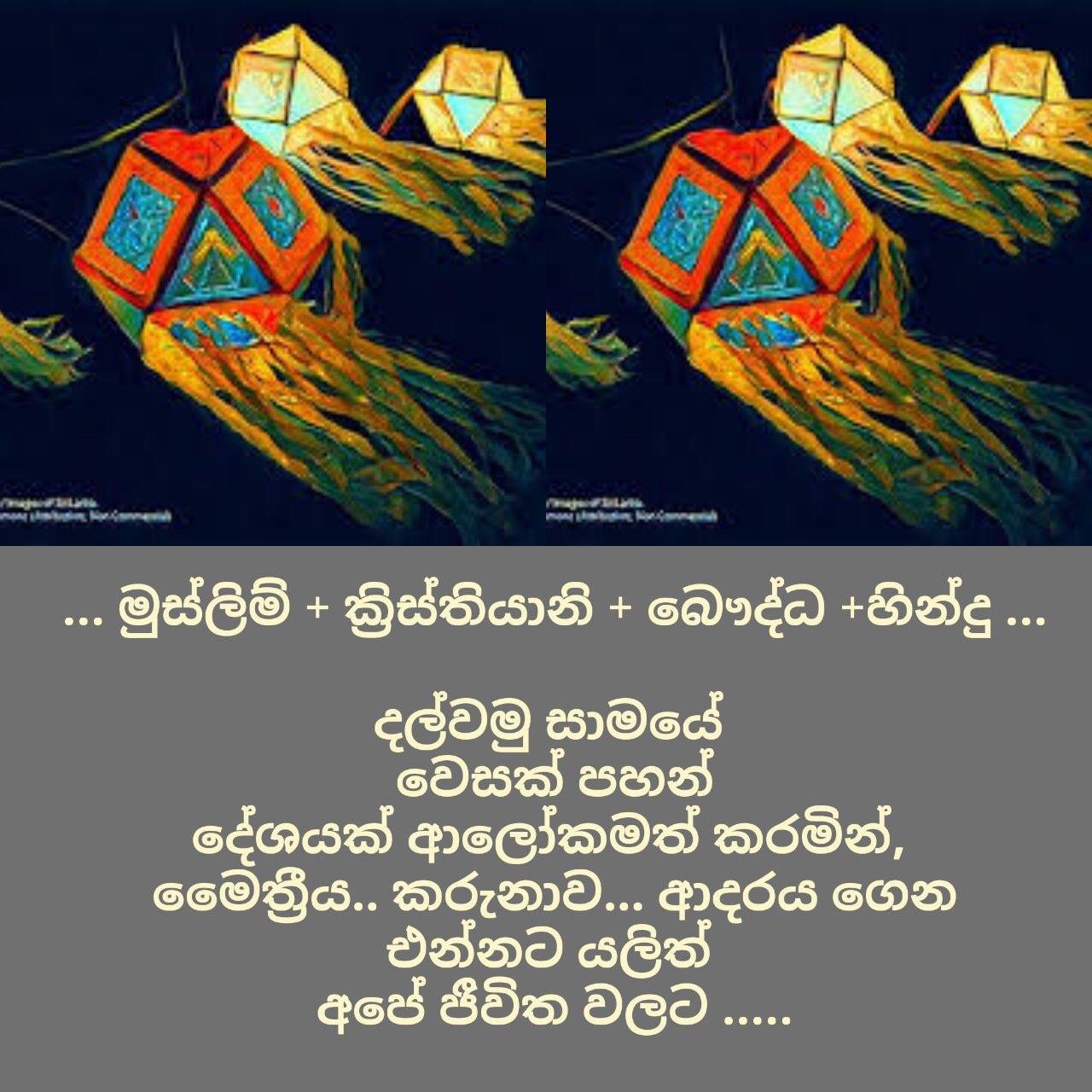
Shihara Farook, a doctor currently resident in the United Kingdom, wants to send a message calling all mosques to ask Muslims to step out and light a Vesak lantern outside their homes. It would be a sign and a positive sign.  There can be other things that the Muslim community can do, but let me not be presumptuous enough to prescribe.  The same goes for other religious communities. Rev Baddiya Thero spoke to Buddhists. Cardinal Malcolm Ranjith speaks to the Catholics. Members of the clergy belonging to other faiths no doubt will speak to their respective flocks.  

My schoolmate and friend Mujib Alavi, when concerns were raised about issues of safety, thanked his friends but insisted that he will take care of his family to the best of his ability. My response was this: ‘Muji, we are part of your family.’  He would take care of me and I would take care of him, I didn’t have to elaborate.  I can speak only for myself, but each one of us can and perhaps should consider speaking for themselves and hopefully in ways that heal and bring people together rather than drive them apart, even as we fight in all ways necessary, the threat at hand: terrorism. It would be a fitting tribute to those who laid down their lives to rid this country of the terrorist menace one decade ago.  

tenderness will not hurt


malindasenevi@gmail.com. www.malindawords.blogspot.com