Showing posts with label Nihal Fernando. Show all posts

06 October 2025

Landscapes are stories


Landscapes have their own moods, feelings and expressions, says Kasun De Silva. He attributed this insight to the photography of Nihal Fernando. He added, ‘landscapes are not just sceneries, but stories.’ It was a comment on one of Fernando’s photos posted on Facebook by Studio Times which Kasun had re-posted on his wall. The original post had the following caption: ‘Nihal Fernando: He never tired of photographing trees …’

True. Also true of many other things that captured his imagination and persuaded him to explore with his incomparable lens. They all had moods, feelings and expressions, come to think of it. But these are not attributes one easily associates with landscapes. People, yes, but landscapes?

Nihal Fernando was a patient photographer. He had the eyes to cut into rectangular shape a given subject. He could also anticipate the ways in which what was before him could transform or, as the case may be, be transformed by moving to test different angles and decide which would best capture the personality of what would become ‘the photograph.’

Angle was just one factor. There was also temperature, light, shade and movement spurred by wind. Elements are not static; as they change so too do the landscapes they make. Trees, included.


The particular photograph was a ‘black and white’ capture of a solitary tree, bent by time perhaps and possibly by wind. My guess is that it was somewhere in or around Horton Plains. The tree reached out to other trees on an adjacent hillock. There was dappled sunlight playing around the trunks of those other trees. There was sunlight causing a shimmer on the grass around the subject-tree. A story, then. Or stories, rather, for there are always multiple narratives; as many as there are readers. We read and in reading we re-write.

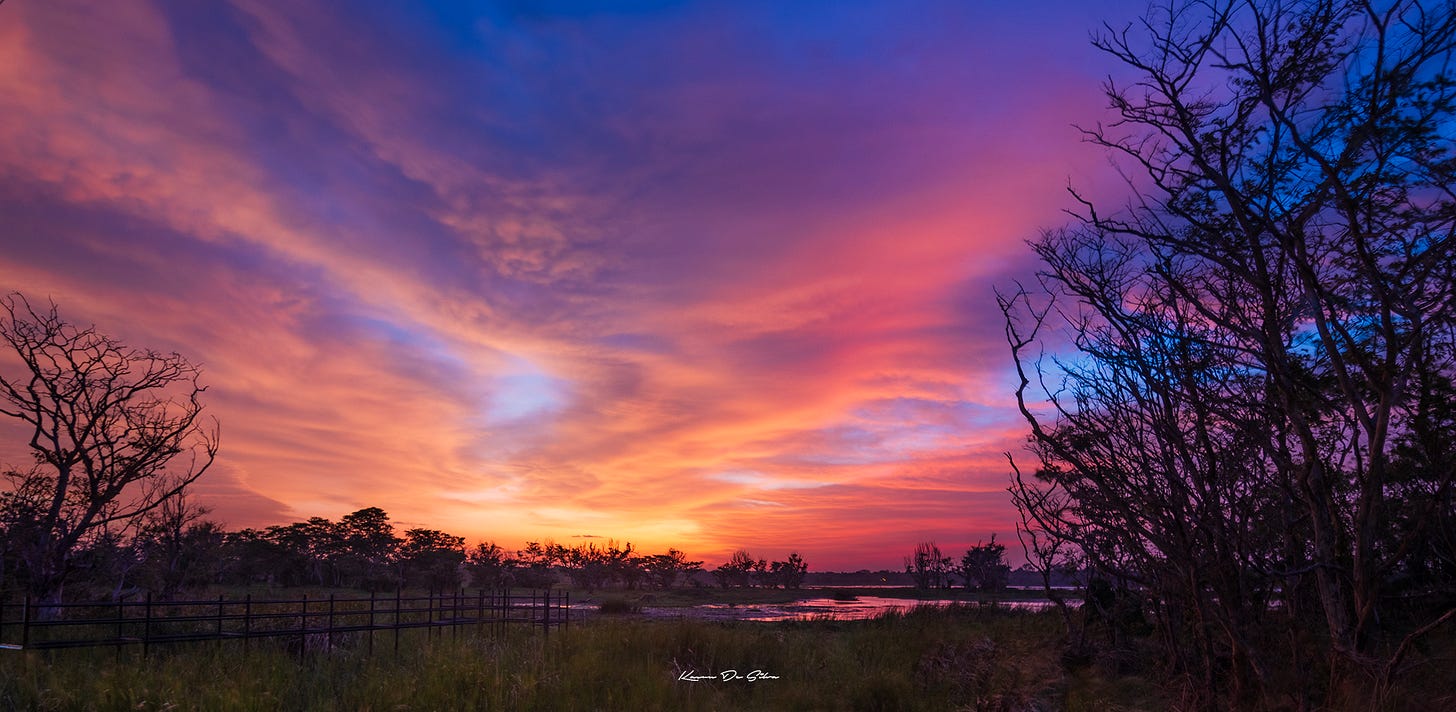
Not too long after sharing the Studio Times post, Kasun posted one of his own photographs. It was of a sunset and titled ‘A painted evening.’ Somewhere close to Habarana, he said. The first thought that crossed my mind was, ‘there can be no landscape painter more accomplished and skilled than the elements.’

In the foreground, a fence that ended at the backend of a small weva. Leaf-bereft trees on either side of the frame, a tree-line a few hundred meters beyond, and then, sky of swirling clouds brushed in shades of blue, orange, gold, red and purple.

It would have stopped me. I, who knows nothing of colour, line and space. For Kasun, it was probably a book-shelf of stories. It was a landscape of many moods, feelings and expressions, obviously. Not ‘scenery,’ but stories. He would have seen the narratives unfold over the next few minutes or hour and even later when the detailed subject blurred, turned to silhouette and disappeared into the nocturnal narratives. He gave us a moment and that was still quite a collection of stories.

And reflecting on landscapes and stories, following Kasun’s observation, it occurred to me that we are surrounded by libraries and galleries; the one housing splendid stories, heroic and tragic, hilarious and sober, brief and lengthy, and the other on whose walls hang paintings that cannot be bought or sold, stolen or defaced.

Of course there’s that added allure in things spared human touch. This is perhaps why some people like to travel, to hike, to explore places that cannot be reached by vehicle, not even a bicycle. Kasun, like Nihal, has offered us glimpses of such libraries and galleries. Then again, there are ‘peopled’ landscapes that are in stark contrast to a wind-sculpted tree in a tropical montane forest. Cityscapes, in a word.

Less ‘peopled,’ but certainly carrying human signature, would be paddy fields, terraced and un-terraced. Wevas. Faraway temples. Even a set of windmills. Or proud posts carrying electricity. One could theoretically conjure any number of images. Landscapes or rather ‘scapes,’ one and all. Each with a mood, a feeling, and expression or multiples of the same. Each, a personality.

Question: do we notice these personalities that have stories to tell? If we do notice, do we stop to read? Don’t we have enough time? Is it that we can’t quickly draw an arrow from ‘the possibility of a story’ through ‘reading’ to some tangible benefit?

Nihal Fernando read. Kasun reads. Nihal Fernando shared his stories as does Kasun. We are enriched, certainly, but we can also enrich ourselves, perhaps in some smaller way. We are, after all, surrounded by moods, feelings and expression.

[This article was published in the Daily News under the weekly column title 'The Recurrent Thursday']

21 January 2023

Visual cartographers and cartography

Who knows a land like the back of his or her hand, as the saying goes? Those who live in full and respectful engagement with the land could be a good enough answer. ‘The land’ is of course not just an earth-piece with a human-decided perimeter. The land is all the resources embedded in a particular ‘plot.’ The soils, the fauna and flora, social intercourse, the past as a shadow on the present and foundation for future,  history and heritage, wisdom in word and as embedded in cultural practice, climate and climate change, the wind, the rain, leaves on the ground, sunlight reflecting off the leaves, breaking into innumerable gold coins scattered for a while on the ground, the trials and tribulations of all creatures in their mutual friendships and enmity. All these things. And more.

So who knows this land? Typically, not many. Indeed, very few if at all would be able to offer a comprehensive and detailed description, even if they had back-of-the-hand knowledge. Certain things just cannot be described in full. It doesn’t mean that they don’t have a clue though.  

‘The land,’ so to speak, grows upon an individual or a collective but only to the extent that it is allowed to grow, allowed to grow and teach in the manner of the kindest and most generous educationist. The land teachers, but students decide whether or not lessons will be learned. Not all who encounter ‘land’ do so with all senses alert and with hearts ready to receive sunlight and rain.

And yet there are people who have lived in this land who have let it grow on them simply by walking through it. They are sociologists, biologists, archaeologists, historians, anthropologists, zoologists but without certification and, typically, unaware that they are endowed with the relevant explorative tools. They walk and in walking they map.

Surveyors, formal and informal, know this land. Among the informal kind, one can think of Nihal Fernando. He was a cartographer whose only tool was a camera. He captured what he saw and in ways that told the magical and constantly unfolding story of this land. His work is an invitation to fall in love. Those who learned photography from him, especially the likes of Luxshman Nadaraja, have walked and re-walked the paths he cleared for us all. Others too, in all probability.

I know of two such cartographers. Tharindu Amunugama and Kasun De Silva. They walk. They record. They have eyes and hearts that can imagine better frames with which to contain what’s before them. Their mapping is obviously very different from the work of formal cartographers. And yet they do give us the contours of living heritage, seasonalities, the play of time and life on faces, the transformation of landscapes and of the land, physically and culturally.
 
I’ve written about Tharindu, his photographs, journeys and philosophical musings which have greatly enhanced my sensibilities and taught me that it is so easy to fall in love with this country over and over again.  I have never met and never travelled with Kasun, and yet, his work has delighted me in much the same way.

Kasun’s Facebook page has several albums titled ‘Authentic Sri Lanka.’ One can argue about the definition of authenticity, but it would be quite a challenge to prove that anything that Kasun has captured is unauthentic, that it is not something that is in fact Sri Lankan. From frame to frame, a face to a river, a sunset and sand dune, a tree to a canopy that filters sunlight, watch the slow movement of an oruwa upon a picturepost card weva, it's a journey upon a living, breathing and serendipitous map.  

In addition, there are albums on Nuwaragala, Basawakkulama, Dambava Tampita Viharaya, Bundala, Mannar, the road to Sri Pada via Eratne, Wawulagala and many other places, every photograph in every collection a piece of visual poetry. They are not ‘stills.’ There’s motion in the captures and the images spill out of the formal frames, find their way into our minds and softly ask (at least to me) ‘who are you?’  And I, having read Rumi, know enough to say, ‘I am you,’ and so they respond, ‘then we are one and therefore there’s room for another.’  

What is this land if not collective memory containing truth and falsehood, and yet not entirely un-capturable? What allows for half-way decent cartography than hearts open to sample its innumerable visual, cultural and sociological flavours both vibrant and subtle? What makes it possible to obtain the pulse of this land if not allowing the land to grow upon your skin, sink beneath and enter and re-enter anew your blood streams?

One doesn’t have to know the land to live decent and comfortable enough lives of course. No one should be presumptuous as to prescribe life to another and I will not. I am just glad that this land exists and I am grateful to its visual cartographers for showing me pathways I could explore in the time left to travel and for reconfirming this indelible truth as far as I am concerned: I am blessed to have been born in this land. 

['The Morning Inspection' is the title of a column I wrote for the Daily News from 2009 to 2011, one article a day, Monday through Saturday. This is a new series. Links to previous articles in this new series are given below] 


Other articles in this series:

Ithaca from a long ago and right now

Lessons written in invisible ink

The amazing quality of 'equal-kindness'

A tea-maker story seldom told

On academic activism

The interchangeability of light and darkness

Back to TRADITIONAL rice

Sisterhood: moments, just moments

Chess is my life and perhaps your too

Reflections on ownership and belonging

The integrity of Nadeesha Rajapaksha

Signatures in the seasons of love

To Maceo Martinet as he flies over rainbows

Sirith, like pirith, persist

Fragrances that will not be bottled 

Colours and textures of living heritage

Countries of the past, present and future

A degree in creative excuses

Books launched and not-yet-launched

The sunrise as viewed from sacred mountains

The ways of the lotus

Isaiah 58: 12-16 and the true meaning of grace

The age of Frederick Algernon Trotteville

Live and tell the tale as you will

Between struggle and cooperation

Of love and other intangibles

Neruda, Sekara and literary dimensions

The universe of smallness

Paul Christopher's heart of many chambers

Calmness gracefully cascades in the Dumbara Hills

Serendipitous amber rules the world

Continents of the heart The allegory of the slow road

12 September 2020

No shortcuts to 'The Point of Best Capture'


Today, anyone with a smartphone is a photographer. Anyone who has Snapseed can make photographs look good. And even if you know nothing of Photoshop, you could still fiddle around and chisel off rough edges, so to speak. You could use any one of the many apps available to highlight, circle and pretty much do whatever you want it to do.

Takes the fun out of photography, some might say but others would say such things have made it more interesting.


I’ve known photographers and their stories amaze me. Their work is instructive. And sometimes they teach, without seeming to do so, as is the usual way of those who have mastered their art.  

So, a week or so ago, I was playing with the mobile phone. I was thinking of frames, angles and light probably displaying amateurishness that was too painful for a good photographer to bear. Tharindu Amunugama was kind. He noticed that I was using the zoom function on the phone.

‘Don’t do that. Get closer. Let your feet do the zooming.’

And so I did just that. ‘Zoom’ was duly retired. And I recalled photographs and photographers. I recalled a poet and an epic poem too.


Adisham Bungalow in Haputale is an impressive piece of architecture, in rain or sun, on a clear day or covered in mist. If you google ‘Adisham’ you’ll get lots of pictures, the vast majority of which would be of the entire house or at least most of it. None of them capture 'Adisham' the way two photographs that Tharindu took  when we visited the place about a month ago.

The first, a closeup. A ‘rock-framed’ set of windows. It spoke of a different era, solidity and a design incorporating ‘roughness.’ The second was a view through a window. It captured a side of the building, arches, a courtyard and a piece of sky that gave a sense of dimensions. The colors or rather configuration of colors, were exquisite.

I hadn’t noticed any of that. I just saw a pretty building, a half-way nice garden and some old furniture. I took in the view. And then it rained. I took in the rain too. All good. I didn’t notice the windows. Saw, but didn’t see.

And I remembered a particular photograph taken at Rangiri Dambulla in an album that contained lots of them. It stood out on account of detail, color, lighting and the architecture of the composition. He had zoom-walked.


And I remembered a photograph taken by the legendary Nihal Fernando. An ancient stupa marked by the bludgeoning of element and time. I remember seeing it at the exhibition titled ‘Eloquence in Stone.’ There was a cloud formation which mimicked the shape of the stupa. I believe this was noted by Sinharaja Thammita-Delgota who I believe wrote the captions for the photographs (later turned into a book by the same name). I remembered Uncle Nihal telling me almost twenty years ago that sometimes you have to wait for hours and hours for the right light. Maybe he waited on this occasion too. Maybe he noticed the movement of clouds and extrapolated the possible cloud formation. Maybe he was lucky in terms of light. The angle, however, was not about luck but design.


I remembered Mahagama Sekera’s ‘Prabuddha’ too and something I wrote about 11 years ago in an article titled ‘Beauty is the number 14 and it lasts for 72 hours.'

‘Prabuddha is at the Ruwanweliseya. It is evening. The evening star is clear in the sky.  Prabuddha walks around the maluwa until he finds that one spot where gaze, pinnacle and star intersect. Writes Prabuddha: ‘deepena thama dansina!’  What is more beautiful now, the artifact, the history symbolized and embedded in it, the evening star, Sekera’s exceptional eye and tender gaze or the intersection of these things?  I am not sure, but Sekara’s juxtaposition was certainly illuminating.’


Prabuddha walked. Sekera made him walk. Maybe this is because Sekera walked. Nihal Fernando walked all over this country long before the dawn of easy-click photography. Tharindu walks even though easy-click is literally at his fingertips.

They’ve walked long enough and in so many directions that they probably know there are no shortcuts to ‘best capture,’ be it in photography or anything else. They wonder. They wander. And therefore they've mastered 'focus,' I feel.


They take wonderful pictures, using their feet.  

Other articles in the series 'In Passing...':  [published in the 'Daily News']  
 
Eyes that watch the world and cannot be forgotten   Let's start with the credits, shall we? 
The 'We' that 'I' forgot 
'Duwapang Askey,' screamed a legend, almost 40 years ago
Dances with daughters
Reflections on shameless writing

Is the old house still standing?
 Magic doesn't make its way into the classifieds

Small is beautiful and is a consolation  
Distance is a product of the will
Akalanka Athukorala, at 13+ alre
ady a hurricane hunter
Did the mountain move, and if so why?
Ever been out of Colombo?
Anya Raux educated me about Juvenile Idiopathic Arthritis (JIA)
Wicky's Story You can always go to GOAT Mountain
Let's learn the art of embracing damage
Kandy Lake is lined with poetry
There's never a 'right moment' for love
A love note to an unknown address in Los Ange
les
A dusk song for Rasika
Jayakody
How about creating some history?
How far away are the faraway places?
There ARE good people!
Re-placing people in the story of schooldays  
When we stop, we can begin to learn
Routine and pattern can checkmate poetry

Janani Amanda Umandi threw a b'day party for her father 
Sriyani and her serendipity shop
Forget constellations and the names of oceans
Where's your 'One, Galle Face'?

Maps as wrapping paper, roads as ribbons
Yasaratne, the gentle giant of Divulgane  
Katharagama and Athara Maga
Victories are made by assists
Lost and found between weaver and weave
The Dhammapada and word-intricacies
S.A. Dissanayake taught children to walk in the clouds
White is a color we forget too often  
The most beautiful road is yet to meet a cartographer


malindasenevi@gmail.com

27 June 2016

I do not understand image but I am glad others do

I have never really understood ‘visuals’.  I realized this most acutely when I started working as a part time copywriter at Phoenix Ogilvy.  I could put word to image but could never imagine appropriate visual for text. 

Years ago, when I was working in the Sunday Island, Nihal Fernando, Lanka-lover who saw, worked, loved, respected and was through and of lens, suggested in his self-effacing and charming way that we work together on a project.   

Nihal Fernando is not just one of the greatest photographers and staunchest patriots we have, but someone who has walked every inch of this country, knows it like the back of his hand and for these and other reasons is eminently qualified to comment and prescribe. 

He gave me a copy of D.S. Senanayake’s ‘Agriculture and Patriotism’ along with a bunch of black and white photographs from Studio Times.  He flagged various passages and marked appropriate photographs.  He wanted me to carry one photograph with one paragraph every week.  The purpose was to educate. After some time, I thought I should add my two-cents worth.  So there would be Nihal’s photograph, D.S. Senanayake’s thought on a relevant subject, playing off each other and at the bottom, my comment.  Six months later, we ran out of text.  Nihal could never run out of images.  So thereafter it was just Nihal and I; his photographs, my comments.  If I wrote something and was asked to suggest a relevant photograph to illustrate what I had written, I would have got tongue-tied or worse, choose something that not only would not complement but might even detract from message. I don’t understand ‘visual’.

This I learnt from Shantha K. Herrath, clearly the most under-utilized talent at Upali Newspapers at the time.  Some say this ‘under-utilization’ and at times non-utilization is all Shantha’s fault, i.e. his eccentricities and stubborn, uncompromising manner, but I am not so sure.   

There is after all a thing called the ‘Shantha K Herrath Lakuna (mark)’ in contemporary Sri Lankan art and newspaper illustration and that speaks of an exceptional talent.

There was a time when Shantha helped with the layout at the Island.  At the time I had persuaded the editor, Manik De Silva, to reserve an entire page for a photo essay.  The photographers, bored out of their skin with taking pictures of politicians at press conferences, were thrilled because they got an opportunity to have fun.  So every week we put together a photo-story on various subjects.  Shantha handled the layout.  He cropped without mercy in favour of the overall visual effect.   The end product pleased the eye.  He would leave some space for a headline and a caption that tied together the images and ‘decorated’ the photo-story.  We adjusted without encroaching too much into each other’s territory. 

I remember telling Shantha that I needed an illustration for an article I had written about the Ceasefire Agreement.  My argument was that the CFA favoured the LTTE and the Eelam Project and inter alia was a deliberate and pernicious attempt by the Norwegians to attack Buddhism and Buddhists.  I had an idea.  I told Shantha that I want a play on the National Flag, with the bo leaves replaced by crosses, the lion by a tiger etc.  He listened.  Then he said ‘umbata kiyanna oney de kiyapang’ (tell me what you are trying to get across).  I told him.  He said ‘ethi’ (enough).  His illustration was so powerful that I might as well have not written my piece.  He does this all the time, the most recent in my memory being in his illustrations for poetry written by Buddhadasa Galappaththi. 

There was no ‘National Flag’.  There was a lion sprawled awakwardly and atop the lion, a tiger, laid-back, sunglasses, soaking up life.  Towering over the two there was a man in a priest’s cassock, cross in hand.  The article was for the daily Island. Gamini Weerakoon, editor, crossed the cross off remarking (according to Shantha) that we don’t need a ‘religious war’ as well.  Even today I believe that there’s a lot of sweeping under the carpet happening, but the editor I think was correct because the focus of the article was about Eelamism. 

Shantha used that illustration as the start of one of the most effective cartoon series I’ve seen. He called it ‘The Fourth Dimension’ (Sunday Island) and called the Sinhala version in the Sunday Divaina ‘Sathes’ (Seven Eyes).  Later, when I started working at Phoenix and came to know art directors and illustrators I was even more humbled by my ignorance and utter inadequacy in comprehending colour, line and space.  ‘Visual-people’ make my blindness painfully apparent.

I am thinking in particular about someone called Lesly (I have never met this person), who illustrates my articles for the Daily News.  I feel this person has got under my skin, borrowed my eyes and seen what I have seen in exactly the same way.  It is uncanny.  When he draws a character I’ve referred to and one whose physical dimensions I have not described, Lesly might well have been looking at a photograph of the person, it’s so ‘spot-on’. 

There’s always been someone who knows the visual so well that my incompetencies with word could be brushed away with illustration. This, then, is a salute to Shantha K Herrath, Wasantha Siriwardena (The Nation), Lalith Senanayake (now at Rivira but illustrated my weekly submissions of Martin Wickramasinghe’s ‘Upan Da Sita’ – From the Beginning’ – which I translated into English over a period of a year and a half when he was at Upali Newspapers and I at the Sunday Island), Lesly, the layout boys at The Island and The Nation and others I have never met. Thank you, all.

This article was first published in the Daily News (June 26, 2010)
Malinda Seneviratne is a freelance writer.  Email: malindasenevi@gmail.com. Twitter: malindasene

21 February 2016

Jeanne Mansoor is waiting to hear from you...

Long years ago, when I was understudy to Manik De Silva at the Sunday Island, Nihal Fernando, a photographer and one who was always intensely passionate about things Sri Lankan, suggested that I arrange for a series of pieces, either as articles or interviews, on how Sri Lanka could be turned around.


He was thinking of people like Ray Wijewardena (click here for what I wrote about Ray shortly after he passed away in August 2010) and others who had not only excelled their chosen fields but whose love for this land was beyond question and moreover whose characters and integrity were unblemished.

I left that newspaper not long afterwards and that was that as far as Uncle Nihal’s splendid project was concerned.


Since then, however, I have used whatever means at my disposal to educate myself about such people and their work and to share whatever knowledge I picked up in that exercise with as many people as possible.

I was told in school that one can learn both from books and from people too. Charles Dickens, through Hard Times told me to look for the best in people and not the worst.
He need not have bothered, for that’s what my mother’s life was all about.

She didn’t teach it, although she was by profession a teacher. She lived it and in living, she taught.

It’s good to know about good people because they set benchmarks. When people are unblemished and when both the unblemished and the ‘unblemishedness’ are known, the blemished and the blemishes stand out.

We can then employ circumspect in our engagements with such individuals. So when I got an email from my friend Jeanne Mansoor a couple of days ago saying that she was collecting a few people’s take on corruption, I was very interested.

It’s a simple project that has a lot of potential in terms of giving frames of reference to people in the matter of assessing the high-profiled, officials and politicians, professionals and stars.

Here Jeanne’s request, which I copy-paste and forward with pleasure and a sense of privilege:


I am putting together some writings about people who are/were incorruptible, as a counter-punch to our country having got out of control corruption-wise. If I can get enough participation - I would like a book to come out of it. I would be grateful if you would write something I can include in the collection - on any Sri Lankan you feel qualifies as an example of incorruptibility and why. There are a few guidelines:

* The incorruptible person may be alive or dead.
* No spouses or children can be included, because both may feel hurt if they are not. However parents and other relations are fine.
* If you feel more than one person you know or knew qualifies, would you write separately on each.
* I’ll need a few lines separately on who that person is/was - pertinent dates too.
* I’ll be cutting down to 500 words maximum per incorrupt person per writer.
* Email me the pieces one at a time if that is easier - it would be easier on me for sure.
* If you have a friend or friends who you feel could contribute to this project, would you ask them to participate and give them my email address. Be sure that they send it under a subject that will alert me to their not being a nuisance writer looking for new friends.
You email her jeanne@sltnet.lk or write to her at Puwakwatte, Kotadeniyawa, 11232, Sri Lanka.


We don’t know the full lives of people we encounter and not even of those who are closest to us. There are no perfect people on this earth.

Our assessments are based on imperfect information sets. Still, there are always people we look up to, take cue from, try to emulate or are inspired by. We don’t have to write to Jeanne and once, hopefully, Jeanne publishes a selection of submissions delivered to her, we may or may not read the book.

She won’t get all the stories and given the parameters associated with the communication of this request, she might get a skewed sample. Still, it’s better than not having it.

Most importantly, we don’t have to wait for such a publication. We can look around and find many beautiful things and wonderful people too.

We will also see horrible and horrifying things and despicable people as well. We can play pick-and-choose as we do quite frequently. What we pick can depend on what we have become and who we want to be.

There’s nothing to stop us from picking wisely, though. Nothing to stop us from sharing our pick with Jeanne. It’s a little ‘something’ we can do for the nation and more importantly, one another, at very little cost.

Let’s try, shall we?

Malinda Seneviratne is a freelance writer who can be reached at malindasenevi@gmail.com and the above article was first published 5 years ago in the 'Daily News' (February 21, 2011) for which paper I wrote a daily column titled 'The Morning Inspection'. 

09 January 2013

‘With the Dawn’: A love-note penned in the Sri Lankan wilds


BOOK REVIEW
‘With the Dawn’, by Nihal Fernando and Herbert Keuneman, published by Studio Times Ltd., reviewed by Malinda Seneviratne.

There are countless melodies that can be composed with the 12 pitches of the Chromatic scale.  There are more than 12 words in the English dictionary and this alone gives sense of dimension pertaining to possible word configuration.  One might say that we have enough and more tools to describe the world to ourselves and one another.  There are times however when we all feel poor, not for lack of word but perhaps for its suffusion.  We cannot pick the correct words to describe to perfection, dimension and detail all.   Then we go silent. 
 
It is the same with painters. Color and line make for innumerable configuration but rendering is always incomplete.  Artists give us new eyes and perhaps inevitably new lies as ways, new ways of self-deception.  One would think, then, that the photographer is a more humble archivist, except that this is also an exercise that involves choices such as time of day, light-shade mix, the ‘settings’ pertaining to camera and of course post-shot play on a computer where a wide range of tools are available to re-render that which was captured. 

When a photographer has travelled a territory more extensively than an archaeologist or surveyor it is clear that he or she can make countless albums for there are innumerable ways to organize material.  It is hard to think of anyone who has traveled the length and breadth of this island as much as Nihal Fernando has done.  Neville Weeraratne in an essay titled ‘Nihal Fernando and Herbert Keuneman: a tale of two kindred souls’ says that the former ‘has seen, heard, experienced and above all understood the land, its people and their life’.  It holds for the latter too, going by that same essay and by the authoritative travel guide ‘The Handbook for the Ceylon Traveller’ which carries the signature of his life, vision, knowledge and the love he shared with Fernando for this country.   Weeraratne describes him this way: ‘His lifelong residence led to a passionate love for the island.  There is (nor was) anyone with his encyclopedic knowledge of the country in whatever the detail and in whichever the discipline.’
Weeraratne’s piece is found towards the end of an album of photographs which is also an essay and a journey, ‘With the dawn’ published by Studio Times.  From dawn to dusk is a long time.  For people like Fernando and Keuneman it’s a set of hours that can theoretically make for countless albums on countless subjects.  This collection is based on the Studio Times exhibition called ‘Wild Life ’73’’ held almost forty years ago at the Lionel Wendt Art Gallery, Colombo.  The photographs displayed were picked by Keuneman just two weeks prior to exhibition date.  That process has been described beautifully thus:

‘Fernando and Keuneman flung open the doors of the studio (Studio Times, that is, located then in the Times Building, Colombo Fort), letting the unsullied air of a quiet morning find its way into the dark corners, as they laid out the photographs on the floor.  Beggars who lived in the foyer of the building, occasionally peered in to look at the whirling images of deer and elephants, monkeys and crocodiles, jungle trees and jungle pools, birds and more birds in flight.  Herbert Keuneman walked among these black-and-white prints, picking up one, peering at the next, tossing photographs here, there, everywhere.  He cast a few aside, sorte4d others, grouped some and started writing the story of a day in the jungle…with the dawn…the birds…awake…and take off…and so it went on until the last bird flew home.’
This was long before digital cameras and ‘photoshop’ those advances that turned point-click amateurs into art photographers if they knew how to photo-edit or could obtain the services of a photo-editor.  We can flip through the pages and be mesmerized by the images.  It would take a traveler however to look at each photograph and imagine the work involved.  Nihal Fernando is well known for his patience.  He did not (and admittedly could not) depend on the insurance of post-click technology to work out the glitches that human frailty (of mind, eye and finger) spawns.

It is a black and white collection.  For this reason the photographer obviously had to work within narrower margins of error.  Color blinds at times and even makes for a lot of fudging.  Perhaps this is why even in today’s digitized world of fascination with color palettes the black and white photographer is still held in awe. 
We cannot tell if the collection was gathered, photographically, over a single day.  But this was a different age of photography and a different society working towards different objectives at a different pace and in less glittered economy.   Nihal Fernando was inspired by love.  So too, Herbert Keuneman.  Such people don’t rush.  They take their time.  It is evident in the collection, both in image and in descriptive line.

They take us from moment to moment, hour to hour, dawn to dusk as though leading us by hand, drawing attention to all that the untrained and less-used-to-loving eye would miss.  Keuneman’s economy of words is ideal complement to Fernando’s photographic poetry.  He says only what is necessary and thereby teaching that silence is an excellent travel companion and even travel guide.  There is silence, silently captured and described in whisper.  There is music here too, for Fernando makes us hear the ripple of water, the movement of wind, the call of bird, flapping of wings and thereby teaches us the language of the civilized, our ancestors who had eyes and did not babble incessantly just because they had mouths and tongues. 
‘With the Dawn’ ends ‘when the last bird flies home’.  It is a limited edition of just 1000 copies.  A different generation of photographers might think that armed with technology they could as much or better with a fraction of the effort.  They would be wrong.  Technology does not have a ‘love-function’.  It is not obtained by point-and-click on a computer screen or inserted as device in a sophisticated camera.  It comes with walking.  It comes with deep reflection.  It comes in conversations with hundreds and hundreds of ordinary people.  It comes with the dawn and takes flight in the wings of the last bird flying home.