Sportsman. Fighter. Thinker. Peace-Maker. Commander.
[Pics from Army archives, the Commander's albums and by Sandra Mack]
Mahinda Kumara Dalupotha while relating a story about
cattle, milk and how multinationals destroyed our dairy industry, mentioned
something about Kurunegala. I asked him
if he went to Maliyadeva College. When
he answered in the affirmative, I told him that I had interview an old boy the
previous day (for ‘The Nation’ newspaper), Lt. General Daya Ratnayake who had
just assumed office as Army Commander.
‘Ah! Andy Aiya!’ he
said, smiling the smile of someone who remembered someone with affection.
‘Andy?’ I asked him where that nickname (which I was
ignorant about) came from.
‘From his initials, I think; there’s an A, an N and a D,’ he
said but without conviction.
The name ‘Ratnayake Mudiyanselage Daya Ratnayake’ doesn’t
have initials that could be twisted into ‘Andy’. The Army Commander, when interviewed for
‘Change’, explained with a smile.
‘I was a great cricket fan as a schoolboy. In 1975 I went to
watch a match between Sri Lanka and the West Indies. Andy Roberts was their main strike
bowler. I was impressed. When I came
back I imitated or at least tried to imitate his action. So my friends called me Andy and that name
stuck. All the students, teachers and
even the Principal knew me as ‘Andy’.
Now he is ‘Daya’.
Daya, before he was ‘Andy’, was Daya, naturally, and was born on
February 22, 1958 to a farming family living in a small village called
Siyambalangamuwa, off Tittawella, which is about 4 km from Kurunegala on the
road to Puttalam.
There are those who would say ‘farming family’ does not
imply ‘farmers’, but ‘landed proprietors’ and those who might drop ‘farmer’
altogether and go for the relatively grandiose ‘landed proprietor’ and others
(these days) who might think that too is goday
compared with ‘Agri-Business Entrepreneur’.
Daya opted for ‘farmer’. He has
a story.
‘Those who applied to join the Army were subjected to a mock
interview by the teachers. I was asked,
“what is your father?” and I said “farmer”.
I was told not to say “farmer”, but say “landed proprietor”. I said and still say “farmer” because I
believe one should be genuine and because the value of a life’s journey is
about how far one has come.’
 |
| Head Prefect, Maliyadeva College |
‘My father was a farmer.
His name, Muthu Banda. He was very well read. He kept himself informed about a lot of
things, local and global. University
students used to visit him, just to talk, just to learn or clarify. He had a deep understanding of politics. He had a bookshelf, he encouraged me to read.
He gave me my first book, Amba Yaaluwo. I still remember him telling me, “You
should always take something more than what the writer has put down in the
book”.
‘He brought home all the newspapers, including English papers. My older sister would read them to us. Our father told us that there could come a
time when we would not go very far without English. He was convinced that we should have kept the
English language when the British left.’
Daya Ratnayake considered his father a visionary, a patriot
of the highest order, his greatest inspiration and endowed with a sensitivity
that allowed him to appreciate even the ‘small good things’.
‘My father died at the age of 81. He had never even consumed a Panadol. A week before he died, in 2006, he told me to
be careful because he had seen a bad dream.
He had never said anything like that.
He had always said, ‘don’t worry….fight….die like a hero, you were born
like a lion, so live and die like one’. I was at Welikanda at the time. I met with an accident. A bike accident. Two days after he told me about the dream.’
If there is a sensitive side to Daya Ratnayake’s character
he has to thank his mother for it, he says. Ran Menika was from Vadakada and
came from a farming family.
‘Amma fed, nurtured, ran the house. She was neat and methodical. She was a strong
character. Nothing could deter her. She
was sensitive and kind, and balanced things off whenever my father was tough.’
Daya Ratnayake has lots of stories about his childhood and
school days. He was the youngest in a family of 5 children, had three sisters
and a brother. Being the youngest had
its advantages; he could duck English classes without any punishment apart from
the occasional rebuke. He went to the
village school, Siyambalangamuwa Kanishta Vidyalaka, for a couple of years and
then attended Udabadalava Sudarshana Maha Vidyalaya up to the 7th
Grade; this being where he started junior cadetting. After entering Maliyadeva College the
following year, he continued his cadetting, eventually securing the rank of
Sergeant Major and becoming the leader of the Cadet Platoon.
School was about the outdoors, mainly, although he was a
good student, finishing at the top end of the class consistently. From the age of 10 he had been selected for
running, starting with 50m and 100m and then events such as the 200m, 400m and
the relays, 4x100 and 4x400. He had
helped his team become to Public Schools Relay Champions and win the Relay Carnival.
He has the unique distinction of captaining his school in
both athletics and rugby. He still had
time, during his school years, to secure a black belt in karate and be at the
forefront of many clubs and societies. He had time to do his school work too,
obtaining 7 credits at the GCE O/L exam, a rare achievement at the time.
Everyone has stand-out memories of schooldays. Some are almost indicative of things to come
while some are turning points. Daya
Ratnayake recounted many a tale, but there were some which give insights into
the soldier, his mind and heart.
The first was when he was about 12 years old. He had gone to St. Peter’s College for an
athletics meet. Even before the team had
left Kurunegala, the boys had been told, ‘You can’t win because there will be
athletes from Royal, Ananda, St Thomas’.
‘I was expecting giants, literally. What came to my mind is the character
“Yodaya” in the cartoon story published by the children’s newspaper Mihira. I looked for giants but found
none. They were all small boys. I won the heat. So ‘big’ never bothered me after that. From then onwards it was, ‘if he can, why
can’t I?’
There was another turning point. Maliyadeva was to play Royal in an Under 17
rugger match at Reid Avenue. Daya
captained Maliyadeva. This is how he
remembers what happened:
‘When we arrived, the Royal captain welcomed us. He just
said, “Hello, how are you?” I lost the match then and there. I was
embarrassed. My father would scold me, I
thought. I would cut classes, I knew.
But on the way back, on the train, I decided that I would learn English before
the next season began. So, like the Ascetic Siddhartha going from one teacher
to another seeking wisdom, I went from one English teacher to another.
Finally I went to Mr. Jaimon. “Jema” told me that my problem was that I was
scared of the language. He taught me a
few simple words. He put me on his bike
and took me around the town. He told me
that he would ask questions and I would have to answer in English, but loud and
clear. He slowed down near crowded places, like bus halts, and fired questions
at me. I blurted out, ‘Yes!’, ‘No!’ and
so on. I lost my fear of the
language. No more stage fright.
“Jema” told me to speak to everyone in
English, the fishmonger, the teacher, the milk-man or anyone else. If that person didn’t know English, it was
his or her problem, not mine, he told me.
He gave me English books to keep on top of my books. So people thought “Andiya kadu kaaraya” (Andy is good in English). I had to live up to the reputation. Within 6
months I had achieved a decent level of language competency.
Losing fear and embarrassment paid off in other ways as
well.
Daya Ratnayake was one of the few boys who could control the
entire school: ‘There were times when the teachers would seek my help; it was
not by bullying or threat of force, but I commanded the respect of the
students.’
On one occasion, after the Principal had sacked the son of a
notorious thug who operated the fish stall in the market, seven or eight nasty
looking men had come to Maliyadeva and were hovering nearby, clearly waiting
for the principal to walk out. The
principal had called young Andy and explained the situation.
‘He was planning to go out surreptitiously. I told him not to. I said, “No Sir, you go out of the main gate,
but should walk; don’t worry about anything”.
I managed to convince him. He
walked toward the bus halt. The gang
approached him. I was ready along with
some of my friends. Within seconds 4
were in the drain and the others fled.
As they ran away, they threatened us, warned us not to come anywhere
close to the market.
‘But that evening I went to the market. Alone. Now when I think back I can’t understand
where I got the courage from. Anyway, I
went up to the fish stall and simply state “Mama
Aava” (I have come!). I pulled one fellow out and punched him. No one in the market came to help the
thugs.’
So, for a while at least, thus it was that Daya Ratnayake
came to rule Kurunegala.
Of all his teachers, the one who was most respected and
remembered with the most affection and sense of gratitude is Mr. D.B.
Dissanayake, the principal.
‘He was straightforward.
He was neat in dress, appearance and in the way he carried himself. There were 5000 students in the school. He had total control. There wasn’t a whisper when he was
around. We all learned the importance of
these qualities. He produced many
officers, professionals including some 20 generals.’
Daya Ratnayake remembered in particular an incident in 1976
where the principal, by example, taught him how to deal with crises, how to
remain calm, employ reason and at all points to do nothing to sully one’s
conscience.
In 1976 a student of Peradeniya University, Weerasooriya,
was shot dead. Students all over the
country protested. The protests spilled
into the schools. Maliyadeva was not
spared. Daya Ratnayake recounts:
‘It was led by students who were probably associated with
the JVP. Some university students had
also got into the school. There was a female student and a priest. The Principal called me and some other
prefects. He said “this school is made
of students, teachers and I. The prost
is justified. I too will protest. I will lead the way, followed by the teachers
and then the students. We are a
disciplined school, so we will do this in a disciplined way”.
‘He said that the protest would be held within the
school. He said posters can be made but
there cannot be filth. When I walked
out, someone called Dassanayake was making a speech. I told him, “Dase, dan navaththanna” (Dase, now stop). He refused.
I lifted the table and he fell down.
Then I addressed the students, got everyone to fall in according to
classrooms, led by monitors and prefects.
A separate team drew posters. The
Principal led us. He gave guidelines for
slogans. The art teachers helped.
‘When it was all done, I was asked to announce that everyone
should go back to class. Meanwhile the JVP
had been holding another meeting in an empty classroom. A few of us were also called. The hamuduruwo
and others spoke. They wanted to set up
something like a cell, they promised to train the members. I just listened. Among those who were invited was Ranga
Bandara, who was in the debating team.
He argued with the JVPers. He said that politics was not relevant to the
school. The hamuduruwo was angry, he
argued back. We realized that Ranga was
right. I said, “hamuduruwane karunakarala
yanna” (Please leave now, reverend).
And so we chased them all out. I
believe if we didn’t stop them or if we had joined them it would have been
disastrous for a lot of people. We were
balanced. The Principal had a lot to do
with that.’
It is as though all factors had conspired to prepare Daya
Ratnayake for a career in the security forces.
‘I remember Mr Wimalasena.
He taught me history when I was in Grade 3 and 4. Wimalasena Sir taught about kings. I loved the way he spoke about wars, battles,
commanders. In later years, although I
did Biology, I loved it when Mr. Samarakoon came on relief. He taught Sinhala. He was well versed in history. I used to get him to talk about Dutugemunu, the
Dasa Maha Yodayo. He inspired me a lot. In retrospect these discussions may have got
deposited in my mind in some special way.
 |
| Officer Cadet (1980) |
‘Cadetting also played a role. I liked the structure, the
form, the discipline, the rigor. From
almost every quarter this was the message I got: “Join the Army”. My family, people from my village, friends,
those who read horoscopes, teachers and even the Hamuduruwo in the daham
pasala were of the view that I am best suited to be a soldier. So by the time I was in the A/L class, it was
not even an opinion, it was the thing to do.
Maliyadeva, it must be remembered, has a long tradition of sending
people to the security forces. That
factor may have also played a role. I
applied to the Navy, Air Force and Police, was selected by all but chose the
Army.’
It was in 1985 that he received his baptism of fire in real
time combat. He was riding in a convoy
of three vehicles from Jaffna to Navathkuli through Ariyalai. They had run into an LTTE ambush led by
Kittu. Two had died instantly, 4 had
been injured.
 |
| Lieutenant Ratnayake |
We were being fired on.
The truck was on the middle of the road.
We got into the ditch. For the first
time in all our lives we had got caught in a live ambush. It was my first
practical test, the first time I was tested as a leader. Everyone looked to me. After the first few moments of shock, I
sprang into action. Thirty seven
terrorists we killed. We held for an
hour. This is how I learned what
leadership meant. From that moment
onwards I was very confident, I knew I could go anywhere and I did, I knew my
men trusted me and they did, they came with me and fought with me.’
He was awarded the Rana
Vikrama Padakkama, the highest honor conferred on a soldier at the
time. It was the first gallantry medal
awarding ceremony presided over by President J.R. Jayewardena. Eighteen got lesser medals, but 4 others
received the Rana Vikrama Padakkama,
all posthumously. My name was the 5th
to be called. Everyone was surprised
when I got up. The President invited me to sit with him at tea.’
The late eighties saw less engagement with the LTTE (this
was the time the Indian Peace Keeping Force, IPKF, was engaging the LTTE in
combat). Daya Ratnayake was in the
Southern Province, attached to the Intelligence unit. Let him say it in his own words.
‘I was doing intelligence work. On one occasion 20 JVP suspects were
caught. They were treated well and I
gave the assurance that none of them would be killed. Still, none of them divulged any useful
information. Then one day I saw a
dead/burning body and I tagged it with the name of the leader. The leader, one of the 20 suspects, was kept
hidden meanwhile. Posters were put up all
over Matara informing everyone that the man was indeed dead. The man didn’t know either. Two days later we caught a cell leader. I interrogated
him. He was just 17 years old, brave and
defiant. He was ready to die. He said “we will all die; even our leader was
killed”. I said “no putha, the leader gave us your name”. Then we showed him the leader. He was
shocked. He spilled the beans. We treated him well, got his parents down and
handed him to them. I just told him to inform us when the district committee
met. Within 2-3 weeks, they did. Food had to be provided by his family. Of the 12 persons who attended, 11 were
apprehended.
‘I interrogated the leader of the military wing. He was sitting across me on the opposite side
of the table. There was no one else in
the room. He spat at me and said “kill
me!” I smiled and said, ‘Spit again malli’.
Within an hour he was in tears. I
believe I learned to become a good interrogator. It is about using the opponent’s strength
against him. It is
about identifying a weak point, using it to leverage an advantage and
eventually breaking the opponent.
‘I was asked by a senior officer to “get rid of” the 11
suspects. I refused, pointing out that
once they are arrested they cannot be killed.
The senior officer said, “I will report you”. I refused to carry out the
order. He said he will give the order in
writing. I said that won’t make a difference.
‘My brother was in the Police at the time. A couple of his friends urged me not to
disobey, saying that I have a great future before me. I told them that I don’t
want to build my future by killing innocent people.
‘We managed to obtain key information that was very useful
in breaking into the JVP’s network. Two to three months later the insurrection
was over. There was a celebration
organized by the Army. The senior officer whom I disobeyed came up to me and
embraced me. He said “Daya, I learned a
lesson; only you had character”.’
The nineties saw Daya Ratnayake serving with distinction in
all parts of the North and East. He is
the only officer who has received medals for gallantry from all presidents,
J.R. Jayewardena, Ranasinghe Premadasa, D.B. Wijetunga, Chandrika Kumaratunga
and Mahinda Rajapaksa. He has received 10 in all, making him the recipient of
the most number of gallantry medals.
He was involved in all major operations in the
nineties. He remembered the tough days
well.
‘In our efforts to liberate Jaffna in 1995 during the Riviresa
operation, we came to a point where the LTTE had 3 defence lines, the Neerveli
Defence Lines. We tried hard for many
days to break through but didn’t succeed.
Some suggested we wait until we got helicopters from Russia, guns from
china.
 |
| During 'Riviresa' Operation |
‘I got my officers together.
I said I will lead the assault.
Second Lt Kapila Chakravarthi, Second Lt Udaya Konarasinghe and Second
Lt Wijesiriwardena, who were all special operations platoon commanders, we
given instructions. We went ahead for 4 km. We had 700 troops. We stopped in Kopai. Things were critical. It is the worst day in my life. January 1,
2000. Around 100 soldiers died. I lost 24 of my own men. I was the brigade commander. We were stuck. But we rescued the group.’
The media will no doubt have fond recollections of Daya
Ratnayake, who was the Military Spokesman 2004-2005. He considers it one of the
best experiences.
‘It was a big challenge, it was very interesting and I enjoyed
it a lot. The tsunami came while I was Military Spokesman. The entire world’s media was here. We had to
deal directly with civil persons. I
didn’t have the training, was not conditioned adequately, but I just talked my
subject, through my experiences. It was
a good exposure. I learned presentation
skills, discovered how people manipulate, that media is not above board or
genuine, and figured out ways of how to get through and get our position
across. I learned to be diplomatic, to
keep myself informed and the importance of being competent and professional
about one’s job.
‘Someone would start saying “there’s a rumor…” and I cannot
say, “I don’t know”. I would keep to
what is known, I would say “Yes, but it is only a rumor”. You have to be smart, give solid answers
without leaving room for further query. It is not easy. Journalists try to antagonize, surprise and
annoy’.
He had started compiling a military data base when he took
on the challenging job of Media Spokesperson. He monitored all the news,
monitored all media just so he was better equipped to respond to particular
media institutions and particular journalists.
He studied the Western media too, because he had to deal with foreign
correspondents frequently.
Things changed in 2005.
Ratnayake, at the time holding the rank of Brigadier, was sent to
Welikanda as the 23 Division Commander. The entire Army was aware of the
change.
‘The Army understands, as it always should, the pulse of the
political leadership. There was an immediate change after the Presidential
Election in November 2005. I felt there
was a huge transformation in attitudes, that there was new hope. We were, at that point, pretty desperate. Our dignity and self-respect had suffered a
lot of damage. Morale was at rock
bottom. But it felt like rain after a
long drought. The Secretary, Defence
Ministry, Gotabhaya Rajapaksa took some bold decisions. He hand-picked right
people for the right job. He
conceptualized the overall strategy.
‘With respect to the men under my command, I realized that I
had to do a lot of confidence-building.
To do this, we had to fine tune structures, intensify training, upgrade
and adequately equip ourselves with weapons, skill, knowledge etc. We had to improve the force multipliers, i.e.
intelligence, psychological operations, civil affairs and communications.
‘I drew a lot from the theories of Sun Tsu, i.e. from his
classic work ‘The Art of War’. The best
form of attack is to attack the strategy of the enemy. Next, it is imperative that we break his
alliances. Third, we have to isolate the
enemy in the battlefield. Fourth, we
never attack walled cities or strong points; the best form of winning a war is
winning it without fighting.’
The Secretary gave a strategy. That’s what ‘The art of war’ is all
about. Ratnayake recalled how the ‘small
group’ concept was developed, or rather transformed with personnel re-equipped,
trained and empowered with immense reserves of self-belief.
He pointed out that the breakaway of what came to be called
the Karuna Faction was important because they were able to see what kind of
people they were fighting against.
‘They were not soldiers.
We asked ourselves, ‘LTTE kiyanne
muntada (Are these fellows what the LTTE is made of)?’
He distinctly remembered the operation to liberate Vakarai
in late 2006 and early 2007. After
Sampur was liberated, Vakarai was the last sea-land link with the North. If the LTTE lost Vakarai, its cadres would
have been isolated in Thoppigala.
‘They kept the civilians because they knew they couldn’t
keep the army at bay. We used the small
group concept. Threatened important points.
Drew the enemy out. Then we sent
smaller groups inside. We are talking about a 700 sq km of jungle. The LTTE had 3000 cadres. There were 40,000 civilians in the Vakarai-Kadiraveli
stretch. We sent groups of 30-40 men,
attacking their movements. Their
transportation system came to a standstill. We targeted the junior level
leadership. In the case of the LTTE
everything revolved around leaders. When
we picked the leaders, the followers didn’t know what to do because leaders
were not being replaced.
‘It was a matter of time before the civilians came out. So we got ready. We built campsites to receive the
people. These included study rooms,
playgrounds and toilets; there was water supply and sanitation, TVs and
telephone facilities. All this without
any support from organizations such as the ICRC, mind you.’
How were the people drawn out though? Ratnayake said that here too there was a well
thought out strategy.
‘We got the message in.
There were certain groups that could go in, for example clergy, ICRC,
SLMM etc. From the beginning, even as we
targeted the LTTE leadership, we deliberately fought a defensive battle, one
that had as objective the rescue of the civilians held hostage by the
LTTE.
‘A total of 69 people came through in the first instance.
They walked through the jungle to get into the cleared areas. We had set up 5 ‘reception centres’. It was like a carnival. They were all welcomed with a cool drink in
long glasses. First aid was administered
to the wounded, the doctors screened them all.
There was hot coffee and hot tea.
Buffet. Large plates. A Tamil film on a mega screen was
played. They were in fact greeted with Tamil
songs. Everything was done to make them comfortable and to put them at ease.
‘There was just one male in the group. They couldn’t believe what they were seeing
and experiencing. Our soldiers were friendly.
They all wanted to go back and tell the others to come. We finally selected 39 and sent them back
with the SLMM and within 5-6 days, 15,000 people came.
‘Everyone received the same treatment. The villagers took on the task of serving
them food. The Hamuduruwos took charge of that aspect. There was a woman who was
in labor. A tractor was hastily
converted into a delivery room. There
was no obstetrician. All buses were stopped.
We looked for and found a labor room nurse going home on leave. One of the lady officers, who was about to get
married, had some hand-me-down nappies given to her by her sister. Powder, cologne and other baby things were
collected. The baby was delivered without any complications.’
Then the others had come.
A total of 718 LTTE cadres and 36 soldiers died in the battle. About a 100 LTTE cadres surrendered. One soldier, captured by the LTTE, was
rescued.
After the Vakarai operation, Daya Ratnayake was sent to
China for a special course of study.
When he returned in 2008 he was made Commissioner General of Rehabilitation,
a post he held until February 2010 when he was appointed Army Chief of Staff.
Like always, the man approached this new task with caution,
taking the trouble to educate himself about things he was unfamiliar with. Prof Rohan Gunaratne had put him in touch
with a rehabilitation expert in Singapore.
 |
| As Commissioner General of Rehabilitation |
‘I figured out that the best rehabilitation lesson available
was the story of the subduing of the murderer Angulimala (Angulimala Dhamanaya). As
for taking care of those in utter despair, what better example, I thought to
myself, than that of Patachara?
Rehabilitation is something that is inside of us. We can draw it out and put it into practice.
‘What had really
happened? Well, Velupillai Prabhakaran
had taken one of the most innocent, intelligent, cultured, and disciplined
communities that prioritized education and religion, and transformed
significant sections of it, especially the youth, into the most dangerous
terrorists in the world. To do this, Prabhakaran
had to lock their hearts. Once this is
accomplished, they can be used for anything. He wanted only mind and
skill. We needed to unlock the heart and
reintroduce values into their hearts – the worth of a human life, dignity,
value of a mother and father, the worth of the collective etc.’
He is convinced that the broader cultural ethos of the
citizens, especially its Buddhist foundations, was a very important factor in
winning the war.
‘Most of our soldiers were from humble backgrounds where
people respected parents, teachers and elders.
Kin names are used not only for kin, indicating a social order and a
cultural tendency to see “relation” and “relationship” wherever one goes. They were disciplined yes, but were endowed
with a broader understanding about human beings, nature, society and the human
condition.
‘They would fight the most intense battle, but if the next
moment they see a child coming out, the weapon is dropped, the child is carried
to safety, an elderly person is supported, a mother is calmed down. Sympathy, compassion, respect, kindness etc.,
all factor in to produce such momentary transformations and this is
remarkable. I can only attribute it to
fidelity a largely Buddhism upbringing.’
Perhaps the best testimony to the strategy adopted and the
best endorsement of Ratnayake’s faith in the soldiers to deliver is the fact
that over 12,000 LTTE suspects and surrendees were rehabilitated and
reintegrated with society: ‘There’s not a single complaint so far to the Police
about any criminal activity!’
Daya Ratnayake is a thinking soldier. He is an avid reader of Buddhist philosophy,
history (especially military history), military philosophy and western theories
of war, especially Vom Kriege (On
War) by Carl von Clausewitz. And yet,
nothing compares with Sun Tzu. Not for
Daya Ratnayake. He seems to have taken his father’s advice to heart: done his
best to take something more than what is in the books he reads.
He has his definition of the ideal soldier. ‘Balance’ is all
important, he believes.
‘There should be balance of head, heart and hand. These
should be synchronized. All five senses
have to be alert and used to the maximum.
Mind is about knowledge. Hand symbolizes skill. Heart is about love, sympathy and
compassion.’
It is not always the case of course, but as far as the
optimal is considered it is certainly an ideal to aspire to.
Lt. General Daya Ratnayake is now the Commander of the Sri
Lanka Army. He is tough. He is simple in
his ways. He left his village many years
ago, but the village never left him. The
stories he heard as a little child remained with him and inspired him.
This writer remember the first time he met this exceptional
soldier, i.e. when Ratnayake was in Welikanda. He was friendly and
courteous. He enjoyed a good joke. He was utterly unassuming. There were no frills about this man. His ‘office’ at the time was a construction
made totally of ammunition boxes in which multibarrel rocket launchers had been
transported. The walls and even the
furniture was made of the same material. There was a painting that was hung on one of
the walls, a painting that depicted the way Keerthi Vijayabahu fought the
Cholas. Three columns of forces, one to
isolate the enemy in Mannar, one to distract the enemy from a different
direction (Digamadulla, Madakalapuwa, Thoppigala with the attack launched from
Welikanda) and the main assault on Polonnaruwa from
Matale-Mahanuwara-Kurunegala.
He knew his men and he knew his superiors. He is known to have been at odds with the
then Army Commander, Lt General Sarath Fonseka, but he has always acknowledged
that there was no one better suited to lead the Army at the time: ‘If I
disagreed, I would speak up, I would criticize and this is because that is my
responsibility during discussions on strategy, but I followed orders and
respected his authority.’
He is a post-conflict Army Commander, having to contend with
a set of challenges which includes a complex reality to contend with in terms
of recovery, a need to move on but with sensitivity to emotions frayed by thirty
years of conflict.
‘Naturally, after the end of the conflict, the focus had to
be on rehabilitation, resettlement, reconstruction and recovery. This had to be done in an environment of
devastation where physical infrastructure was almost non-existent and civil
administrative structures crippled.
Thirty years took away a lot. The
rest of the world had gone ahead. We had a huge backlog to clear.
‘First of all we had to attend to de-mining and
resettlement. We had to rehabilitate
LTTE cadres, provide them with skills necessary to lead productive lives and
reintegrate them into society. These
were all achieved at record speed. No other country saddled with a
post-conflict situation comparable to ours has achieved as much or at such a
short period.
‘Livelihood recovery and the full restoration and
enhancement of infrastructure takes longer, but even in this, we have shown a
lot of progress.’
Lt. General Ratnayake is not unaware of impatience and
accusations of neglect, after all there were people who directly or indirectly
supported the LTTE demanding that the Army dismantle all military camps and
such immediately after the LTTE military leadership was vanquished.
‘We have to understand that everyone sacrificed a lot;
people of all communities suffered, both the peace-loving and those who
invested in terrorism, the patriots and the not so patriotic. Thirty years is a long time to wait for
peace. So when the LTTE was defeated it was like opening the sluice gates. Everyone wanted everything right now! And whenever something is achieved, they want
more, and if more is done they ask for better quality. This is not wrong. We need to be clear about what can be done,
about what we plan to do, what can be expected and when.
‘The aspirations and impatience have to be taken note of and
managed. A lot of education needs to
happen and this includes countering pernicious and politically motivated
mis-education, not only of people in the conflict zone but others in the country
as well as the international community.
‘We need to understand that as a country and a society we
had traveled a long distance on the road to agathiya,
the extreme. Coming back is easier said than done. Reason must prevail over emotion. Discipline
is vital.’
Daya Ratnayake is a leader. He has always been one. For him leadership is only one of two
elements associated with ‘command’, the other being management. He contends that leadership is basically
about direct influence employed on subordinates, whereas management is made of
indirect impact. A young officer’s work
is 90% leadership, he said, adding that as you move up the ranks, management
becomes as important.
 |
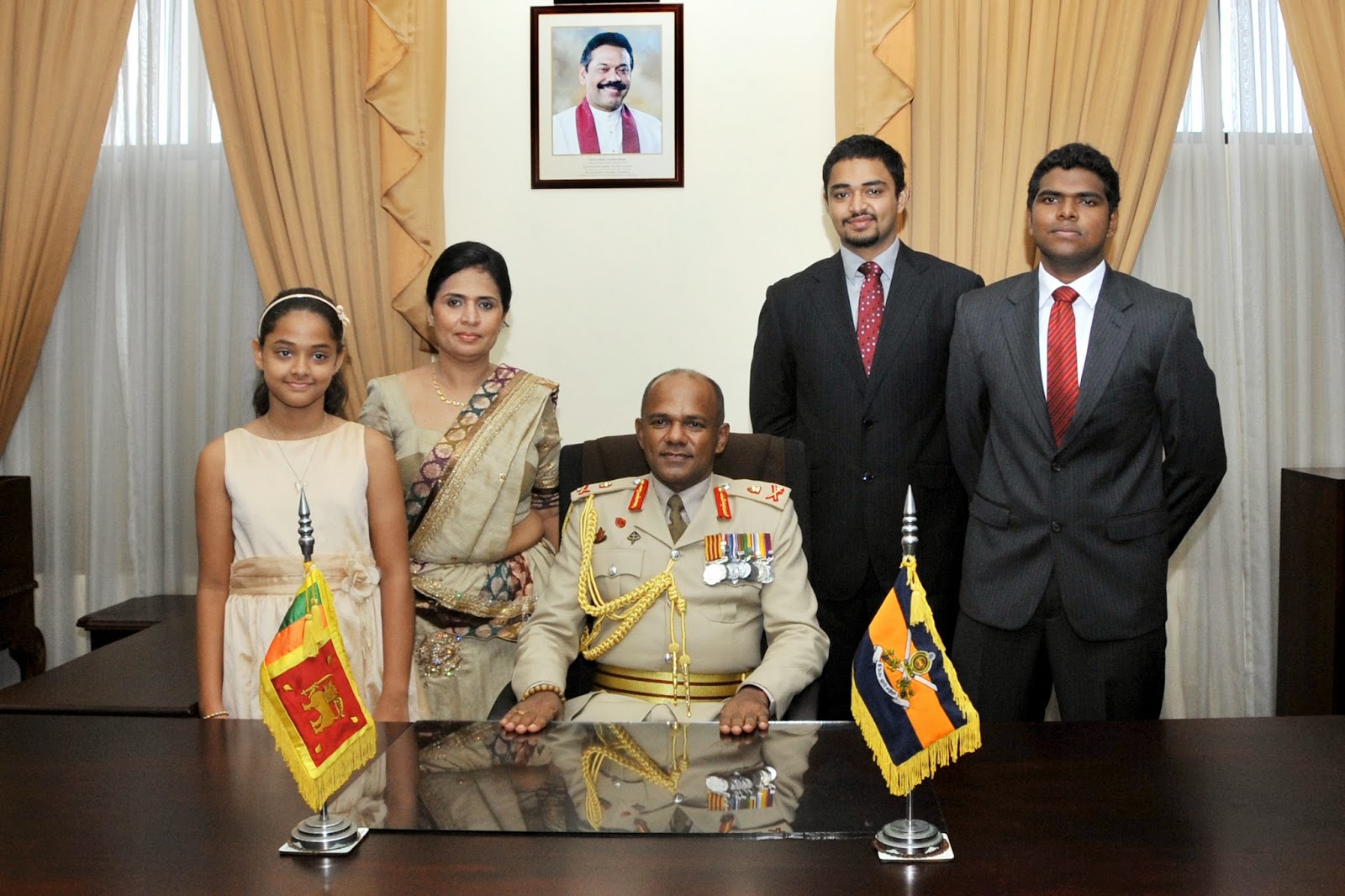
| The Commander with his family |
He is a fighter when in uniform, a thinker at all times, and
at home a loving husband and father. His son Yasas, a sportsman like his father
and again like his father given to philosophical reflection, is reading for a
degree in Sociology in Minnesota. The
younger son Vinura studies Logistic Management at the Kotelawala Defence University. The youngest, Minaya, just 9 years old
appears to be his immediate superior and probably listens only to the
Commander’s wife Dammi.
Lt. General Daya Ratnayake, youngest son of Muthu Banda and
Ran Menika, hails from a farming community in a small village called
Siyambalangamuwa, off Tittawella, about 4 km from Kurunegala on the road to
Puttalam. He was ‘Daya’ as a child and
then he was ‘Andy’. He recovered his
name after he left school. He got a
title recently, ‘Army Commander’.
Through it all, it is clear, he loved the map of a country called Sri Lanka. He did much to recover that torn cartography
and stitch it together, in the name of his ancestors and for the protection of
generations yet to walk the length and breadth of this land. He is a commander of soldiers, yes, but no
less worthy of salute from the general citizenry.