Showing posts with label Kasun De Silva. Show all posts

12 February 2026

To seek and cherish the land that isn't mine but ours


It’s a sociological and political term, this thing called ‘post-independence.’ There are books with titles that include the term. It is uttered often by politicians and of course academics when they talk about all things under the sun and on this earth over and under the feet of us Sri Lankans that belong to all and none (or some).

Mahagama Sekera owned this island, this nation. He owned it because he never claimed it. And because he owned it, he could bequeath it to anyone he liked. He picked everyone:

vaesi vasinaa ahasa api
muthu bandinaa muhuda api
mini dilenaa polova api
siri lankaa ratama api

 
Translatable thus:
We are the sky that rains
We are the ocean that crafts pearls
We are the earth that of glittering gems
We (make) the entire country that is Sri Lanka


I did not think of Sekera or this particular understanding of our country. Kasun De Silva did. In an Independence Day message posted on Facebook, along with one of his many photographs that capture a landscape and a moment in ways that takes my breath away (and probably that of many others as well), Kasun offered the following:

‘Happy Independence Day to Sri Lanka, whose real values are given freely to those who seek and cherish..!’

I like the insertion of the word ‘real’ here. It implies there are values that are not real. Fake. What they are and what’s ‘real’ is of course subjective, but what Kasun may be saying is that those that speak of history, living heritage and lived lives that are wholesome constitute that which is wholesome, endearing and gives pride and meaning to us all.

Where are they? They exist not upon surfaces to be scooped up callously, not in places easily accessed. They are not for casual collection. They are obtained, Kasun says, only by seeking. Therefore they are hidden or disguised. This doesn’t mean they are in remote places, off-grid and enchanting.

Yes, you will see value in such places. Flip through Kasun’s photo albums and you will understand what I mean. You could also just close your eyes, place a finger on the map of Sri Lanka and just go there. With eyes and heart open of course.

Sekera didn’t tell us how to find that which is sought, but he described people and places where truth might reside in his final and according to some yet-incomplete (as in draft-stage) lengthy poetic narrative, Prabuddha.

In the manner of a bodhisatva requesting ‘niyatha vivarana’ or conclusive blessing, Prabuddha speaks to the Buddha Siddhartha Gautama:

And therefore, Siddhartha!
And therefore grant me permission of finality
bless me in the manner of the Buddhas who came before
blessed the Buddhas to be,
now, this moment. 
 
At this very table,
upon this very chair
among these papers,
in a paddy field that knows
tilling, sowing and reaping,
among slogans, strikes and 
the teeth of a factory wheel,
in a crowded train
carrying men and women 
in their thousands
to work and back,
to secure the ultimate truth
Enlightenment,
not alone, no
but with those millions
to know together
to reach collectively
the truth
Enlightenment!


Again, we have the notion of the collective. The all-of-us. The all-of-us in all places high and low, but particularly in the glossed over and forgotten places where political economy burns without fire, obtains organs surreptitiously, privileges profit over labour, insults and humiliates, but can never steal or murder resolve.

That which this country is, that which we are, that which we belong to and own, needs to be sought and obtained. This is a precondition for cherishing.

Can we define it? I don’t think so. The sacred is a secret jealously guarded. We are offered signs so we may read, extrapolate and obtain ‘the real.’ It might require us to move along or among the five aggregates, the pancakkhandha, namely rupa (form/body), vedana (sensation/feeling), sanna (perception/recognition), sankhara (mental formations/volition) and vinnana (consciousness). The short hand would be ‘with eyes open,’ ready to perceive, ready to dive through appearances and dwell in those less-seen and less-talked-of things in discourses pertaining to independence, pre-independence and post-independence.

I am sitting at a table at home. From here, I can see a cloudless sky. There are birds I can hear and a few I can see. Flowers amid layers of differently hued greens. Sunlight that has made peace with canopies and comes to rest in bits and pieces on grass and leaves, flower pots and window panes. I haven’t seen pearls in the seas I have visited. My earths have not yielded precious stones. And yet, I have known rain and other things that are precious albeit intangible, in places like those Kasun captures and shares and places we both have visited separately.

I seek. I do cherish the truths and values I have in my frailty discerned. There’s so much more to find. So much more seeking to be done. They are free, and that's a blessing. Perhaps I will cherish this land that is not mine but ours even more deeply in the days to come, the years I have left.

Malinda Seneviratne is a freelance writer. malindadocs@gmail.com


06 October 2025

Horton Plains in abundant illumination


Long before I learned thanks to social media that our country is far more beautiful than we thought it was and at a time when I hadn’t lived enough and hadn’t the means to travel as much as I have since, Maha Eliya or Horton Plains, was my preferred travel destination. This was in the eighties.

So my friends and I would take the night mail train to Ohiya. It would reach Ohiya at dawn. We opted for the trail that went through the tropical montane forest which was prettier and more interesting than the tarred road to the plains. And shorter.

Thereafter we would spend a few days, usually two to four but once seven, ‘up there’ where we did not belong but were indulged by the forces and (other) creatures of nature. We were duly enchanted by the silence, low temperatures, mists, birdsong, vast open spaces, starry nights, grazing sambur, the occasional wild boar, leopard droppings, mountains, streams, waterfalls, wayside flowers and berries. And the silence.  

That immensity is humbling. And it hit me particularly hard on at least two occasions. The first was at World’s End. It was early morning and there was no mist. We could see the lay of our land all the way to the Southern coast. I remembered the map of Sri Lanka. I realised what a tiny island we live on. And yet that tiny island seemed enormous to me that morning. And I realised how small I am.

Then there was a particularly clear night in December. The skies were so clear that we could see shooting stars and satellites. The universe, I knew, was larger than our planet and I already knew how small our island is.  

Decades later a friend added perspective: ‘we are on a pas-guliya (clod of soil) that goes around the sun. That too was humbling.

But the plains!

I knew even then that although it is but a tiny spot on the map of Sri Lanka, Maha Eliya was too enormous to be explored exhaustively. I know what I saw. I remember. I knew that others who visited this fascinating Maha Eliya would have seen things I hadn’t seen. I didn’t know that they could see differently what had caught my eye.

I’ve seen sunlight on the plains. I’ve seen it rain. I’ve seen dusk yielding to night. I hadn’t seen heaven descending on heaven. Kasun De Silva did. He captured four distinct layers. In the foreground, the plains. At its end, the trees. Above, a dull-blue sky and above it a thick and ominous layer of rain clouds.

Heaven to heaven. How so?

There were two distinct streams of light, angling, connecting the earthly layer and the rectangular block of storm-clouds captured in the composition. Heaven, first as metaphor for territories above, and secondly as descriptive of the land we are privileged to inhabit, a land that can make us feel divine or at least divinely endowed. 


Kasun had a companion capture. He had taken it about thirty minutes earlier from the opposite side. This I responded to as follows:

Night is imminent, says the sky
and adds, ‘I am pregnant with rain.’
But now,
through cloud-gap
or mountain pass
but as though deliberate
and not atmospheric accident
nor geographic architecture
light streamed in,
unexpected and soft.
The plains are painted.
Indelibly.

He said, ‘lovely, ayya!’

And I informed him: ‘Your photo reminded me of a chance encounter with a beautiful girl. Wrote it for her actually.  The unintended consequences of your photography!’

He asked: ’Bitter sweet memories?’

‘Still in the sweet phase,’ I was smiling when I wrote this. I did tell him, ‘so read it as a love poem, it would read very differently.’ He already had: ‘…as soon as you said it. The meaning totally changed. Awesome with both cases. And beautiful with both as well.’

And so we continued.

‘Poetry, like all art including photography, belongs to the “reader.”’

All of the above, for most readers, would be incidental and quite irrelevant, but not his final observation:

‘I believe every landscape has its own mood and own feeling.  Every landscape has a story and an emotion as well as a character. So, to me capturing a landscape is as similar as photographing a human.’

And so I revisited Horton Plains, convinced that ‘Maha Eliya’ which literally means ‘Great Light’ but has connotations of open space as well, is a name far more rational and for many reasons too than the dull and troubling description of a geographical element to which the name of a colonial thug was tagged. 

I revisited Maha Eliya, feeling blessed that I had witnessed emotions and character. I may or may not see the ‘maha eliya’ descending on our heaven, but I told myself that even if I cannot capture landscape-people the way Kasun does, I can still revisit and hopefully see, notice and remember them. I could be delighted all over again. And feel blessed to inhabit a heaven-lit paradise, right here on earth. 

[This article was published in the Daily News under the weekly column title 'The Recurrent Thursday']
 

Landscapes are stories


Landscapes have their own moods, feelings and expressions, says Kasun De Silva. He attributed this insight to the photography of Nihal Fernando. He added, ‘landscapes are not just sceneries, but stories.’ It was a comment on one of Fernando’s photos posted on Facebook by Studio Times which Kasun had re-posted on his wall. The original post had the following caption: ‘Nihal Fernando: He never tired of photographing trees …’

True. Also true of many other things that captured his imagination and persuaded him to explore with his incomparable lens. They all had moods, feelings and expressions, come to think of it. But these are not attributes one easily associates with landscapes. People, yes, but landscapes?

Nihal Fernando was a patient photographer. He had the eyes to cut into rectangular shape a given subject. He could also anticipate the ways in which what was before him could transform or, as the case may be, be transformed by moving to test different angles and decide which would best capture the personality of what would become ‘the photograph.’

Angle was just one factor. There was also temperature, light, shade and movement spurred by wind. Elements are not static; as they change so too do the landscapes they make. Trees, included.


The particular photograph was a ‘black and white’ capture of a solitary tree, bent by time perhaps and possibly by wind. My guess is that it was somewhere in or around Horton Plains. The tree reached out to other trees on an adjacent hillock. There was dappled sunlight playing around the trunks of those other trees. There was sunlight causing a shimmer on the grass around the subject-tree. A story, then. Or stories, rather, for there are always multiple narratives; as many as there are readers. We read and in reading we re-write.

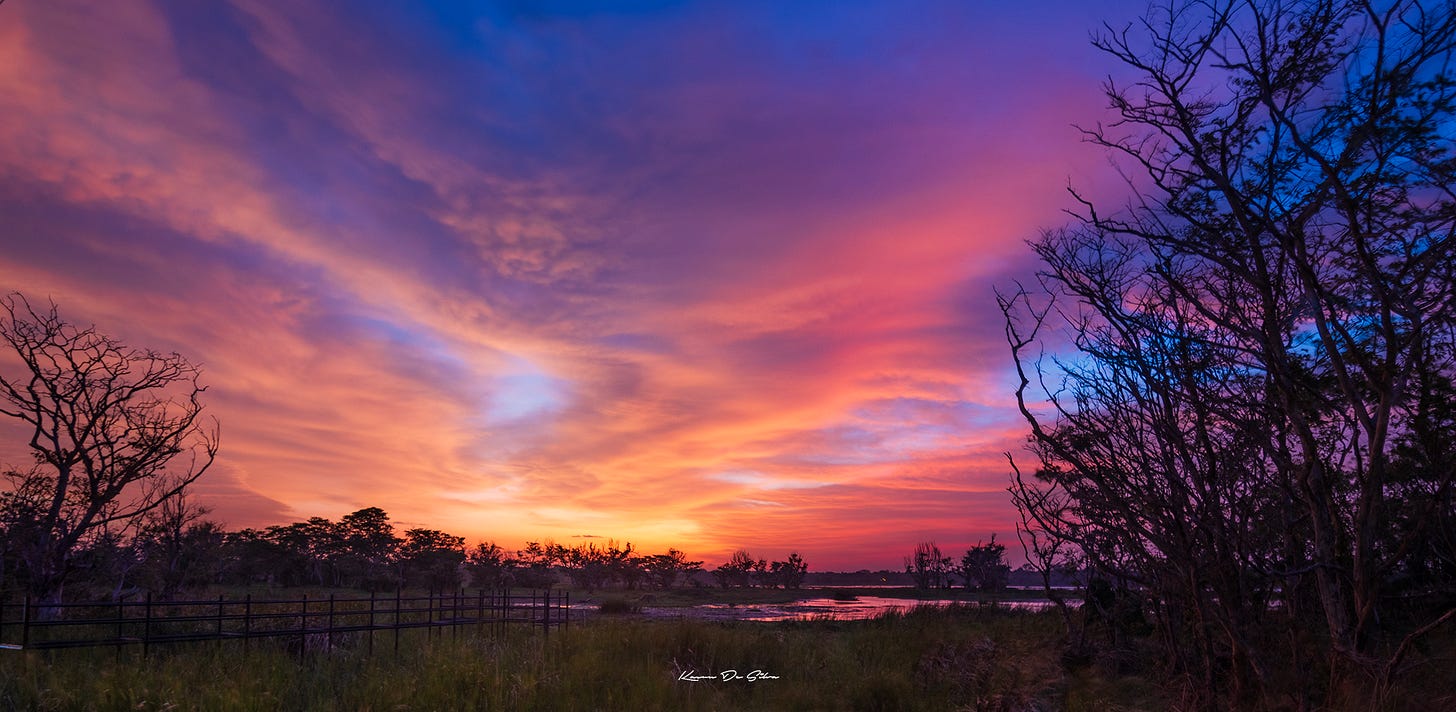
Not too long after sharing the Studio Times post, Kasun posted one of his own photographs. It was of a sunset and titled ‘A painted evening.’ Somewhere close to Habarana, he said. The first thought that crossed my mind was, ‘there can be no landscape painter more accomplished and skilled than the elements.’

In the foreground, a fence that ended at the backend of a small weva. Leaf-bereft trees on either side of the frame, a tree-line a few hundred meters beyond, and then, sky of swirling clouds brushed in shades of blue, orange, gold, red and purple.

It would have stopped me. I, who knows nothing of colour, line and space. For Kasun, it was probably a book-shelf of stories. It was a landscape of many moods, feelings and expressions, obviously. Not ‘scenery,’ but stories. He would have seen the narratives unfold over the next few minutes or hour and even later when the detailed subject blurred, turned to silhouette and disappeared into the nocturnal narratives. He gave us a moment and that was still quite a collection of stories.

And reflecting on landscapes and stories, following Kasun’s observation, it occurred to me that we are surrounded by libraries and galleries; the one housing splendid stories, heroic and tragic, hilarious and sober, brief and lengthy, and the other on whose walls hang paintings that cannot be bought or sold, stolen or defaced.

Of course there’s that added allure in things spared human touch. This is perhaps why some people like to travel, to hike, to explore places that cannot be reached by vehicle, not even a bicycle. Kasun, like Nihal, has offered us glimpses of such libraries and galleries. Then again, there are ‘peopled’ landscapes that are in stark contrast to a wind-sculpted tree in a tropical montane forest. Cityscapes, in a word.

Less ‘peopled,’ but certainly carrying human signature, would be paddy fields, terraced and un-terraced. Wevas. Faraway temples. Even a set of windmills. Or proud posts carrying electricity. One could theoretically conjure any number of images. Landscapes or rather ‘scapes,’ one and all. Each with a mood, a feeling, and expression or multiples of the same. Each, a personality.

Question: do we notice these personalities that have stories to tell? If we do notice, do we stop to read? Don’t we have enough time? Is it that we can’t quickly draw an arrow from ‘the possibility of a story’ through ‘reading’ to some tangible benefit?

Nihal Fernando read. Kasun reads. Nihal Fernando shared his stories as does Kasun. We are enriched, certainly, but we can also enrich ourselves, perhaps in some smaller way. We are, after all, surrounded by moods, feelings and expression.

[This article was published in the Daily News under the weekly column title 'The Recurrent Thursday']

01 September 2023

The parameters of 'entirety'


['The Morning Inspection' is the title of a column I wrote for the Daily News from 2009 to 2011, one article a day, Monday through Saturday. This is the 211th article in the new series that began in December 2022. Links to previous articles are given below]   

The word ‘entirety’ means ‘the whole of something.’ The keyword here is ‘something.’ Any ‘thing’ well defined would yield some contours. There are lines of one kind or another within which that thing resides and which help give its name meaning.

Things are named. We see ‘a chair’ and we know its dimensions. There are lines that define it. Within these there is ‘chair’. Outside it is ‘not-a-chair.’  And that’s an ‘entirety,’ the ‘whole’ of the chair.  

What is the ‘entirety’ of a mirror, though? Let’s consider a plain, rectangular mirror. The rectangle gives us the size of the mirror. The glass that reflects is the mirror. What lies beyond those lines is ‘not-mirror.’  The properties of this particular object as opposed to a chair or table for example make it harder to pinpoint ‘entirety.’  That which the mirror reflects is part of what the mirror is.  One might even argue that mirror-properties compel us to take both object and reflection as being part of mirror-entirety.  

It was Kasun De Silva’s wide-angled photograph titled ‘The entirety’ that made me reflect on this interesting word and indeed concept.  What is this ‘entirety,’ I wondered. There’s an entirety that is  defined by the frame and it could be described as ‘the whole of whatever is inside the rectangle.’ Every photograph and painting or indeed anything that comes in a frame of any kind is an entirety as per the above definition.  We could have an ant-entirety, a moon-entirety, a face, an eye, two eyes, part-face, petal or flower, a crowd of people or a section of the gathering or a single individual. All ‘entireties.’  A grain of sand is as much an entirety as a universe of any dimensions you wish to imagine.  

Entirety, then, is a play of choice. Kasun’s entirety is legit. It’s a capture that is a capture-all. Someone else may not even notice this ‘entirety’ perhaps because the focus is on something else or it could so happy that for someone else ‘entirety’ would be a small part of what Kasun captured.  Accordingly, Kasun’s entirety could be a small part of what someone else might consider to be all-encompassing.  

Kasun has captured a large expanse. There’s ‘big’ written all over it. It is certainly not a grain of sand. It is not a chair or table. It is a mirror in a sense because it reflects Kasun’s preferences. And yet, it is a black and white photograph and therefore is a creation from which other colours have been removed.

Someone might argue that Kasun has compromised or subverted entirety by privileging two colours. On the other hand, if entirety is a construct then it is as imperfect, as art-directed as a color capture that dissolves lines, banishes silhouette, drowns the play of light and shade with a full palette and so on.

This is ‘entirety’ as far as Kasun is concerned.  Entirety of what, we don’t know. That’s what I find poetic and liberating in the caption. Kasun says ‘entirety’ and anyone who looks at it can define it in terms of particular preferences.

A vast landscape, as mentioned, has 'big' written over it. Big is a close cousin of Entirety. But then again, this photograph features three figures, a man, a woman and a child. Family, perhaps. That’s a unit. It comes framed. It is an 'entirety' or at least persuades us to think of the universe which to some is ‘family,' all encompassing, complete in and of itself. 

A family, yes, but one which is in size minuscule when set against water bodies and a seamless sky or rather a limitlessness ‘contained’ by the inevitable frame and framing that is ‘the entirety’ of the photographing exercise.  A family that is a grain of sand in an entirety whose parameters are as yet unknown or unknowable. A family that is a grain of sand and yet is an entirety — that’s another way to put it.  

There’s an entire-figure. There’s an entire-family. There are entire-clouds. There’s a hint of an entire-sky and an entire-universe. There’s a Kasun-entirety, there’s an entirety of Kasun’s photography and there’s this, the Kasun-entirety titled ‘The Entirety.’  The entirety, also, of gratitude to someone who offered an entirety that was made for reflection.  And the ‘entirety’ that is everything that I’ve written about the word.

malindadocs@gmail.com 

Other articles in this series: 

In loving memory of Carrie Lee (1956-2020)

Mobsters on and off the screen

Transfixing and freeing dawns

We're here because we're here because we're here

Life signatures

Sha'Carri Richardson versus and with Sha'Carri Richardson  

A canvas for a mind-brush

Sybil Wettasinghe's shoes

Love is...

A stroll with Pragg and Arjun along a boulevard in Baku

Meditation on tree-art

Daya Sahabandu ran out of partners but must have smiled to the end

Gentle intrusions 

Sleeping well

The unleashing of inspiration

Write, for Pete's sake

Autumn Leaves Safeness

 Sapan and voices that erase borders

Problem elephants and problem humans

Songs from the vaekanda

The 'inhuman' elephant in a human zoo

Ivan Art: Ivanthi Fernando's efforts to align meaning

Arwa Turra, heart-stitcher

Let's help Jagana Krishnakumar rebuild our ancestral home

True national anthems

Do you have a friend in Pennsylvania (or anywhere?)

A gateway to illumination in West Virginia

Through strange fissures into magical orchards

There's sea glass love few will see 

Re-residencing Lakdasa Wikkramasinha

Poisoning poets and shredding books of verse

The responsible will not be broken

Home worlds

Ownership and tenuriality of the Wissahickon

Did you notice the 'tiny, tiny wayside flowers'?

Gifts, gifting and their rubbishing

History is new(s)

Journalism inadvertently learned

Reflections on the young poetic heart

Wordaholic, trynasty and other portmanteaus

The 'Loku Aiya' of all 'Paththara Mallis'

Subverting the indecency of the mind

Character theft and the perennial question 'who am I?'

Innocence

A degree in people

Faces dripping with time

Saji Coomaraswamy and rewards that matter

Revolutionary unburdening

Seeing, unseeing and seeing again

Alex Carey and the (small) matter of legacy

The Edelweiss of Mirissa 

The insomnial dreams of Kapila Kumara Kalinga 

The clothes we wear and the clothes that wear us (down) 

Every mountain, every rock, is sacred 

Manufacturing passivity and obedience 

Precept and practice 

Sanjeew Lonliyes: rawness unplugged, unlimited 

In praise of courage, determination and insanity 

The relative values of life and death 

Feet that walk 

Sarinda's eyes 

Poetry and poets will not be buried 

Sunny Dayananda 

Reunion Peradeniya (1980-1990) 

What makes Oxygen breathable?  

Sorrowing and delighting the world 

The greatest fallacy  

Encounters with Liyanage Amarakeerthi 

Beyond praise and blame 

Letters that cut and heal the heart 

Vanished and vanishing trails 

Blue-blueness 

A forgotten dawn song from Embilipitiya 

The soft rain of neighbourliness  

The Gold Medals of being 

Jaya Sri Ratna Sri 

All those we've loved before 

Reflections on waves and markings 

A chorus of National Anthems 

Saying what and how 

'Say when' 

Respond to insults in line with the Akkosa Sutra 

The loves of our lives 

The right time, the right person 

The silent equivalent of a thousand words 

Crazy cousins are besties for life 

Unities, free and endearing 

Free verse and the return key

"Sorry, Earth!" 

The lost lyrics of Premakeerthi de Alwis 

The revolution is the song 

Consolation prizes in competitions no one ever wins 

The day I won a Pulitzer 

Ko? 

Ella Deloria's silences 

Blackness, whiteness and black-whiteness 

Inscriptions: stubborn and erasable  

Thursday! 

Deveni: a priceless one-word koan 

Enlightening geometries 

Let's meet at 'The Commons' 

It all begins with a dot 

Recovering run-on lines and lost punctuation 

'Wetness' is not the preserve of the Dry Zone 

On sweeping close to one's feet 

Kumkum Fernando installs Sri Lanka in Coachella, California

To be an island like the Roberts... 

Debts that can never be repaid in full

An island which no flood can overwhelm 

Who really wrote 'Mother'? 

A melody faint and yet not beyond hearing 

Heart dances that cannot be choreographed 

Remembering to forget and forgetting to remember 

On loving, always 

Authors are assassinated, readers are immortal 

When you turn 80... 

It is good to be conscious of nudities  

Saturday slides in after Monday and Sunday somersaults into Friday  

There's a one in a million and a one in ten 

Gunadasa Kapuge is calling 

Kumkum Fernando installs Sri Lanka in Coachella, California 

Hemantha Gunawardena's signature 

Pathways missed 

Architectures of the demolished 

The exotic lunacy of parting gifts 

Who the heck do you think I am? 

Those fascinating 'Chitra Katha' 

The Mangala Sabhava 

So how are things in Sri Lanka? 

The most beautiful father 

Palmam qui meruit ferat 

The sweetest three-letter poem 

Buddhangala Kamatahan 

An Irish and Sri Lankan Hello 

Teams, team-thinking, team-spirit and leadership 

The songs we could sing in lifeboats when we are shipwrecked 

Pure-Rathna, a class act 

Jekhan Aruliah set a ball rolling in Jaffna 

Awaiting arrivals unlike any other 

Teachers and students sometimes reverse roles 

Matters of honor and dignity 

Yet another Mother's Day 

A cockroach named 'Don't' 

Colombo, Colombo, Colombo and so forth 

The slowest road to Kumarigama, Ampara 

Sweeping the clutter away 

Some play music, others listen 

Completing unfinished texts 

Mind and hearts, loquacious and taciturn 

I am at Jaga Food, where are you? 

On separating the missing from the disappeared 

Moments without tenses 

And intangible republics will save the day (as they always have) 

The world is made of waves 

'Sentinelity' 

The circuitous logic of Tony Muller 

Rohana Kalyanaratne, an unforgettable 'Loku Aiya' 

Mowgli, the Greatest Archaeologist 

Figures and disfigurement, rocks and roses 

Sujith Rathnayake and incarcerations imposed and embraced 

Some stories are written on the covers themselves 

A poetic enclave in the Republic of Literature 

Landcapes of gone-time and going-time  

The best insurance against the loud and repeated lie 

So what if the best flutes will not go to the best flautists? 

There's dust and words awaiting us at crossroads and crosswords 

The books of disquiet 

A song of terraced paddy fields 

Of ants, bridges and possibilities 

From A through Aardvark to Zyzzyva  

World's End 

Words, their potency, appropriation and abuse 

Street corner stories 

Who did not listen, who's not listening still? 

The book of layering 

If you remember Kobe, visit GOAT Mountain 

The world is made for re-colouring 

The gift and yoke of bastardy 

The 'English Smile' 

No 27, Dickman's Road, Colombo 5 

Visual cartographers and cartography 

Ithaca from a long ago and right now 

Lessons written in invisible ink 

The amazing quality of 'equal-kindness' 

A tea-maker story seldom told 

On academic activism 

The interchangeability of light and darkness 

Back to TRADITIONAL rice 

Sisterhood: moments, just moments 

Chess is my life and perhaps your too

Reflections on ownership and belonging 

The integrity of Nadeesha Rajapaksha 

Signatures in the seasons of love

To Maceo Martinet as he flies over rainbows 

Sirith, like pirith, persist 

Fragrances that will not be bottled  

Colours and textures of living heritage 

Countries of the past, present and future 

A degree in creative excuses

Books launched and not-yet-launched 

The sunrise as viewed from sacred mountains 

The ways of the lotus 

Isaiah 58: 12-16 and the true meaning of grace 

The age of Frederick Algernon Trotteville 

Live and tell the tale as you will 

Between struggle and cooperation 

Of love and other intangibles 

Neruda, Sekara and literary dimensions 

The universe of smallness 

Paul Christopher's heart of many chambers 

Calmness gracefully cascades in the Dumbara Hills 

Serendipitous amber rules the world 

Continents of the heart
  
The allegory of the slow road